On incentives: three links below go to the sellers and pay this site a commission. All three products are held to the same standard, and the section on what you might be delaying argues against all of them.
These statements have not been evaluated by the Food and Drug Administration. These products are not intended to diagnose, treat, cure, or prevent any disease. Urinary symptoms in men over 50 usually mean an enlarged prostate — but prostate cancer, bladder cancer and a urethral stricture produce identical symptoms. No supplement tells them apart.
Three prostate supplements, three different failures — and comparing them is more useful than comparing any two, because each one misses in a distinct way.
Prosta Peak targets the right condition with the botanical that has the worst trial record in the category.
ProstaVive targets the wrong hormonal direction entirely, pushing on the axis that makes prostates grow.
Total Control 24 contains arguably the best-evidenced ingredient of the three — and operates across so many websites with conflicting formulas that you can’t be sure which product you’d receive.
Right condition, wrong ingredient. Wrong target. Right ingredient, no fixed address.
Here’s what decides each one.
What BPH Actually Is, and What Treats It
Everything below depends on this, so it’s worth thirty seconds.
Prostate growth is driven by dihydrotestosterone (DHT), which the body makes from testosterone using an enzyme called 5-alpha-reductase.
5-alpha-reductase inhibitors reduce serum and intraprostatic DHT, causing prostate tissue to involute — finasteride lowers serum DHT by roughly 70%, and prostatic DHT by 85 to 90%. They are the only class of therapy that acts on the pathophysiologic substrate of the disease, arresting progression and reducing the risk of acute urinary retention and surgery.
Lower the androgen, shrink the prostate. Hold that direction — it decides one of these three products entirely.
What Each One Is
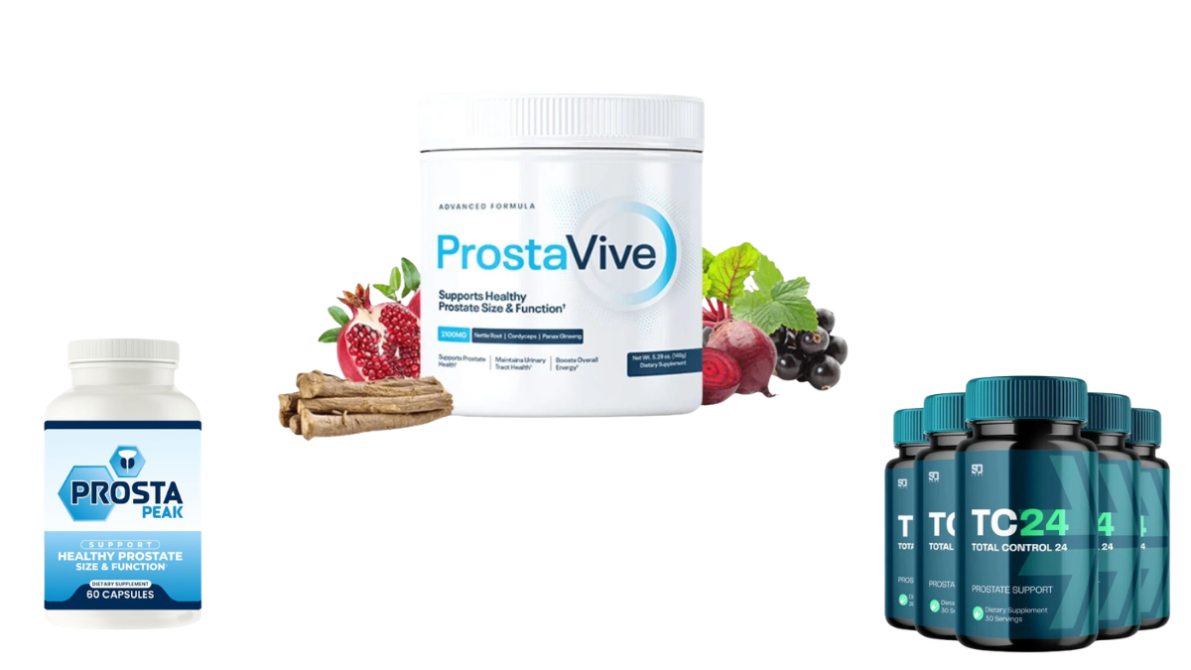
Prosta Peak is a capsule built primarily on saw palmetto, with pygeum and soursop among its other components. It carries a 180-day guarantee.
ProstaVive is a powder with eleven named ingredients: boron, tongkat ali, ashwagandha, fenugreek, panax ginseng, maca, artichoke, nettle root, zinc, magnesium and vitamin D. Also 180 days.
Total Control 24 is a capsule built on pygeum africanum, with Myrciaria jaboticaba, a branded ingredient called Lipophytol® and boron. Sixty-day guarantee.
Prosta Peak: The Wrong Ingredient
Saw palmetto is the most popular ingredient in this entire category, and it has the weakest evidence in it.
Our Prosta Peak review covers the trial record in detail.
Saw Palmetto’s Trial Record
Three pieces, and they point the same way.
The STEP trial found no improvement over placebo.
CAMUS escalated doses to 960 mg daily over 72 weeks — triple the usual amount — and found placebo numerically better.
That’s not an absence of evidence. It’s a substantial body of evidence pointing at no effect.
What Prosta Peak Gets Right
Two things, and the first is genuinely reassuring.
Saw palmetto does not affect PSA readings at any dose tested in CAMUS. That matters practically: it won’t mask a prostate cancer screening result, which is a real concern with some interventions.
And it contains pygeum, which is the right ingredient — at an undisclosed amount.
What it gets wrong beyond saw palmetto: the page advertises 20+ ingredients in one place and lists four in another. Its sixteen references concern the condition rather than the ingredients. And it contains soursop, which has an annonacin neurotoxicity literature and no prostate rationale whatsoever.
ProstaVive: The Wrong Target
The most interesting failure of the three, because the formula is coherent — for a different purpose.
Of eleven ingredients, five are sold primarily as testosterone boosters: tongkat ali, fenugreek, ashwagandha, boron and zinc. The product’s own page describes fenugreek as supporting male sex hormones.
Our ProstaVive review works through what that means.
Why Raising Testosterone Runs Backwards
Return to the pharmacology above. More testosterone means more substrate for 5-alpha-reductase to convert into DHT inside the prostate — and DHT binding the androgen receptor is what stimulates proliferation.
Three qualifications, because overstating this would be its own error. Herbal testosterone effects are modest and inconsistent. DHT isn’t elevated in men with BPH — it stays roughly constant with age while plasma testosterone declines, which is why researchers call androgens permissive rather than straightforwardly causal. And there’s no evidence any supplement enlarges anyone’s prostate.
But the tension is real. Either those ingredients meaningfully move your androgens — in which case they push the axis that drives prostate growth — or they don’t, in which case the formula’s selling point is empty.
If you take finasteride, dutasteride or an alpha-blocker, this is a specific conversation with your urologist.
The Citation That Argues Against It
A detail that makes this concrete rather than theoretical.
ProstaVive’s page anchors its mechanism to a 2023 study from Fukushima Medical University. We checked, and the paper is real — published in the International Journal of Molecular Sciences by the Department of Urology.
What it examines is androgen-independent mechanisms in BPH: ischemia, oxidative stress, metabolic syndrome and inflammation.
So the one credible citation on the page is a paper about the mechanisms that aren’t hormonal, cited to support a formula built on hormone-raising herbs.
What ProstaVive Gets Right
Fairness matters, and there are three real credits.
All eleven ingredients are named — no unnamed proprietary blend, which is above the median here.
Nettle root is the one that fits. It has traditional use in lower urinary tract symptoms and interacts with sex hormone binding globulin in a direction consistent with reducing androgenic drive.
And the Fukushima citation is genuine and correctly attributed, which is rarer in this market than it should be.
What it gets wrong beyond the target: the supplement facts panel is published as an image file you can’t copy or search, and the pricing arithmetic doesn’t reconcile — a three-bottle “regular price” appears higher than the six-bottle one, and a stated saving of $714 doesn’t match its own subtraction.
Total Control 24: The Wrong Address
The third failure is structural rather than pharmacological, and it’s the one that makes the other checks impossible to run.
The ingredient choice is the best of the three. Pygeum africanum has real evidence, and — notably — the formula excludes saw palmetto, which given the trial record above is a defensible decision rather than an omission.
The problem is that there isn’t one formula.
Nine Domains, Two Different Formulas

Searching the product returns a cluster of sites presenting themselves as official, several with near-miss spellings — the kind of address you reach by mistyping.
And they don’t list the same ingredients. Most describe the pygeum-based blend. At least one describes saw palmetto, beta-sitosterol and zinc instead — a substantially different formula.
That’s not a marketing inconsistency. It’s a verification failure with consequences:
You can’t run the dose test, because there’s no stable formula to test.
“I read it on the official site” stops meaning anything, because there isn’t one.
And the refund terms that apply to you are the ones on the page you bought from, which may differ from the page that convinced you.
What Total Control 24 Gets Right
Excluding saw palmetto is the single best formulation decision among the three products. Given 27 randomised trials in 4,656 men finding little or no benefit, leaving it out reflects attention to the evidence.
Pygeum is the right inclusion. And one of the brand’s pages states plainly that the product is not an FDA-approved medication, calling the distinction important for consumers — which is accurate and more candid than most pages in this category manage.
The Ingredient All Three Should Contain
Pygeum deserves its own section, because it’s the botanical with the best case and two of the three products already have it.
A Cochrane review of 18 randomised trials covering 1,562 men found that pygeum users were more than twice as likely to report improvement in overall symptoms, with 19% less nocturia, 24% less residual urine volume and 23% better peak urine flow.
The trials used around 100 mg daily of standardised extract — a specific, achievable figure.
None of the three publishes its pygeum amount. That’s the single most useful number missing from all three labels.
Beta-Sitosterol: The One With the Best Evidence
And one more that only appears on one page of one product.
Beta-sitosterol has the strongest evidence for BPH symptoms of any botanical — better than saw palmetto, and generally regarded as at least comparable to pygeum.
It appears on one Total Control 24 domain and in neither of the other two products.
If you’re comparing prostate supplements generally, beta-sitosterol and pygeum are the two names to look for — and a stated milligram amount beside them.
Head to Head
| Prosta Peak | ProstaVive | Total Control 24 | |
|---|---|---|---|
| Targets prostate biology | ✅ Yes | ❌ Targets testosterone | ✅ Yes |
| Contains pygeum | ✅ Yes | ❌ No (nettle root) | ✅ Yes |
| Contains saw palmetto | ⚠️ Primary ingredient | ❌ No | ✅ Excluded |
| Ingredients named | ⚠️ Contradictory counts | ✅ All 11 | ⚠️ Varies by domain |
| Doses published | ❌ No | ⚠️ Image only | ❌ No |
| Stable formula | ✅ Yes | ✅ Yes | ❌ Differs by site |
| Guarantee | 180 days | 180 days | 60 days |
| References about ingredients | ❌ None of 16 | ⚠️ One, arguing the other way | — |
Doses: None of the Three
Worth stating plainly, because it’s the check that would decide everything.
Not one of the three publishes a usable amount for its lead ingredient.
Prosta Peak publishes nothing. ProstaVive publishes a panel as an image — technically present, practically unsearchable. Total Control 24 publishes nothing, across multiple formulas.
Pygeum’s studied dose is 100 mg of standardised extract. That’s a number two of these three products could print and don’t.
Guarantees and Terms
Prosta Peak and ProstaVive both offer 180 days — genuinely generous, and the strongest single element of either offer.
Total Control 24 offers 60, the shortest of the three.
Current terms are on the Prosta Peak, ProstaVive and Total Control 24 sites. Screenshot the price and refund wording on the day you order — particularly with Total Control 24, where terms differ between domains.
Testimonials and Shared Assets
One finding applies to Prosta Peak specifically and is worth knowing because it recurs across this market.
Its customer testimonials — attributed to named men with ages and US states — appear word for word on the sales page of an unrelated weight-loss supplement. The university logos on its page are served from a directory named after a third product, with two filenames misspelled.
That says nothing about what’s in the capsule. It says the social proof was assembled rather than collected.
Safety: Where They Differ
Prosta Peak: soursop contains annonacin, associated in the literature with neurotoxicity and an atypical, L-DOPA-resistant parkinsonism. There’s no prostate rationale for its inclusion.
ProstaVive: ashwagandha has a documented if uncommon association with liver injury and is generally avoided in thyroid disease without medical input. Panax ginseng interacts with warfarin and affects blood glucose. And the androgen question above warrants a urologist’s input if you take prostate medication.
Total Control 24: without a stable ingredient list, specific cautions can’t be given — which is itself the caution.
All three: if you take a 5-alpha-reductase inhibitor or an alpha-blocker, or have a history of prostate cancer, speak to your urologist first.
What You Might Be Delaying
The most important section, and it applies before any of the three.
Getting up repeatedly at night, a stream that starts and stops, never quite emptying — in a man over 50 those usually mean benign prostatic hyperplasia. Common, manageable, not dangerous in itself.
Usually. The same symptoms come from prostate cancer, bladder cancer, a urethral stricture, a neurological condition or diabetes, and they feel identical from the inside. Untreated BPH itself can progress to chronic high-pressure retention, a potentially life-threatening condition, and to permanent changes in the bladder muscle.
Get medical attention promptly for: blood in the urine · inability to pass urine at all · fever alongside urinary symptoms · persistent pelvic or lower back pain · sudden worsening · new bone pain.
The risk with any of these three isn’t that the capsule harms you. It’s the six months a man spends on a multi-bottle package feeling vaguely better, not making the call.
What Actually Works for BPH
The honest hierarchy, and none of the three is on it.
Get assessed. A PSA test, a digital examination and a conversation identify what you’re actually dealing with.
5-alpha-reductase inhibitors act on the causal mechanism, arrest progression, and reduce the risk of retention and surgery. Alpha-blockers relieve symptoms faster. Both are inexpensive as generics.
If a supplement is what you want: beta-sitosterol and pygeum are the ingredients with defensible evidence, sold standalone at stated doses for a fraction of a multi-bottle package.
And the free part: reduce fluids in the two or three hours before bed, ease off evening alcohol and caffeine, double void, and check whether anything you already take — antihistamines and decongestants are the usual culprits — is making things worse.
Which Case Is Strongest, and For Whom
None is recommended, and the reasons differ.
Total Control 24 has the best ingredient logic — pygeum included, saw palmetto correctly excluded — and the worst verifiability. If you could be certain which formula you’d receive, it would be the most defensible of the three. You can’t be.
Prosta Peak has the most stable identity and the weakest lead ingredient. Saw palmetto’s record across 27 trials in 4,656 men is the clearest negative result in this category. Its pygeum is a genuine point in its favour, at an unknown amount, and the soursop is a real question.
ProstaVive has the clearest ingredient disclosure and the wrong target. Naming all eleven components is above the median. Five of them push the hormonal axis in the direction opposite to BPH treatment.
Who any of these might suit: a man who has already had his urinary symptoms properly assessed and been told it’s ordinary BPH, who isn’t on prostate medication, has no cancer history, and understands he’s buying an unquantified botanical rather than treatment. On that basis, Total Control 24’s formula is the best-chosen — provided you can confirm which one you’re getting.
Who should skip all three: anyone who hasn’t had this looked at, anyone on a 5-ARI or alpha-blocker, anyone with a prostate cancer history, and anyone buying on the testosterone framing.
Where That Leaves You
Three products, three ways of missing, and one lesson that transfers to any prostate supplement you’ll encounter.
Ask three questions in order. Does it contain pygeum or beta-sitosterol — the two with real evidence? Does it publish the amount? And is there one official site, or several with different formulas?
Those three checks sorted these three products completely, and they’ll sort the next one too.
And the appointment beats all of it. BPH is manageable and the treatments work. The symptoms that mimic it are far more treatable caught early. That’s a short conversation, and it’s the only thing on this page that tells you which situation you’re actually in.
For the full analysis of each, see our Prosta Peak review, our ProstaVive review and our Total Control 24 review. All three sit inside our guide to men’s health supplements, which explains why this aisle is really three separate categories.
Frequently Asked Questions
Which of these three is best for an enlarged prostate?
None is recommended, and they fail differently. Total Control 24 has the best ingredient logic — it contains pygeum and correctly excludes saw palmetto — but operates across multiple websites listing different formulas, so you can’t be certain which you’d receive. Prosta Peak is built on saw palmetto, which failed a Cochrane review of 27 trials in 4,656 men. ProstaVive names all its ingredients, and five of them raise testosterone, which runs opposite to how BPH is treated.
Does saw palmetto work for BPH?
The evidence says largely no. The STEP trial found no improvement over placebo, CAMUS escalated to 960 mg daily and found placebo numerically better, and a Cochrane review of 27 randomised trials in 4,656 men concluded there’s little or no benefit. One genuinely useful finding did emerge: saw palmetto doesn’t affect PSA readings, so it won’t mask a cancer screening result.
Do testosterone boosters affect the prostate?
Potentially, and it’s the right question. Prostate growth is driven by DHT, converted from testosterone — which is why the only drug class acting on BPH’s causal mechanism works by blocking that conversion, lowering prostatic DHT by 85 to 90%. Herbal testosterone effects are modest and inconsistent, so the practical risk is likely small. But a prostate product built on testosterone-raising ingredients works against the established pharmacology, and if you take prostate medication that’s a urologist conversation.
What ingredient should I actually look for?
Beta-sitosterol has the strongest evidence for BPH symptoms among botanicals, with pygeum africanum close behind — a Cochrane review of 18 trials in 1,562 men found pygeum users more than twice as likely to report improvement, with 19% less nocturia, at around 100 mg daily of standardised extract. Look for those two names with a milligram figure beside them.
Why do so many prostate supplements have several official websites?
It’s common in direct-response commerce, and it creates a practical problem: the sites often disagree on formula, price and refund terms. When that happens, none of the usual checks can be run, because there’s no stable product to check. Whichever page you buy from, screenshot the ingredient list and the refund terms on the day you order.
When should I see a doctor instead of buying any of these?
Blood in the urine, inability to pass urine, fever with urinary symptoms, persistent pelvic or back pain, sudden worsening, or new bone pain all need prompt attention. Beyond that, any new or persistent urinary change in a man over 50 warrants assessment — BPH, prostate cancer, bladder cancer and several other conditions produce identical symptoms, and no supplement distinguishes between them.

Raphael Albert is the founder and content creator of Nutra Plus. Passionate about health, nutrition, fitness, and wellness, he spends his time researching scientific studies, health trends, and evidence-based lifestyle strategies to create informative and easy-to-understand content. While he is not a doctor or licensed healthcare professional, his goal is to help readers make more informed wellness decisions. All content is for educational purposes only and should not replace professional medical advice. Always consult a qualified healthcare provider regarding your health concerns.