A note on this guide: it’s educational and carries no affiliate link. It exists to help you read a probiotic label properly before you spend a cent – on any product, ours-reviewed or otherwise.
These statements have not been evaluated by the Food and Drug Administration. Probiotics are not intended to diagnose, treat, cure, or prevent any disease. If you have a diagnosed condition – gum disease, IBS, a weakened immune system – talk to your dentist or doctor before starting any supplement; nothing here replaces professional care.
Are All Probiotics the Same? The Short Answer
No – all probiotics are not the same, and treating them as interchangeable is the single most expensive mistake shoppers make in this aisle. A probiotic’s benefit is tied to its specific strain, not its species or the billions of CFU on the front of the bottle. The strain studied for bleeding gums is a different organism from the one studied for IBS, even when they share a first and last name.
So a capsule built to colonize your mouth won’t do your gut’s job, and a gut formula won’t help your gums – not because either is fake, but because they were designed for different neighborhoods of your body. Here’s the thing most labels won’t tell you: unless a product names its exact strain code, you can’t actually confirm it contains the version any study tested.
This guide explains why, in plain language – and it uses four products we’ve already reviewed as live examples of the principle, not as recommendations.
The Name Game: Genus, Species, and the Part That Actually Matters
Every probiotic has a three-part name, and the order matters like a home address. Take Lactobacillus rhamnosus GG:
- Genus (Lactobacillus) – the broad family. Like a surname. Tells you the general category and almost nothing about what it does.
- Species (rhamnosus) – narrows it down, but still not enough for any real decision.
- Strain (GG) – the specific, tested organism. This is where the clinical evidence actually lives.
As one plain-spoken guide puts it, a label that lists only genus and species – “Lactobacillus acidophilus” with no strain code – is “like a prescription that says take an antibiotic without specifying which one.” The strain designation is the whole point. Two strains inside the same species can have completely different, even opposite, effects on the body, because they differ in surface proteins, the acids and compounds they produce, how well they survive stomach acid, and which sites they colonize. Same species, different machines.
What the Research Actually Proves
This isn’t a marketing opinion – it’s the settled position of the field. The largest analysis of its kind, a systematic review of 228 clinical trials, set out specifically to test whether probiotic benefits are strain-specific and condition-specific. The conclusion was blunt: strong evidence supports that efficacy is both.
In the study’s own examples, certain Lactobacillus strains clearly prevented antibiotic-associated diarrhea “while other Lactobacillus strains did not show efficacy” – within the same genus. The authors warned that reviews which lump different probiotics together produce “misleading conclusions.”
The International Scientific Association for Probiotics and Prebiotics (ISAPP) – the field’s leading scientific body – states the same principle for consumers directly: “Different strains have different effects, as shown in scientific studies.” They even publish a public explainer titled, fittingly, “Are all probiotics the same?” The answer, from the people who define the term, is no.
Same Body, Different Neighborhoods: Why Location Decides Everything
Here’s the intuition that makes it click. Your body isn’t one habitat – it’s several, each with its own climate. The mouth is a warm, oxygen-rich surface world of teeth and gums, bathed in saliva. The gut is a vast, largely oxygen-poor tube many feet long, with a completely different pH and a completely different resident population. A bacterium adapted to cling to tooth enamel and crowd out cavity-causing microbes is not the same tool as one adapted to survive bile and colonize the colon wall.
That’s why “site of action” is a real scientific criterion, not a metaphor. Strains differ in whether they even survive the trip to a given location, and in whether they can grab hold once there. An oral probiotic is often designed to be chewed or dissolved in the mouth precisely so it contacts gum tissue – swallowing it whole would waste it. A gut probiotic may be enteric-coated or spore-based specifically to survive stomach acid and reach the intestine. Put the gut organism in your mouth and it does nothing useful there; put the oral organism to work deep in the colon and you’ve sent a locksmith to do a plumber’s job.
Case Study: Three Oral Probiotics – and the Strains That Belong in Your Mouth
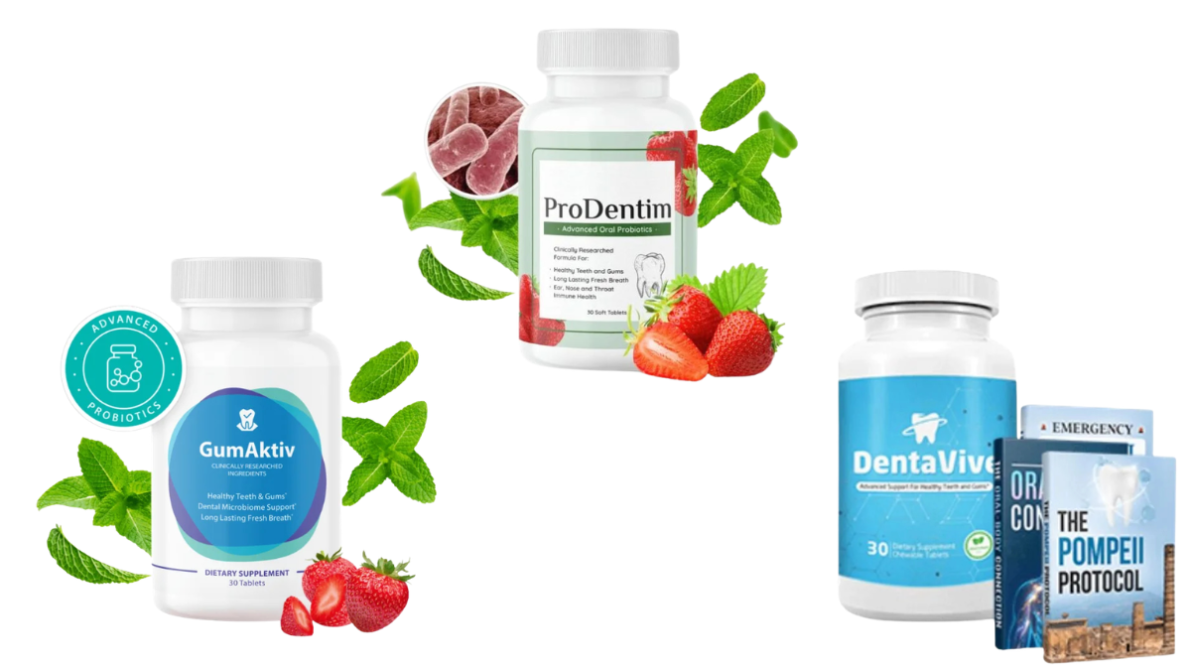
Consider three products we’ve reviewed in the oral-health space: ProDentim, GumAktiv, and DentaVive. What they have in common is instructive: they’re built around organisms with genuine oral evidence, like Lactobacillus reuteri and Lactobacillus paracasei, and several are chewables so the bacteria actually meet the gums.
The evidence behind those strains is real. A 2023 systematic review of nine randomized trials found L. reuteri, used alongside professional cleaning, significantly improved gum pocket depth and attachment versus cleaning alone. A randomized crossover trial of L. paracasei lowered the gingival index in gingivitis patients. But – and this is the whole lesson – that gum evidence belongs to coded strains (like L. reuteri DSM 17938). When an oral product names only “L. reuteri” without the code, or hides the per-strain dose inside a proprietary blend, you can’t confirm it’s the studied version. The category is right; the label detail is what separates a traceable product from a hopeful one. That’s a running theme across our ProDentim, GumAktiv, and DentaVive reviews.
Case Study: A Gut Probiotic Does a Completely Different Job
Now flip to the other end of the body. A gut-focused formula like Bioma Probiotics is built around a different cast entirely – typically Bifidobacterium strains and gut-adapted Lactobacillus, often paired with prebiotic fiber and postbiotics, and packaged to survive stomach acid so they reach the intestine. Its target problems are also different: bloating, regularity, digestive comfort. None of that overlaps with crowding Streptococcus mutans off your teeth.
The gut evidence is just as strain-specific, and just as strict about dose. In one landmark IBS trial, Bifidobacterium longum 35624 beat placebo at 1 billion CFU per day – while both a lower and a higher dose failed. That’s a vivid reminder that “more is not better,” and that dose and formulation are part of the strain’s identity.
So swapping Bioma’s gut strains into your mouth, or an oral chewable into your gut regimen, isn’t a shortcut – it’s a category error. Right neighborhood, right resident, right dose, or the evidence simply doesn’t transfer. Our Bioma review applies the same label check we use on the oral products, just aimed at a different organ.
The CFU Trap: Why a Bigger Number Isn’t a Better Product
If strain is the address, CFU count is just how many guests you sent – and the marketing loves a big number because it’s easy to print and easy to compare. “50 billion CFU” simply sounds stronger than “5 billion.” In most cases that logic is backwards.
As one clinical breakdown put it, “a 50 billion CFU product with five unidentified strains has less clinical backing” than a smaller dose of a single, properly identified, trial-validated strain. The number tells you how many bacteria are present; it says nothing about whether they can do anything useful where they land.
Two more traps hide inside the CFU number. First, the count on the label is almost always measured at manufacture, not at expiration – and probiotics die over time, so the viable dose at purchase can be far lower. Second, a huge count of the wrong strain, or of an unnamed “blend,” is still the wrong tool. When you shop, the useful question isn’t “how many billions?” It’s “which named strain, at what dose, tested for the outcome I actually care about?”
How to Read Any Probiotic Label in 30 Seconds

You don’t need a microbiology degree – just a short checklist. Before buying any probiotic, oral or gut, run down this list:
- Is there a strain code? Look for letters and numbers after the species (GG, DSM 17938, BL-04, 35624). No code = you can’t connect it to research. This is the biggest red flag.
- Is the dose disclosed per strain? A single “proprietary blend” CFU total that doesn’t split among strains hides how much of the good one you’re getting.
- Does the strain match the goal? An oral strain for gums; a gut strain for digestion. A formula stuffed with off-target strains is a marketing halo, not a plan.
- Is CFU guaranteed at expiration, not just manufacture? If it only says “at time of manufacture,” assume you’re getting less.
- Does the delivery match the destination? Chewable or lozenge for the mouth; acid-resistant or enteric-coated for the gut.
A product that passes all five is rare – and worth more than any “billions” claim on the front.
When to See a Professional, Not Reach for a Probiotic
One honest caveat before you shop at all: probiotics are optional support for generally healthy people, not treatments. If your gums bleed regularly, hurt, or you have persistent bad breath, that’s a dentist visit – gum disease is a real condition a chewable won’t fix.
If you have ongoing digestive pain, unexplained weight change, or blood in your stool, that’s a doctor, not a gut capsule. And people who are immunocompromised, seriously ill, or have a central venous line should talk to a clinician before taking any probiotic, because of a small risk of infection. Matching the right strain to the right site is smart shopping – but it’s still shopping, not medicine.
Frequently Asked Questions
Can I use a gut probiotic for my teeth and gums, or vice versa?
Not effectively. The strains studied for gum health (like L. reuteri DSM 17938 or L. paracasei) are different organisms from those studied for digestion (like Bifidobacterium longum 35624), and they’re formulated for different sites – chewables that contact the gums versus acid-resistant capsules that reach the intestine. Benefits proven for one strain don’t transfer to another, even within the same species, so you’d be paying for the wrong tool.
Does a higher CFU count mean a better probiotic?
Usually not. CFU tells you how many bacteria are present, not whether they’re the right strain or can survive to where they’re needed. A smaller dose of a named, trial-validated strain often has far more clinical backing than a huge count of unidentified “blend.” Also check whether the CFU is guaranteed at expiration, since probiotics die over time.
What’s the single most important thing on a probiotic label?
The strain code – the letters and numbers after the species name (like GG, BL-04, or DSM 17938). That designation is what links the product to actual clinical trials. A label listing only genus and species, or just “probiotic blend,” gives you no way to know whether the bacteria inside are the ones that helped people in studies.
Are the strains in oral probiotics like ProDentim really different from gut ones like Bioma?
Yes. Oral formulas are built around organisms with gum and mouth evidence and are often chewable so they contact the gums; gut formulas use different strains packaged to survive stomach acid and act in the intestine.
They target different problems in different parts of the body. Our individual reviews of ProDentim, GumAktiv, DentaVive, and Bioma each apply the same strain-and-dose label check to the specific product.

Raphael Albert is the founder and content creator of Nutra Pulse. Passionate about health, nutrition, fitness, and wellness, he spends his time researching scientific studies, health trends, and evidence-based lifestyle strategies to create informative and easy-to-understand content. While he is not a doctor or licensed healthcare professional, his goal is to help readers make more informed wellness decisions. All content is for educational purposes only and should not replace professional medical advice. Always consult a qualified healthcare provider regarding your health concerns.