Transparency note: this site normally earns a commission when readers buy through our links. There are no purchase links in this article. It exists to help you understand the category before you decide; the individual reviews it points to carry their own disclosures.
These statements have not been evaluated by the Food and Drug Administration. These products are not intended to diagnose, treat, cure, or prevent any disease. Gum tissue that has receded does not grow back on its own, bone lost to periodontitis does not return, and a cavity that has broken through enamel needs a filling. All three are far more manageable caught early — which is why the appointment matters more than anything on this page.
A few years ago, oral health supplements barely existed as a category. Now there are dozens — capsules, chewables, powders, drops — promising to rebuild enamel, reverse gum disease, rebalance your oral microbiome and let you skip the dentist.
I’ve reviewed eight of them in detail, one at a time, and the most useful thing I learned wasn’t about any ingredient.
It was that most of these products fail on delivery, not on formulation.
The ingredients are frequently reasonable. Xylitol has real anti-caries evidence. Certain probiotic strains have published trials. Hydroxyapatite genuinely remineralises. The problem is that a product can contain exactly the right compound and still do nothing — because it never reaches the tissue the problem lives in.
That sounds abstract. It isn’t. Your mouth contains tissues with completely different blood supplies, and that single fact determines which delivery routes can work and which cannot. Once you understand it, you can evaluate any product in this category in about two minutes, including ones that don’t exist yet.
This guide sets out that framework, then applies it to what’s actually on the market.
The Question That Decides Everything
Before ingredients, before doses, before reviews, ask one thing:
Can this product physically reach the tissue where my problem is?
Most supplement evaluation starts with “does this ingredient work?” In oral health that’s the second question, and asking it first is how people end up buying something that couldn’t work regardless of what’s in it.
The answer depends on two things: whether the target tissue has a blood supply, and whether there’s a physical barrier between the delivery route and the problem.
Get those right and everything else follows.
Your Enamel Has No Blood Supply
This is the single most useful fact in this article.
Tooth enamel is the hardest substance your body makes, and it is acellular and avascular — it contains no living cells and no blood vessels. The cells that build it, called ameloblasts, break down just before the tooth erupts, removing enamel’s ability to regenerate or repair itself.
After that, enamel receives minerals from exactly one place: saliva, at the surface.
Calcium, phosphate and fluoride ions are taken up from saliva and deposited onto the enamel surface — a surface chemistry process driven by pH and ion concentration in the fluid bathing your teeth. That’s why fluoride toothpaste works, and why dentists tell you to spit rather than rinse: you’re leaving active ingredient in contact with the surface.
So any product promising to strengthen or rebuild enamel from inside your body is describing a delivery route that doesn’t exist. Not a weak route. No route.
Now contrast that with the other tissues in your mouth:
Gum tissue is living and vascularised. It has a blood supply, so nutrition genuinely affects how it resists and recovers from inflammation. A systemic supplement can plausibly reach your gums.
The jawbone holding your teeth is bone, fed by blood like any other bone. Systemic nutrition reaches it — though bone already lost to periodontitis doesn’t come back.
Plaque is a biofilm physically attached to tooth surfaces, especially below the gumline. Nothing that arrives through your bloodstream reaches the outside of a tooth. Removing biofilm is mechanical, which is what brushing, flossing and professional scaling exist to do.
That’s the map. Now the products.
Group One: Capsules and Tablets You Swallow
These are systemic products. Whatever’s in them enters your bloodstream and arrives at tissue from within.
What that route can do: support gum tissue quality, if you’re deficient in something relevant. Contribute to bone health generally. Address a genuine nutritional gap.
What it cannot do: reach enamel, or touch the biofilm on the outside of a tooth.
Two products in this group illustrate the problem clearly.
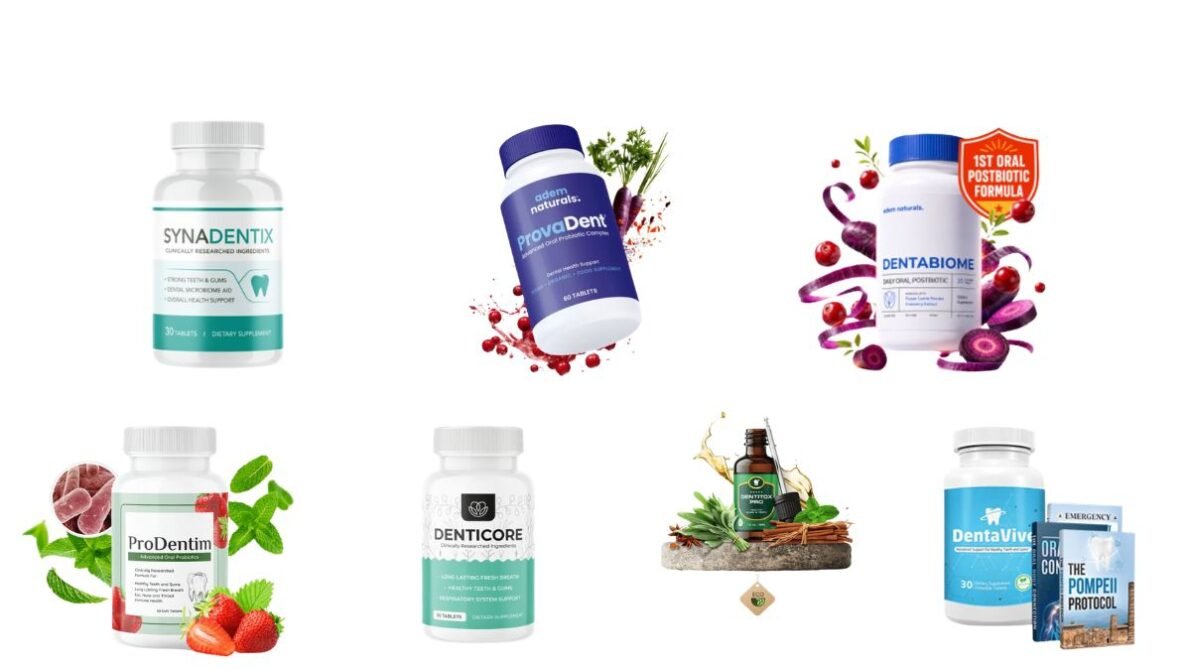
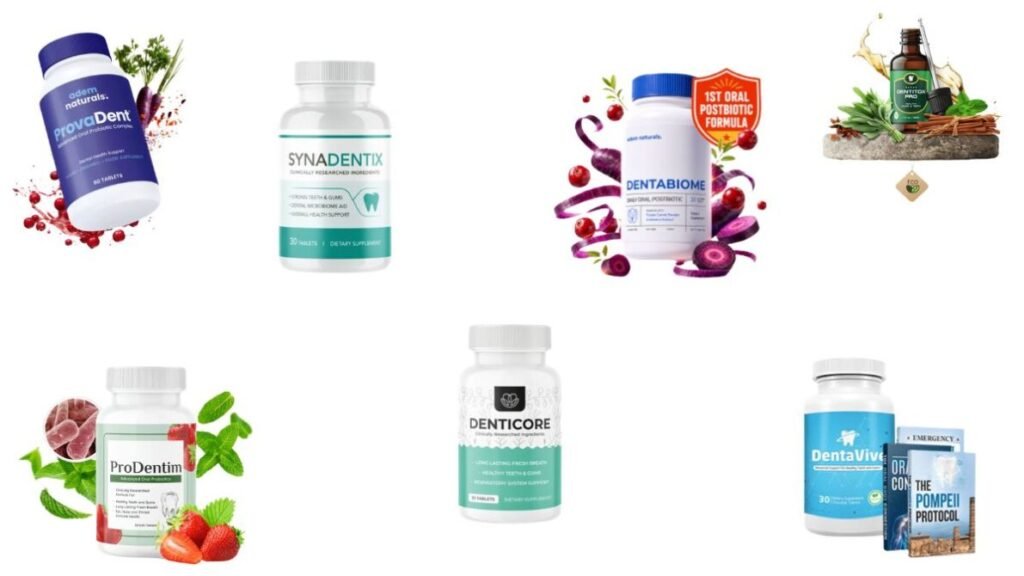
Our DentiCore review covers a mineral tablet — calcium, iodine, copper, chromium, shilajit and others — sold for gum health. The minerals aren’t absurd choices, and gum tissue is vascularised, so the systemic route isn’t wrong in principle. The mismatch is that gum disease is driven by biofilm on a surface, and a swallowed mineral arrives from the wrong side. That review also covers two safety points worth knowing: undisclosed iodine in a nutrient with a genuinely narrow safe window, and shilajit’s heavy metal profile.
Our DentaVive review covers a product whose own brand websites can’t agree on whether it works locally in the mouth or systemically through the bloodstream — and which, on some pages, promises enamel remineralisation from within. That’s the claim the anatomy rules out. That review works through why in detail.
The practical filter for this group: if a swallowed product is sold for enamel or for plaque, the route is wrong regardless of the ingredients. If it’s sold for gum tissue support, the route is plausible and the question becomes dose.
Group Two: Drops You Apply to Your Gums
A smaller group, and it produces the most interesting failure mode.
Applying something directly to gums and teeth is the right route for anything meant to act locally. Contact time and concentration at the surface are the mechanism.
The complication is formulas that mix local and systemic ingredients.
Our Dentitox Pro review covers exactly this: liquid drops applied to the gum line, containing xylitol and zinc — which act on contact and belong there — alongside vitamins D3, K2 and A, phosphorus and potassium, which work through intestinal absorption and blood transport.
Vitamin D3 increases calcium absorption from your gut. Vitamin K2 activates proteins that direct calcium into bone. Both pathways start in the intestine. Rubbing them on your gum line, then brushing them away, doesn’t engage either.
That’s a formula divided against itself: half of it is delivered correctly, and half needs a route it never gets. And the half that isn’t delivered is usually the half that justifies the headline claim.
The practical filter: when a topical product contains vitamins or minerals whose known mechanism is systemic, ask whether the route serves them. Usually it doesn’t.
Group Three: Chewables and Lozenges
This is where the category gets it right, and where the more interesting products live.
A chewable or dissolving lozenge puts its contents in direct contact with teeth, gums and saliva for as long as it takes to dissolve. That’s the correct route for surface disease, for enamel remineralisation, and for anything meant to compete with bacteria in your mouth.
Getting the route right doesn’t guarantee the product works — it just means the question moves on to what’s in it and how much.
Four products sit here, and they fail differently, which is what makes them worth reading together.
Our ProvaDent review covers a chewable built on xylitol and four probiotic strains — none of which are named, in a field where strain identity determines whether anything happens. That review also carries a warning for dog owners that no other review of the product includes.
Our ProDentim review covers another oral probiotic chewable, where the same question about strain identification applies.
Our DentaBiome review covers a chewable built around a genuinely real molecular target — an enzyme called FabM that helps cavity-causing bacteria survive their own acid, published in peer-reviewed research. The product wraps a marketing coinage around it that doesn’t appear in the literature, and attributes the discovery to a researcher its own footer describes as fictional.
Our Synadentix review covers the best-formulated product I’ve reviewed in this category: a chewable built on the antimicrobial protein system found in your own saliva — lactoperoxidase, glucose oxidase, lysozyme and lactoferrin — which is the same system behind established pharmacy toothpastes with decades of clinical literature. Its problem isn’t the science. It’s that enzymes are measured in activity units, and none are published.
The practical filter: route is right, so ask about identity and amount. Named strains? Stated doses? Enzyme activity units? If the answer is no to all three, you’re buying a well-designed vehicle carrying an unknown cargo.
Probiotic or Postbiotic? The Distinction That Matters
A newer split within the chewable group, and it’s genuinely meaningful.
Probiotics are live organisms. For them to do anything, they must survive manufacturing, storage, shelf time and your saliva in sufficient numbers. Viable counts at the point of use are frequently far below label figures, and most oral probiotic products don’t publish a CFU count you could check against.
Postbiotics are non-viable — inactivated cells or their metabolites. They’re shelf-stable, they don’t degrade the same way, and there’s no overgrowth risk.
That’s a real formulation advantage, and it’s rarely explained honestly.
The clearest illustration is that two products on the market share the same trademarked supporting blend, the same xylitol, cranberry and purple carrot base, and the same number of bacterial components — but one sells them as live probiotics and the other as postbiotics. Reading those two reviews together shows exactly what the distinction changes and what it doesn’t.
Our DentiCore vs ProvaDent comparison sets the systemic and local approaches side by side, which is the more fundamental version of the same question.
What postbiotics don’t solve: the amount. A stable ingredient at an undisclosed dose is still an undisclosed dose.
Which Strains Actually Have Evidence
If a product’s bacterial component is the reason you’re buying it, this section is the check to run.
Probiotic effects are strain-specific — not species-specific. That’s one of the better-established principles in the field, and in oral health the research names its strains precisely.
The organisms with genuine published support in oral care are identifiable:
- Streptococcus salivarius K12 and M18
- Lactobacillus reuteri (specific ATCC-designated strains)
- Lacticaseibacillus paracasei SD1
- Streptococcus rattus JH145
A critical evaluation of oral care probiotic strains describes how these work — interfering with biofilm formation through competitive adhesion, occupying binding sites on tooth surfaces to block colonisation by cariogenic pathogens. That same review makes a pointed observation: when certain organisms appear in commercial oral care products, they are essentially never identified to strain level — and the absence of that information suggests they aren’t good candidates.
Systematic review evidence exists for probiotic Streptococcus strains in caries prevention, and it’s genuinely promising for those named organisms.
So the check is simple: does the label give you an alphanumeric strain code, or just a species name? “L. reuteri” is a species. “L. reuteri DSM 17938″ is a strain. Only the second connects to research.
Worth calibrating expectations too. Even well-chosen strains produce modest results — one randomised trial of L. reuteri tablets in people with gingivitis found bacterial counts shifted without significant change in the clinical measures over eight weeks. Real research, honest result.
What the Science Genuinely Supports
Setting products aside, here’s what actually has evidence in this space.
Fluoride, applied topically. The single most evidence-backed intervention in preventive dentistry, and it’s in the toothpaste you already own. It works by incorporating into the enamel crystal structure and making it more acid-resistant — at the surface, from saliva.
Mechanical plaque removal. The foundation of periodontal treatment is mechanical debridement — scaling and root planing, which physically reduces bacterial load on affected root surfaces. Nothing you swallow or chew substitutes for it, because nothing you swallow scrapes a surface.
Xylitol — at the right dose and frequency. Streptococcus mutans takes it up but can’t ferment it into acid, which suppresses growth over time. Clinical trials generally use somewhere between 6 and 15 grams daily, split across several exposures — one school-based randomised trial delivered 11.7 to 15.6 grams in three doses. Frequency matters as much as total, because the mechanism is repeatedly denying bacteria substrate. Most supplements contain a small fraction of that in a single daily dose. Dental xylitol gum or mints match the research better and cost less.
Hydroxyapatite, topically. It’s the mineral enamel is made of, and delivering it to the tooth surface has a real rationale. Established in several markets, with a growing evidence base.
The salivary antimicrobial enzyme system. Lactoperoxidase, glucose oxidase and amyloglucosidase chain together to produce hypothiocyanite, a natural antimicrobial, while lysozyme and lactoferrin add separate antibacterial effects. Commercial toothpastes built on this have been studied for decades. The results are modest — reasonable evidence for relieving dry mouth symptoms and reducing malodour, limited proof of effect on cavity-causing bacteria in the living mouth.
Reducing sugar frequency, not just quantity. Each exposure triggers an acid attack. Three sweet things at once does less damage than three spread across the day.
And one thing that gets missed: saliva itself. It’s the delivery system for remineralisation, so anything reducing it — dehydration, mouth breathing, and a long list of common medications — increases risk. Dry mouth is often medication-related and often adjustable, which makes it worth raising with a doctor.
On what “reversing decay” can honestly mean: early enamel demineralisation, where minerals have leached out but the surface is intact, can remineralise. That’s real. A cavity that has broken through the surface cannot — by any product, at any dose. It needs a filling, and delaying that turns a small restoration into a root canal.
When It’s Not a Supplement Question
Some signs mean the decision isn’t which product to buy.
See a dentist promptly for:
- Bleeding gums that persist beyond a couple of weeks of good hygiene
- Gums pulling away from teeth, or teeth that look longer than they did
- A tooth that feels loose
- Sensitivity that doesn’t settle, or a tooth that aches
- A bad taste or smell that won’t shift
- Any visible hole, chip or dark spot on a tooth
Same-day care for: facial or jaw swelling, severe pain, fever with dental pain, or a tooth knocked loose by injury. Swelling around a tooth can indicate an abscess.
And the principle worth repeating, because it’s the reason early matters: gum tissue that has receded does not grow back on its own, and bone lost to periodontitis does not return. Gingivitis — inflammation without bone loss — is reversible with professional cleaning and proper daily hygiene. Periodontitis is manageable, but the bone doesn’t come back. The gap between treating it this year and treating it in three is the gap between reversible and permanent.
No supplement changes that arithmetic. Some may help around the edges. None replaces the appointment that tells you which situation you’re in.
How to Choose: Four Questions
If you’re still considering something, these four take about two minutes and eliminate most of the market.
1. Does the route reach the problem? Swallowed products can reach gum tissue and bone. They cannot reach enamel or surface biofilm. Chewables and lozenges act where surface disease is. Drops applied to gums work for local actives and not for systemic vitamins. Match the format to the tissue.
2. Are the specifics published? Strain codes, not species names. Milligram amounts, not “proprietary blend.” For enzymes, activity units — because enzymes degrade, and weight alone tells you nothing about whether they still work.
3. Do the amounts match the research? Xylitol needs grams across the day. Named probiotic strains have studied CFU counts. If a product publishes a number, compare it. If it publishes none, you’re not comparing anything.
4. Is it an addition or a substitute? This is the one that matters most. A product presented as complementing brushing, flossing and dental visits is being sold honestly. A product presented as letting you skip any of those is not — and the delay costs more than the money.
A fifth, informally: if the sales page invents a condition, cites references that don’t name its own ingredients, or attributes its discovery to someone you can’t look up, those are signals worth weighing independently of the formula.
The Full Library, by Subtopic
Everything covered here, organised by what you’re likely comparing.
Swallowed capsules and tablets — systemic route
- DentiCore review — mineral tablet for gum health, plus iodine and shilajit safety considerations
- DentaVive review — why the enamel claim can’t work by the route described
Topical drops
- Dentitox Pro review — the split-formula problem, and fat-soluble vitamin considerations
Chewables and lozenges — local route
- ProvaDent review — four strains, none named, plus a warning for dog owners
- ProDentim review — oral probiotics and the strain question
- DentaBiome review — a real enzyme target wrapped in an invented mechanism
- Synadentix review — the salivary enzyme system, correctly chosen and unquantified
Head-to-head
- DentiCore vs ProvaDent — systemic versus local, side by side
Frequently Asked Questions
Do oral health supplements actually work?
Some ingredients do, at the right dose and by the right route. Xylitol has real anti-caries evidence at 6 to 15 grams daily across several exposures. Named probiotic strains have published trials. Hydroxyapatite remineralises enamel topically. What almost none of these products demonstrate is delivering those ingredients at those amounts — and several are sold by routes that can’t reach the tissue at all.
Can a supplement rebuild tooth enamel?
Not from inside your body. Enamel is acellular and avascular, and the cells that build it break down before the tooth erupts. It receives minerals only from saliva, at the surface. Early demineralisation — a white-spot lesion with an intact surface — can remineralise topically. A cavity that has broken through cannot, by any product.
What’s the difference between probiotics and postbiotics for teeth?
Probiotics are live organisms that must survive manufacturing, storage and your saliva to do anything. Postbiotics are non-viable cells or metabolites — shelf-stable, with no overgrowth risk. That’s a genuine advantage for stability. It doesn’t solve the more common problem, which is that neither type usually publishes how much you’re getting.
Which probiotic strains have evidence for oral health?
The ones named in the research: Streptococcus salivarius K12 and M18, specific ATCC-designated Lactobacillus reuteri strains, Lacticaseibacillus paracasei SD1, and Streptococcus rattus JH145. Look for an alphanumeric strain code on the label. A species name alone doesn’t connect to any study.
How much xylitol do I need for it to matter?
Trials showing reduced cavity rates generally use 6 to 15 grams daily, split across several exposures, because the mechanism depends on repeatedly denying bacteria fermentable substrate. Most supplements contain a fraction of that in one daily dose. Dental xylitol gum or mints designed for gram quantities match the research more closely.
Is fluoride or hydroxyapatite better?
Both work topically and both have evidence. Fluoride has the deeper evidence base and makes enamel more acid-resistant by incorporating into its crystal structure. Hydroxyapatite supplies the mineral enamel is made of and is established in several markets. Worth discussing with your dentist rather than deciding from a sales page — and either way, the route is topical.
Can any of this replace brushing and dental visits?
No. Plaque is a biofilm physically attached to your teeth, and removing it is mechanical. Professional cleaning finds problems while they’re small, and cavitated decay and lost bone don’t resolve on their own. Anything in this category is at best an addition.
When should I see a dentist instead of buying something?
Persistent bleeding gums, gums pulling away from teeth, a loose tooth, sensitivity that doesn’t settle, a visible hole or dark spot, or a bad taste that won’t shift. Same-day care for facial swelling, severe pain, or fever with dental pain. Gum recession and bone loss don’t reverse on their own, which is why timing matters more than product choice.

Raphael Albert is the founder and content creator of Nutra Plus. Passionate about health, nutrition, fitness, and wellness, he spends his time researching scientific studies, health trends, and evidence-based lifestyle strategies to create informative and easy-to-understand content. While he is not a doctor or licensed healthcare professional, his goal is to help readers make more informed wellness decisions. All content is for educational purposes only and should not replace professional medical advice. Always consult a qualified healthcare provider regarding your health concerns.