This review contains no affiliate links. I earn nothing if you buy ProvaDent. These statements have not been evaluated by the Food and Drug Administration. This product is not intended to diagnose, treat, cure, or prevent any disease. A cavity that has broken through enamel does not heal, and bone lost to gum disease does not grow back. Both are far more manageable caught early. Bleeding gums, sensitivity, or a tooth that hurts are reasons to book a dental appointment.
The ProvaDent sales page contradicts itself before you reach the ingredients. It sells a chewable, and then, in a section describing “the remarkable ingredients found in each ProvaDent capsule,” it instructs you two paragraphs later to chew two tablets a day.
None of this is dangerous. It’s the kind of thing that happens when sales copy is reused and edited across funnels. But it’s a useful first data point, because it tells you that the copy is a marketing asset rather than a carefully maintained description of a product, and that matters when you get to the part where four probiotic strains are advertised and none of them is named.
That’s what this ProvaDent review is mostly about.
ProvaDent Review: What ProvaDent Is
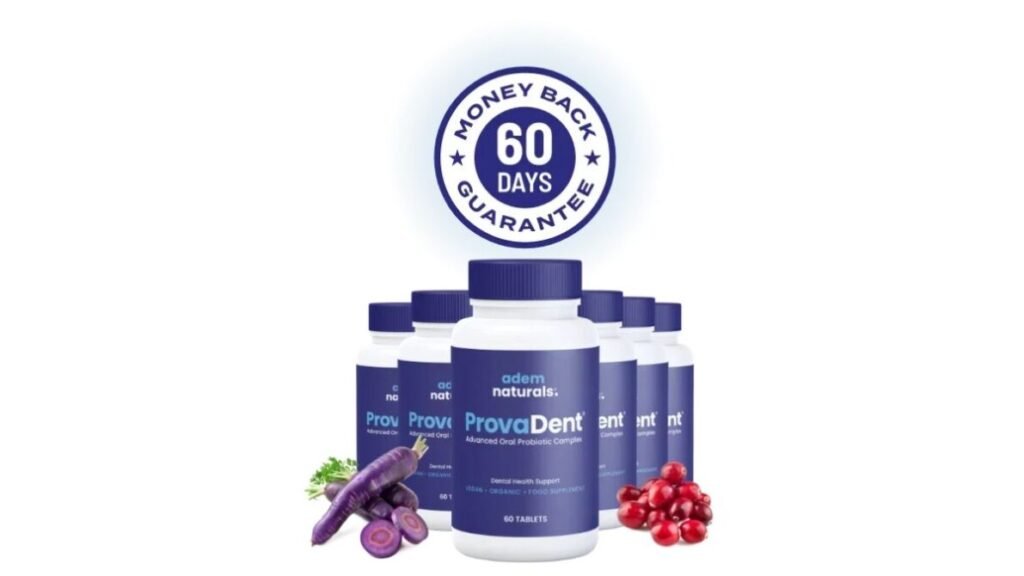
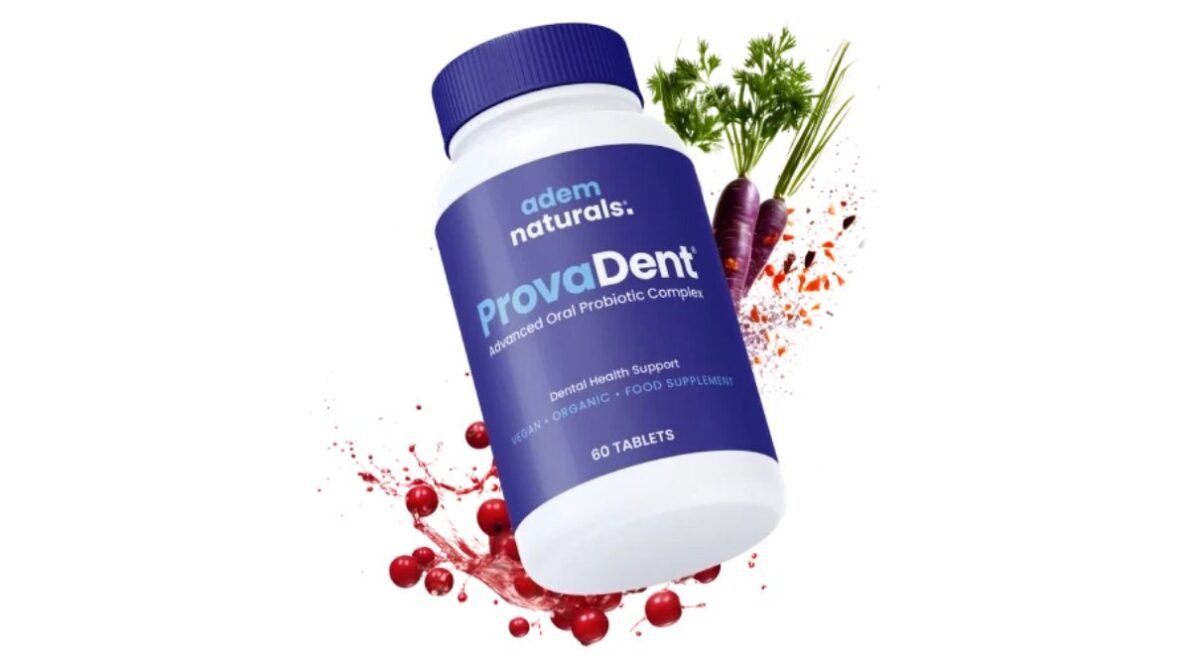
A chewable tablet, taken twice daily — the FAQ suggests after breakfast and before bed — sold through the official ProvaDent site with ClickBank as the retailer of record and a 60-day money-back guarantee.
Five components are listed:
- Organic xylitol, a sugar alcohol, described as supporting a balanced oral microbiome and fresh breath.
- BioFresh™ Clean Complex, described as a proprietary blend of natural ingredients.
- Cranberry extract.
- Purple carrot powder.
- Four strains of probiotics.
No amount is published for anything. Not a milligram of xylitol, not a CFU count, not a percentage. The page tells you to chew the tablets “the same way you’d enjoy a breath mint.”
Two things deserve credit up front. ClickBank is the retailer, which puts the order on an established payment platform with its own return policy. And the FAQ tells you to show the bottle to your doctor if you take prescription medication, which is correct advice that plenty of sellers skip.
“Four Strains of Probiotics” — and Not One Is Named
This is the central problem, and it’s worth understanding properly because it applies to every probiotic you’ll ever buy.
Probiotic effects are strain-specific. Not species-specific, strain-specific. That’s one of the better-established principles in the field, and in oral health it’s unusually well documented, because the research names its strains precisely.
The strains with genuine evidence in this area are identifiable: Streptococcus salivarius K12 and M18, Lactobacillus reuteri (specific ATCC-designated strains), Lacticaseibacillus paracasei SD1 and ET-22, Streptococcus rattus JH145. A critical evaluation of oral care probiotic strains describes how these work: K12 and L. paracasei interfering with biofilm formation through competitive adhesion, occupying binding sites on tooth surfaces to block colonization by cariogenic pathogens.
That same review makes a point that lands directly on this product. Discussing a species commonly added to oral care formulas, it notes that in such products the organism is essentially never identified to the strain level, and concludes that the absence of strain-level information suggests it isn’t currently a good probiotic candidate for oral care.
ProvaDent advertises “4 Strains of Probiotics” as a headline feature and names none of them. There’s no CFU count either.
So the four strains could be K12 and M18, organisms with real trial support for exactly what this product claims, or they could be generic dairy cultures with no oral colonization ability. The literature is clear that this distinction determines whether anything happens, and the page doesn’t let you check.
It’s also worth knowing that even well-chosen strains produce modest results. A randomized placebo-controlled trial of L. reuteri tablets in 40 people with gingivitis found reductions in certain bacterial counts but no significant changes in the clinical variables, meaning the bacteria shifted but the gums didn’t measurably improve over eight weeks. Real research, honest result, and a useful calibration for expectations.
Xylitol Is the Real Ingredient, at the Wrong Dose
Xylitol is the one component here with a long research history, and it deserves a proper explanation.
It’s a sugar alcohol that oral bacteria, particularly Streptococcus mutans, the main cavity organism, can take up but cannot ferment into acid. Over time, that suppresses their growth and reduces acid production. This is why xylitol appears in dental chewing gums worldwide. The evidence is more modest than the marketing, though: a Cochrane review of xylitol products judged the evidence for preventing cavities to be low quality.
The catch is the dose, and it’s substantial. A randomized school-based trial delivering xylitol via gummy snacks used 11.7 to 15.6 grams per day, split across three doses during school hours. Other clinical work has used 6 to 10 grams daily. The consistent finding across this literature is that both total daily amount and frequency of exposure matter. Spreading several grams across the day is the mechanism, because it’s about repeatedly denying the bacteria fermentable substrate.
Two chewable tablets cannot hold 6 to 10 grams of anything. A tablet you can comfortably chew weighs a fraction of that, and xylitol here shares space with four other listed components plus binders and flavoring.
So the ingredient is reasonable, the mechanism is real, and the delivery is far below what the trials used. If xylitol is what appeals to you, dental xylitol gum or mints designed to deliver gram quantities across the day are the format the research actually used, and they cost considerably less.
The Swallowing Claim Describes Something You Don’t Want
This one stopped me, and it’s worth flagging carefully.
The FAQ explains that “every time you swallow you’re sending good bacteria down the intestinal and respiratory pathways.”
Swallowing sends material down your esophagus into your stomach. It does not send material into your respiratory tract. When material does enter the airway, that’s aspiration, and it’s a malfunction, not a feature. It’s precisely the mechanism by which oral bacteria reach the lungs and contribute to aspiration pneumonia, which is a genuine and well-documented concern, particularly in older adults and anyone with swallowing difficulty.
I don’t think the copy intends to describe aspiration. The likeliest reading is loose writing by someone reaching for a sense of whole-body benefit. But the sentence describes, as a selling point, the one thing you’d want a mouth product not to do.
It’s a good illustration of why sales-page mechanisms are worth reading slowly. The direction of travel between mouth and lungs is one-way and downhill, and it’s a reason to keep your mouth clean rather than a reason to send anything anywhere.
BioFresh Clean Complex and the Biofilm Promise
The page states that BioFresh Clean “targets and destroys biofilm, the sticky film on your teeth where harmful bacteria grow.”
That’s the most consequential claim on the page, and it’s the one with the least behind it. BioFresh™ Clean Complex is described only as “our proprietary blend of natural ingredients that contribute to a clean, vibrant oral environment.” No ingredients are listed. No amount. No published research is cited for it, and I could find none.
Meanwhile, biofilm removal is the entire foundation of dental care. It’s what brushing, flossing and professional scaling exist to do, mechanically, because the film is physically attached to a surface. A claim to destroy it chemically, from an undisclosed blend, is a large claim resting on nothing a reader can check.
Cranberry extract has some interesting laboratory work on proanthocyanidins interfering with bacterial adhesion, and it’s a reasonable ingredient to include. Human oral outcomes data is thin, and the amount here is unstated.
Purple carrot powder is a source of anthocyanins. The page’s own description, “packed with nutrients, contributes to your overall well-being,” makes no oral claim at all, which is telling.
If You Have a Dog, Read This
This is the section I’d most want people to see.
Xylitol is severely toxic to dogs. In dogs, it triggers a rapid, dose-dependent insulin release that most other mammals don’t experience. Doses above roughly 100 mg/kg are associated with hypoglycemia, and above about 500 mg/kg some dogs develop severe hepatic insufficiency or failure. Signs can appear within 15 to 30 minutes: vomiting, weakness, lethargy, seizures, collapse. Liver injury can follow within 12 to 48 hours. Some veterinary sources describe xylitol as roughly a hundred times as toxic to dogs as chocolate.
Now consider what ProvaDent is. A sweet chewable that the seller says to take the way you’d enjoy a breath mint, which means it lives in a handbag, a bedside drawer, or on a kitchen counter rather than in a medicine cabinet.
That’s the profile of the products pet poison helplines get called about.
If you have a dog and you buy this, treat the bottle the way you’d treat sugar-free gum: high shelf, closed cupboard, never in a bag left on the floor. If your dog does get into it, that’s an immediate call to a vet or a pet poison helpline, not a wait-and-see, because treatment is far more effective before symptoms develop.
Cats, for what it’s worth, aren’t at risk. This is a dog-specific vulnerability.
What I Liked
- ClickBank is the retailer, which puts the order on an established payment platform with its own return policy, though its checkout wording is return or replacement.
- Xylitol is a reasonable ingredient choice. Whoever built this formula knew what the anti-cavity research points at. The dose doesn’t follow, but the selection is sound.
- The FAQ gives correct advice about showing the bottle to your doctor if you take prescription medication.
- Oral probiotics are a real and active research area. This isn’t an invented category. Strains like S. salivarius K12 and M18 have genuine trial support, and a product built around named strains at stated counts would be worth taking seriously.
- A 60-day guarantee, stated on the sales page and repeated at checkout.
- The tree-planting partnership is a small thing and probably marketing, but it’s a harmless kind of marketing.
Things to Consider
- Four strains advertised, zero named, in a field where strain identity determines whether anything happens.
- No CFU count.
- No amount for any ingredient, including the xylitol.
- Xylitol trials use 6 to 15 grams daily, split across the day; two tablets cannot approach that.
- “BioFresh Clean Complex” has no disclosed ingredients and no cited research, yet carries the biofilm-destruction claim.
- The FAQ says all ingredients “have been proven to be safe in clinical trials,” while the page names no strain and no amount.
- The swallowing explanation describes aspiration as a benefit.
- The page calls the product both a capsule and a tablet.
- “As Seen On” network logos appear on one funnel with no visible affiliation disclaimer.
- “87% of customers order 6 bottles” and a 4.9 rating from 18,594 reviews both appear with no source or destination.
- Image alt text on the page references unrelated supplement brands, a sign of a shared template rather than purpose-built content.
Who Should Be Careful
- Anyone with a dog in the house. This is the most likely real-world harm associated with the product.
- Anyone with IBS or sensitive digestion. Xylitol is a polyol, the “P” in FODMAP, and can cause bloating, gas and laxative effects, especially as intake rises.
- Anyone significantly immunocompromised, on chemotherapy, post-transplant, or with a central line. Live bacterial products warrant medical input in those situations.
- Anyone with a heart valve replacement or history of infective endocarditis. Discuss any live probiotic with your cardiologist or dentist.
- Parents: a sweet chewable that tastes like candy is a product children may help themselves to. Store it accordingly.
And the one that matters most: persistent bleeding gums, gums pulling away from teeth, loose teeth, sensitivity that doesn’t settle, or a tooth that aches need a dentist. Cavitated decay doesn’t remineralize, and bone lost to periodontitis doesn’t return. Both are far more manageable early, and no chewable changes that.
What Actually Works for Teeth and Gums
The honest hierarchy, which no supplement displaces.
Mechanical removal of plaque is the foundation: brushing twice daily with fluoride toothpaste, cleaning between the teeth every day, and professional scaling at the interval your dentist recommends. Biofilm is physically attached; the treatment is physical removal.
Fluoride is the single most evidence-backed intervention in preventive dentistry, and it’s in the toothpaste you already own.
Reducing the frequency of sugar exposure matters more than the total amount, because each exposure produces an acid attack. Three sweet things at once does less damage than three spread across the day.
Not smoking, and controlling blood sugar if you have diabetes. Both are strong, modifiable risk factors for gum disease.
And if you want xylitol specifically, use it the way the trials did: several grams daily, spread across multiple exposures, in gum or mints designed for that purpose.
Oral probiotics may eventually earn a place as an adjunct alongside all of the above. The research is genuinely promising, and strains like K12 and M18 are the ones to watch. Adjunct means alongside, and it means named strains at stated doses.
Price, Guarantee, and the Review Count
Pricing runs $69 for one bottle, $59 each for three ($177), and $49 each for six ($294) with free US shipping on the three and six-bottle orders and two digital bonuses on the larger orders. Struck-through prices of $199, $597 and $1,194 appear beside them, reference figures nobody has been shown to pay.
The guarantee is 60 days. The FAQ says to email customer support and request a full refund, even if you never used the product. The ClickBank checkout words it differently: “return or replacement of any product within 60 days.” Those are not the same promise, so read ClickBank’s return policy before you pay. The charge appears on a statement as CLKBANK*ProvaDentOral.
On reviews: one funnel displays a 4.9 rating based on 18,594 reviews, and the ClickBank checkout shows 9.3 “Excellent!” based on 36,015 reviews. Neither links to a place where a review can be read, and the two numbers don’t match. The page states that 87% of customers order six bottles, directly above the six-bottle button, with no source, and the checkout runs an “order is reserved for” countdown. The first testimonial photo carries the alt text “nitric boost customer review by steve” on a quote signed Kelly T., and the site footer says some names “have been changed.” No verified-purchase pool exists, since the product is sold direct only, and search results are dominated by affiliate content. I wrote up how to check any supplement’s reviews yourself in HepatoBurn Customer Reviews: I Went Looking for Real Ones.
If you order, screenshot the price and guarantee wording on the day you pay, and keep the ClickBank order receipt. That’s your refund route.
Final Verdict
ProvaDent is built on two ingredients that genuinely belong in oral care, presented in a way that makes it impossible to know whether you’re getting anything useful.
Xylitol may help, at grams per day, spread across the day. Oral probiotics can work, when the strains are named ones with trial support, at stated counts. ProvaDent gives you neither number. It advertises four strains without naming one, in a field where strain identity is the entire question, and it wraps a biofilm-destruction claim around a proprietary complex whose ingredients are undisclosed.
Who might reasonably try it: someone who likes the idea of a pleasant daily oral habit alongside proper brushing, flossing and dental visits, who has no dog in the house, who tolerates polyols, and who understands they’re buying a mint with possible marginal benefit rather than a treatment. As a small addition to real care, it’s not unreasonable. As a substitute, it’s the wrong purchase.
Who should skip it: anyone with a dog who can’t guarantee secure storage, anyone hoping to avoid a dental appointment, and anyone with active gum disease or a painful tooth.
If the ingredients are what appeal to you: buy dental xylitol gum or mints that state the grams, and if you want an oral probiotic, buy one that names its strains. K12 and M18 are the ones with published trials, sold openly under those designations, and you’ll know what you’re taking.
And the part that beats everything above: fluoride toothpaste, flossing you actually do, fewer sugar exposures across the day, and the cleaning appointment. Unglamorous, cheap, and the only things in this article with decades of evidence behind them.
If you’re weighing ProvaDent against DentiCore, our DentiCore vs ProvaDent comparison sets the two side by side, with the same checks applied to both.
ProvaDent Frequently Asked Questions
Which probiotic strains are in ProvaDent?
The page advertises four strains and names none of them, with no CFU count. That matters because probiotic effects are strain-specific — the oral strains with published trial support are identified precisely in the literature, such as S. salivarius K12 and M18, L. reuteri, and L. paracasei SD1. Without strain names, the research on those organisms can’t be applied to what’s in the bottle.
How much xylitol do you need to prevent cavities?
Clinical trials generally use somewhere between 6 and 15 grams daily, split across several exposures through the day — frequency matters as much as total amount. Two chewable tablets cannot deliver that. If xylitol is what you want, gum or mints designed to provide gram quantities across the day match what the research used.
Is ProvaDent safe if I have a dog?
The product itself isn’t dangerous to you, but xylitol is severely toxic to dogs — hypoglycaemia above roughly 100 mg/kg and potential liver failure at higher doses, with signs sometimes appearing within half an hour. Because this is a sweet chewable people keep in bags and on counters rather than in a cabinet, store it well out of reach. If your dog eats any, call a vet immediately rather than waiting for symptoms.
Can it replace brushing or a dental visit?
No. Plaque is a biofilm physically attached to tooth surfaces, and removing it is mechanical — brushing, flossing and professional cleaning. Cavitated decay doesn’t heal and bone lost to gum disease doesn’t grow back. Anything like this is at best an addition to proper care.

Raphael Albert is the founder and content creator of Nutra Pulse. Passionate about health, nutrition, fitness, and wellness, he spends his time researching scientific studies, health trends, and evidence-based lifestyle strategies to create informative and easy-to-understand content. While he is not a doctor or licensed healthcare professional, his goal is to help readers make more informed wellness decisions. All content is for educational purposes only and should not replace professional medical advice. Always consult a qualified healthcare provider regarding your health concerns.
1 thought on “ProvaDent Review 2026: An Honest Look at This Oral Probiotic Chewable”