On incentives: two links below go to the seller and pay this site a commission. This is the first product in this category I’ve reviewed whose formula I’d defend on the science — and the section on where to get the same system cheaper still argues against buying it here.
These statements have not been evaluated by the Food and Drug Administration. This product is not intended to diagnose, treat, cure, or prevent any disease. Bone lost to gum disease doesn’t grow back, and a cavity that has broken through enamel needs a filling. Both are far more manageable caught early — bleeding gums, sensitivity, or a tooth that aches are reasons to book a dental appointment.
I’ve reviewed a lot of oral health supplements, and they fail in predictable ways. Minerals you swallow, sold for plaque that sits on the outside of a tooth. Probiotic strains advertised as a feature and never named. Enamel repair promised by products that travel through your bloodstream, when enamel has no blood supply at all.
So I want to be straightforward about this one: I recognised the formula, and it’s legitimate.
Lactoperoxidase, glucose oxidase, amyloglucosidase, lysozyme and lactoferrin aren’t invented ingredients. They’re the antimicrobial proteins in your own saliva — and that specific combination is the basis of established commercial oral care products that have been sold in pharmacies and studied in clinical trials for decades.
That’s a genuine first for this category on this site, and it deserves to be said before anything else.
This Synadentix review is therefore a different kind of article. Not “does the mechanism exist” — it does. But “can you tell whether this particular product delivers it,” and “is this the sensible way to buy it.” Those questions have less flattering answers.
What Synadentix Is — and Why the Format Matters
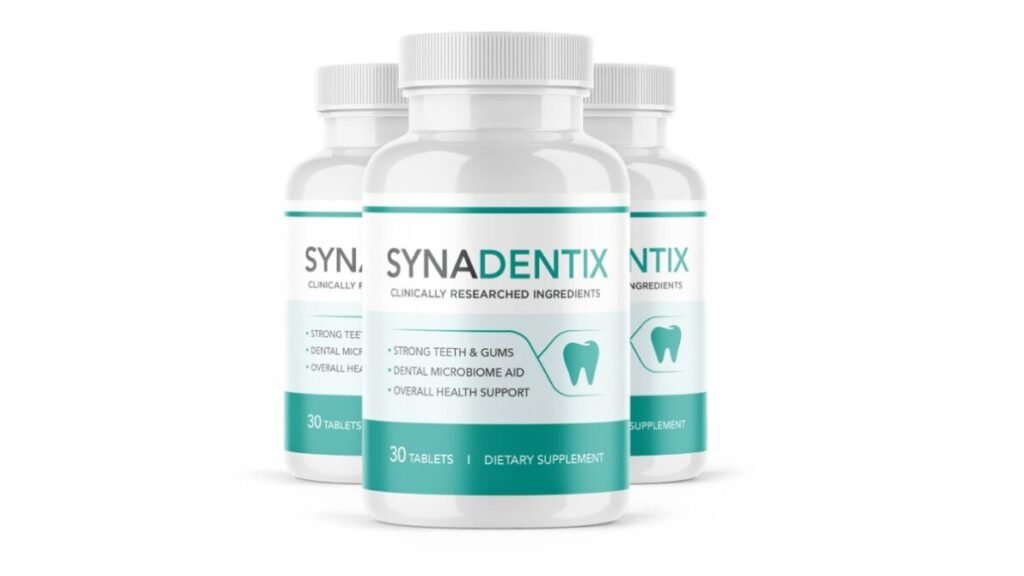
A chewable, sold through the official site with BuyGoods as the retailer of record and a 60-day money-back guarantee.
Start with the format, because in oral health it decides more than the ingredient list does.
Dental disease happens on surfaces. Plaque is a biofilm physically attached to teeth. Enamel demineralisation and remineralisation happen at the tooth surface, in contact with saliva. Gum inflammation is driven by bacteria in the pocket between gum and tooth.
A chewable dissolves in your mouth. It puts its contents in direct contact with those surfaces, mixed into saliva, for as long as it takes to dissolve. That’s the right route — and it’s the opposite of the swallowed mineral tablets this category is full of.
Ten ingredients are named: guava fruit powder, microcrystalline hydroxyapatite complex, beta-glucanase, dextranase, amylase, lactoperoxidase, glucose oxidase, amyloglucosidase, lysozyme and lactoferrin.
The page calls that “a perfectly dosed proprietary mix” — the same oxymoron that runs through this whole market. A proprietary blend is one whose doses aren’t disclosed. You’re told it’s dosed perfectly and simultaneously not told the doses.
The Salivary Enzyme System Is Real Science
Here’s the mechanism, and it’s worth understanding because it’s genuinely elegant.
Your saliva contains a self-defence system. Lactoperoxidase catalyses a reaction converting thiocyanate — present naturally in saliva — into hypothiocyanite, a potent antimicrobial against bacteria, fungi and viruses. To do that it needs hydrogen peroxide, and that’s where glucose oxidase comes in: it generates hydrogen peroxide from glucose. Amyloglucosidase supplies the glucose by breaking down dietary starch.
Three enzymes, chained together, producing an antimicrobial from ingredients already in your mouth.
Alongside them, lysozyme breaks bacterial cell walls, and lactoferrin binds iron that bacteria need — and has documented antibacterial effects against periodontal pathogens including Porphyromonas gingivalis, plus anti-biofilm activity.
None of this is fringe. These innate salivary defence proteins have been incorporated into oral health care products — dentifrices, mouth rinses, moisturising gels and chewing gums — specifically to restore saliva’s own antimicrobial capacity in patients with dry mouth. The commercial products built on this system are named in the literature: Zendium, Biotène, Enzycal.
A randomised clinical study of a toothpaste containing a three-enzyme system plus lysozyme, lactoferrin and immunoglobulin examined its effect on plaque microbiome ecology and found shifts consistent with a healthier community.
So the concept Synadentix is built on has been in pharmacies for decades and in journals for longer.
There Is Even a Trial in This Exact Format
This is the part that separates Synadentix from every other product I’ve reviewed in this category.
A randomised, double-blind, crossover, placebo-controlled clinical trial tested a tablet containing lactoferrin, lactoperoxidase and glucose oxidase for oral malodour — a tablet you dissolve in your mouth. Same route, same core ingredients.
The doses used were 100 mg of lactoferrin, 1.8 mg of lactoperoxidase and 24 mg of glucose oxidase.
That’s the number that matters, and I’ll come back to it. Separately, research on lactoferrin and lactoperoxidase-containing food in older individuals found significant decreases in gram-negative bacteria including periodontal pathogens in supragingival plaque and tongue coating.
For once, this isn’t a case of borrowing credibility from research about something else. The research is about these ingredients, in this format, for outcomes people actually care about.
What Those Trials Actually Found
Now the honest calibration, because “the science is real” and “the effect is large” are different statements.
The clinical evidence for this approach is modest and mixed, and the reviewers say so themselves.
A four-week study of a lactoperoxidase-system toothpaste and mouthrinse in twenty xerostomia patients relieved subjective oral dryness in sixteen of them — a real result. But the same study found no change in salivary hypothiocyanite, lysozyme, lactoferrin or peroxidase activity, and no major changes in salivary microflora. The authors noted the symptom relief “was not necessarily related to the presence of antimicrobial agents.”
The major review of this field concludes that clinical evidence remains limited. Another notes that while these proteins have well-documented antibacterial effects against Streptococcus mutans in vitro, very little proof exists that they affect cariogenic flora in the living mouth.
So: a plausible, well-characterised mechanism, real products built on it, some clinical signal — particularly for dry mouth symptoms and breath — and no demonstration that it prevents cavities or reverses gum disease.
That’s a reasonable thing to buy if your expectations match it. It is not what the sales page describes.
Hydroxyapatite Is the Right Ingredient, in the Right Place
Microcrystalline hydroxyapatite deserves specific credit, because it solves a problem most of this category gets wrong.
Tooth enamel is the mineral hydroxyapatite. It’s also acellular and avascular — no living cells, no blood supply. Nothing you swallow reaches it, ever. Enamel takes up calcium and phosphate from saliva, at the surface, or not at all.
That’s why supplements promising to rebuild enamel from inside the body can’t work, and it’s the central finding of our review of a competing product.
Hydroxyapatite in a chewable is the correct answer to that constraint. It puts the mineral in contact with the tooth, in saliva, at the surface — the only route enamel has. Hydroxyapatite toothpastes are established in several markets and have a real, if still-debated, evidence base for remineralisation.
Whether it works here depends entirely on concentration and contact time, neither of which is published. But the reasoning is sound, and after reviewing products that got this exactly backwards, that’s worth acknowledging.
Dextranase: The One Genuinely Clever Addition
Three enzymes in this formula aren’t part of the standard salivary system, and one of them is a smart inclusion.
Dextranase breaks down dextran — the sticky glucan polymer that Streptococcus mutans produces to build and anchor plaque biofilm. Rather than killing bacteria, it degrades the scaffolding they live in. Enzymatic plaque control has a research history going back decades and it’s a mechanistically distinct approach from antimicrobials.
Beta-glucanase works on related polysaccharides. Amylase breaks down starch, which fits the amyloglucosidase-glucose oxidase chain described earlier.
Guava fruit powder is the outlier. It has traditional use for oral health in several cultures and some laboratory antibacterial data, and essentially no clinical evidence in this context. It’s not objectionable; it’s just not doing what the enzymes are doing.
Enzymes Without Activity Units Are Unverifiable
Here’s the problem that undercuts everything above, and it’s more serious for this product than for a typical botanical blend.
Enzymes aren’t measured in milligrams alone. They’re measured in activity units. Two products can contain the same weight of lactoperoxidase and deliver completely different effects, because what matters is how much catalytic activity survives manufacturing, storage and shelf time. Enzymes denature — with heat, with humidity, with age.
The published trial used 100 mg of lactoferrin, 1.8 mg of lactoperoxidase and 24 mg of glucose oxidase. Synadentix publishes no weights and no activity units for anything.
So you cannot know whether this chewable delivers a fraction of that trial dose, a multiple of it, or enzymes that have already lost most of their activity in a bottle sitting in a warehouse.
That’s not a pedantic objection. For this specific formula, activity is the entire product. A botanical at half the studied dose does something. An enzyme with no remaining activity does nothing at all, and looks identical on a label.
If you contact the company about one thing before ordering, make it this: ask for enzyme activity units, and ask about stability testing over shelf life.
What I Liked
This is the longest version of this section I’ve written for an oral health product, and that’s the point.
The route is correct. A chewable acts where dental disease actually is. After reviewing swallowed tablets sold for surface problems, this is the fundamental thing to get right, and it’s got it right.
The enzyme system is real, established science. Not an invented mechanism — the basis of commercial products sold in pharmacies for decades and studied in peer-reviewed trials.
There is trial evidence in this exact format. A randomised, double-blind, placebo-controlled study of a dissolving tablet with these core ingredients. That’s more format-matched evidence than any competitor in this category offers.
Hydroxyapatite is anatomically correct here. The right mineral, delivered by the only route enamel can receive it.
Dextranase is a thoughtful inclusion that targets biofilm structure rather than just bacteria.
BuyGoods is the retailer of record, giving the refund an independent route, and the footer carries correct advice about consulting a physician.
The claim language on the ingredients section is restrained — “supports the oral microbiome” rather than promising to cure anything.
Things to Consider
No doses and no enzyme activity units, in a formula where activity is the mechanism.
No stability or shelf-life data, for ingredients that degrade.
“A perfectly dosed proprietary mix” tells you it’s dosed correctly while declining to say the doses.
The clinical evidence is modest — symptom relief in dry mouth and breath, with limited proof of effect on cavity-causing flora in vivo.
Prices don’t render as text on the page I examined; the totals appear as blank fields filled in by script.
“96% of customers order 6 bottles” and “based on 13,451 reviews” both appear with no source or destination.
The same enzyme system is available as toothpaste in pharmacies, at a fraction of the cost.
No third-party testing or certificate of analysis is published.
“Protects Your Brain” and the Bonus Problem
Two things on the page overreach badly, and they’re worth separating from the formula.
The brain claim. The page states the product “protects your brain from these harmful bacteria.” This gestures at a real research area — P. gingivalis has been detected in the brains of people with Alzheimer’s disease, and the oral-systemic link is genuinely being investigated. But it is nowhere near established that treating oral bacteria protects cognition, and no product has demonstrated it. That’s a serious claim resting on preliminary science.
The bonuses. These are where the page stops sounding like a formulator and starts sounding like a funnel. One promises a 30-second pH ritual that keeps you “kissable for up to 16 hours,” valued at $147. Another offers facial yoga to rewire your breathing, at $157. The third promises a fingertip ritual that “plumps your smile in 60 seconds flat,” at $197.
Gum tissue does not plump in sixty seconds. Those retail prices describe nothing anyone has paid.
It’s a genuine shame, because the formula didn’t need this. A product built on the salivary enzyme system could have been sold on that alone, honestly, and been more convincing.
Who Should Be Careful
Anyone with a milk protein allergy. This matters here specifically: lactoferrin and lactoperoxidase used in oral care products are typically purified from bovine colostrum or milk. If you have a dairy allergy, ask the company about the source before ordering. This is the most product-specific caution in this article.
Anyone significantly immunocompromised should discuss any oral microbiome product with their clinician.
Anyone with a known allergy to ingredients you can’t quantify — ask for the full panel first.
Parents, if it’s a sweet chewable: store it out of reach, and check with a dentist before giving anything like this to a child.
Anyone pregnant or breastfeeding — no safety data exists for this combination, and the footer correctly advises consulting a physician.
And the important one: persistent bleeding gums, gums pulling away from teeth, loose teeth, a bad taste that won’t shift, or a tooth that aches need a dentist. Gingivitis is reversible. Periodontitis destroys bone permanently, and a cavity that has broken through enamel needs a filling, not a chewable. The gap between treating either early and treating it in three years is the gap between simple and expensive.
Price, Guarantee, and the Cheaper Version That Already Exists
Pricing follows the familiar tiered structure — two, three and six-bottle options with per-bottle cost falling and three bonus ebooks on the largest. On the page I examined the totals appeared as blank fields populated by script, so check the actual figures at checkout. Terms are on the Synadentix site, with BuyGoods handling the transaction and a 60-day guarantee.
Now the practical point, and it’s the one I’d want you to weigh most.
The salivary enzyme system in this product is already sold as toothpaste. Zendium, Biotène and Enzycal are commercially available in pharmacies and online in many markets, built on the same enzymes — amyloglucosidase, glucose oxidase, lactoperoxidase — with lysozyme and lactoferrin in several formulations. They’re the products the published research was actually conducted on. They cost a few dollars a tube, they list their ingredients, and you use them twice daily for two minutes, which is considerably more contact time than a chewable provides.
If the enzyme system is what appeals to you, that’s where to start. You get the same mechanism, from products with the trial evidence attached to them, at a fraction of the price — and you can add a hydroxyapatite toothpaste if remineralisation is your interest.
Where a chewable could genuinely add something is dry mouth, where extra saliva stimulation and antimicrobial support between brushings has a real rationale. That’s a narrower and more honest use case than the page describes.
On reviews: the product is sold direct only, so no verified-purchase pool exists, and the review count on the page has no destination.
Final Verdict
Synadentix is the best-formulated oral health product I’ve reviewed, sold in the same opaque way as the worst of them.
The route is right. The enzyme system is real science with commercial products and clinical trials behind it. There’s even randomised evidence in this exact dissolving-tablet format. Hydroxyapatite belongs in a chewable in a way it never belongs in a swallowed capsule. Dextranase is a genuinely thoughtful inclusion.
And none of it can be verified, because enzymes are measured in activity units and this product publishes none — no weights, no units, no stability data. For a formula where catalytic activity is the mechanism, that gap is larger than it would be anywhere else.
Who this might reasonably suit: someone with dry mouth, or persistent bad breath, who brushes and flosses properly and sees a dentist, who wants something with antimicrobial rationale between brushings, and who accepts they’re buying an unverifiable quantity of a real system. If that’s you, buy the smallest package and judge inside the 60-day window.
Who should look elsewhere: anyone expecting cavity reversal or gum disease treatment, and anyone who’d rather pay a few dollars for the pharmacy version with the trial evidence attached.
What I’d suggest first: an enzyme toothpaste from the established brands, used twice daily, plus flossing and your dental appointments. If enamel is your concern, add a hydroxyapatite toothpaste. That combination gives you everything Synadentix is built on, with published amounts, for a fraction of the cost.
For contrast on how differently this category can be approached, our DentiCore review covers a mineral tablet you swallow for a problem that lives on the surface of your teeth, and our ProvaDent review covers a chewable that gets the route right but never names its probiotic strains. Synadentix gets further than either — which is why the missing doses are so frustrating.
Frequently Asked Questions
Do salivary enzyme products actually work?
The mechanism is real and well characterised — lactoperoxidase, glucose oxidase and amyloglucosidase chain together to produce hypothiocyanite, a natural antimicrobial, while lysozyme and lactoferrin add separate antibacterial effects. Commercial toothpastes built on this system have been studied for decades. The clinical results are modest: reasonable evidence for relieving dry mouth symptoms and reducing malodour, limited proof of effect on cavity-causing bacteria in the living mouth.
What’s actually in Synadentix, and how much?
Ten ingredients are named, and no amounts are published for any of them. That matters more here than usual: enzymes are measured in activity units, not just milligrams, and activity declines with storage. Ask the company for enzyme activity units and shelf-stability data before ordering.
Is hydroxyapatite better than fluoride?
They work differently and both have evidence. Fluoride has the deeper evidence base and incorporates into the enamel crystal to make it more acid-resistant. Hydroxyapatite supplies the mineral enamel is made of and is established in several markets. Either way, both work topically — enamel has no blood supply, so nothing swallowed reaches it. Worth discussing with your dentist rather than choosing from a sales page.
Can this replace brushing or a dental visit?
No. Plaque is a biofilm physically attached to teeth, and removing it is mechanical. Anything like this is at best an addition. Cavitated decay doesn’t heal and bone lost to gum disease doesn’t return, which is why the appointment matters more than the purchase.

Raphael Albert is the founder and content creator of Nutra Pulse. Passionate about health, nutrition, fitness, and wellness, he spends his time researching scientific studies, health trends, and evidence-based lifestyle strategies to create informative and easy-to-understand content. While he is not a doctor or licensed healthcare professional, his goal is to help readers make more informed wellness decisions. All content is for educational purposes only and should not replace professional medical advice. Always consult a qualified healthcare provider regarding your health concerns.