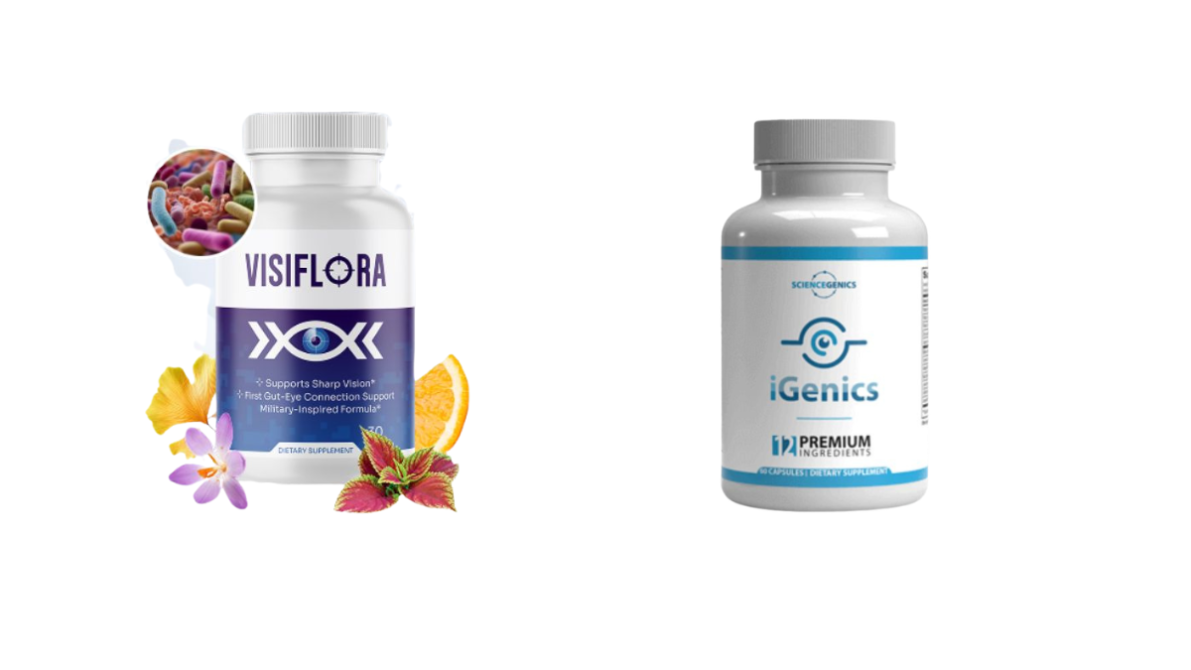
On incentives: two links below go to the sellers and pay this site a commission. The section on beta-carotene and smokers argues against buying either without checking a label first, which isn’t what a commission buys.
These statements have not been evaluated by the Food and Drug Administration. These products are not intended to diagnose, treat, cure, or prevent any disease. If you smoke or used to, check for beta-carotene before buying any eye supplement. And if you have cataract surgery scheduled, tell your surgeon about anything containing ginkgo. Both sections are below.
iGenics vs VisiFlora looks like a comparison between two different products. Underneath, both rest on the same piece of research — and understanding what that research actually showed sorts most of the decision before you look at an ingredient list.
That research is the AREDS2 trial, and it’s genuinely good. Large, well-conducted, funded by the National Eye Institute. It’s why ophthalmologists recommend a specific supplement formulation to specific patients.
The problem is that its finding is narrow, and neither product’s marketing stays inside it.
Here’s what the trial found, what both products do with it, and the two label checks that matter more than anything else in this category.
What AREDS2 Actually Found
The formulation tested was lutein, zeaxanthin, zinc, copper, and vitamins C and E.
The finding: it reduces the risk of progression from intermediate age-related macular degeneration to advanced AMD by roughly 25%.
Three things follow from that sentence, and each one narrows it further.
It applies to people who already have intermediate AMD. It does not prevent AMD from developing in healthy eyes, and there’s no established benefit in early AMD.
It doesn’t restore vision. Damage already done isn’t reversed.
It doesn’t affect cataract. Cataract is clouding of the lens — a structurally different problem — and AREDS2 found no effect on it.
So the honest description is: for people with a specific diagnosis, at a specific stage, it slows progression by about a quarter. That’s valuable and worth taking seriously. It’s also a much smaller claim than either product makes.
What Each One Is
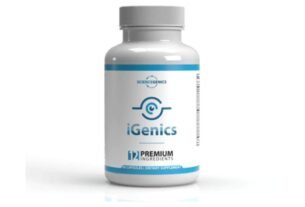
iGenics is a capsule built on the AREDS2 core — lutein, zeaxanthin, zinc, copper, vitamins C and E — with additional botanicals including ginkgo biloba, bilberry, saffron and turmeric.
VisiFlora is a 22-ingredient formula built on the same carotenoid base, with a “gut-eye axis” framing added — the idea that ocular health is influenced by the gut microbiome. It includes lutein, zeaxanthin, saffron, ginkgo and beta-carotene among its components.
Where iGenics vs VisiFlora Actually Separates
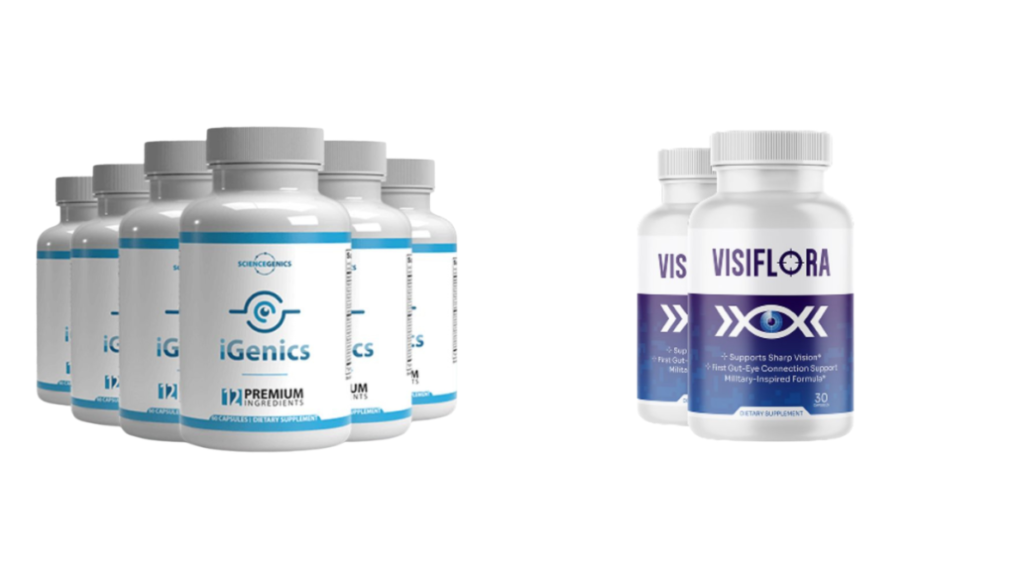
Four dimensions, and the honest answer is that they separate less than the marketing suggests.
Core formula. Nearly identical — both AREDS2-derived.
Ingredient count. iGenics fewer; VisiFlora 22, which raises a dilution question.
Added framing. iGenics stays within eye health; VisiFlora adds the gut-eye mechanism.
Safety profile. Similar, and both require the same two checks.
Setting up the table, the thing worth noticing about iGenics vs VisiFlora is how many rows come out the same:
| iGenics | VisiFlora | |
|---|---|---|
| AREDS2 core present | ✅ Yes | ✅ Yes |
| Contains saffron | ✅ Yes | ✅ Yes |
| Contains ginkgo | ⚠️ Yes | ⚠️ Yes |
| Beta-carotene | ❓ Label not published | ⚠️ Yes |
| Ingredient count | Moderate | 22 |
| Doses published | ❌ No | ❌ No |
| Added mechanism claim | None | Gut-eye axis |
The Shared Core: Lutein and Zeaxanthin
Both products are built on the same two carotenoids, and they deserve credit before criticism.
Lutein and zeaxanthin concentrate in the macula, where they form macular pigment — filtering blue light and acting as antioxidants in the tissue most vulnerable to oxidative damage. That’s real physiology, not marketing.
The AREDS2 doses were 10 mg lutein and 2 mg zeaxanthin daily. Those are the numbers to compare any product against.
Neither product publishes its amounts, which means neither can be checked against the trial it’s built on. That’s the same failure, shared.
Saffron: The Best Ingredient in Both, and the Headline in Neither
Here’s the most interesting thing these two share, and it’s genuinely favourable.
That’s independent evidence, in the right population, showing benefit on top of the standard formulation. Among everything in either product, saffron has the strongest case for being there.
And it’s the headline in neither. iGenics leads with its AREDS2 credentials and ginkgo; VisiFlora leads with the gut-eye framing and its ingredient count.
If saffron is what interests you, the studied dose is 20 mg. Standalone saffron supplements state their milligrams. Neither of these does.
iGenics and the Ginkgo Problem
Our iGenics review documents a specific issue with how ginkgo is positioned.
Ginkgo appears as a main ingredient, framed around circulation to the eye. A Cochrane review of ginkgo for age-related macular degeneration found only two small trials with 119 participants in total, and concluded the evidence was insufficient.
One hundred and nineteen people, across two trials, for an ingredient presented as central.
VisiFlora also contains ginkgo, with the same evidence limitation — and both share the surgical caution below.
VisiFlora’s 22 Ingredients
The count is the differentiator, and it cuts both ways.
More ingredients means more chances that something useful is in there. It also means each one occupies a smaller share of whatever the capsule holds.
The arithmetic question is simple: AREDS2 used 10 mg lutein and 2 mg zeaxanthin. Saffron’s trial used 20 mg. Those three alone come to 32 mg of material with published evidence behind it. Whether 22 ingredients leaves room for all three at studied doses depends entirely on the capsule size and the distribution — neither of which is published.
A 22-ingredient formula is not automatically worse than an eight-ingredient one. It’s harder to verify, and that’s the practical difference.
The Gut-Eye Axis: Real or Framing?
VisiFlora’s distinguishing claim deserves a fair hearing.
The gut-eye axis is a genuine emerging research area. There’s plausible work connecting gut microbiome composition to ocular inflammation and to AMD risk, and the mechanisms proposed — immune modulation, systemic inflammation, metabolite signalling — are the same ones established in the gut-brain axis.
What it isn’t yet is a basis for a product claim. The research is early, largely observational or preclinical, and there are no randomised trials showing that a probiotic or prebiotic improves macular outcomes in people.
Compare that with the gut-brain axis, where a meta-analysis of 21 randomised trials found small but consistent cognitive effects. The eye equivalent doesn’t have that yet.
So: a plausible framing with a thin evidence base, added to a formula whose actual evidence comes from AREDS2 and saffron.
Beta-Carotene: The Check That Matters Most
This is the single most important thing on this page, and it takes ten seconds.
VisiFlora contains beta-carotene. iGenics doesn’t publish a full label, so you can’t tell.
Beta-carotene was removed from AREDS2 for a specific reason: in the original AREDS formulation, high-dose beta-carotene was associated with increased lung cancer risk in current and former smokers.
That wasn’t a theoretical concern. It’s why the formulation was reformulated.
Why Smokers Specifically
The overlap is what makes this urgent rather than academic.
Smoking is one of the strongest modifiable risk factors for macular degeneration. People who smoke or used to are therefore heavily over-represented among people shopping for eye supplements.
Which means a substantial share of the audience for these products is precisely the group for whom beta-carotene carries a documented risk.
If you smoke or used to, read the label before buying any eye supplement. If beta-carotene is present, ask your ophthalmologist. If the label isn’t published, that’s a reason to ask the company before ordering — and not receiving an answer is itself an answer.
Ginkgo and Eye Surgery
The second shared warning, and it applies to both products equally.
Ginkgo is associated with bleeding risk, and in ophthalmology specifically there are documented cases of spontaneous hyphema and retrobulbar haemorrhage in patients taking it. Eye surgeons commonly advise stopping ginkgo one to two weeks before cataract surgery.
Two things make this matter more than it first appears.
Cataract surgery is extremely common in this demographic. The same people managing AMD are the people scheduled for cataract procedures.
And both products contain more than one item on the pre-surgical caution list. iGenics contains ginkgo, turmeric and vitamin E — all three appear in surgical bleeding-risk guidance.
If you have any eye surgery scheduled, tell your surgeon exactly what you’re taking, and expect to be asked to stop it well in advance.
Dose Transparency
Neither publishes amounts. Both fail this check equally.
That matters more here than in many categories, because AREDS2 is a specific formulation at specific doses. Its evidence attaches to 10 mg lutein and 2 mg zeaxanthin, not to “contains lutein and zeaxanthin.”
A pharmacy AREDS2 product prints those numbers on the box. That’s the comparison worth making.
The Bilberry Myth
Worth correcting because it appears across this category.
Bilberry’s reputation for improving night vision traces to a Second World War story about RAF pilots eating bilberry jam. It’s a persistent tale and the research doesn’t support it — controlled studies have not found meaningful night-vision benefit.
Bilberry is a reasonable antioxidant. It isn’t a night-vision aid, and a product leaning on that claim is leaning on folklore.
Guarantees and Terms
Our iGenics review documents an inconsistency worth knowing: different pages associated with the product state different guarantee periods — 60, 180 and 365 days appearing across sources.
Whichever product you buy, screenshot the guarantee wording on the page you purchase from, on the day you pay. Those are the terms that apply to you, and in this category they’ve proven inconsistent.
What Both Get Right
Fairness matters, and there’s real credit due.
The AREDS2 core is the correct starting point for an eye supplement. Both chose it. That’s not a random ingredient list.
Both include saffron, which has independent randomised evidence showing benefit additive to AREDS. That’s a genuinely good inclusion in both.
Neither claims to restore vision in the way some products in adjacent categories do.
And the underlying problem is real. AMD is the leading cause of severe vision loss in older adults, and wanting to do something about it is entirely reasonable.
What Neither Addresses
Neither publishes doses, so neither can be compared with the trial both are built on.
Neither is a substitute for ophthalmological monitoring, which is what actually changes outcomes in AMD — because the wet form has treatments that work, and catching conversion early is the whole game.
And neither addresses the interventions with the strongest evidence: not smoking, managing blood pressure, UV protection, and a diet with genuine leafy greens and oily fish.
When to See an Ophthalmologist, Not Buy a Supplement
Get urgent assessment for: sudden vision loss in one eye, a dark curtain or shadow across your field of vision, a sudden increase in floaters, flashes of light, or straight lines appearing wavy or distorted.
That last one matters specifically for AMD. Distortion of straight lines — door frames, text, tiles — can indicate conversion from dry to wet AMD. Wet AMD has effective treatments, and outcomes depend heavily on how quickly it’s caught. Many ophthalmologists give patients an Amsler grid to check at home for exactly this reason.
And if you haven’t been diagnosed: the AREDS2 evidence applies to intermediate AMD. If you don’t know what stage you have — or whether you have it at all — that’s an eye exam, not a purchase. The formulation has no established benefit in healthy eyes.
Which Case Is Stronger, and For Whom
Neither is clearly stronger, and that’s the honest answer.
They share a core formula, share saffron, share ginkgo and its surgical caution, and share the failure to publish doses. The differences are real but smaller than the marketing implies.
VisiFlora’s ingredient count gives it more surface area and less verifiability. Its gut-eye framing is plausible and thinly evidenced. And it contains beta-carotene, which is a firm disqualifier for current and former smokers.
iGenics is simpler, which is mildly in its favour — but it doesn’t publish a full label, so you can’t confirm what it lacks either. Its ginkgo positioning overstates a Cochrane review of 119 participants.
Who either might reasonably suit: someone with diagnosed intermediate AMD, under ophthalmological care, who doesn’t smoke and has never smoked, has no eye surgery scheduled, and understands they’re buying an unverified version of a formulation available with printed doses elsewhere.
Who should skip both: anyone who smokes or used to, without checking the label first. Anyone with cataract surgery scheduled. Anyone without a diagnosis. And anyone hoping to improve vision they’ve already lost.
Where That Leaves You
The most useful conclusion isn’t which product wins. It’s that the trial both are built on is available as a product with the doses printed on the box.
Pharmacy AREDS2 formulations state their lutein and zeaxanthin content, are widely available, and are what ophthalmologists actually recommend. If saffron interests you — and the evidence says it reasonably should — standalone saffron at the studied 20 mg is sold separately.
That combination gives you both evidence bases, at known doses, for less money and with a label your ophthalmologist can read.
And the appointment matters more than either. AREDS2 slows progression in one specific stage. Knowing which stage you’re in is the thing that determines whether any of it applies to you.
For the full analysis of each, see our iGenics review and our VisiFlora review. Both sit inside our guide to hearing and vision supplements, which separates the three systems this category treats as one.
Current terms are on the iGenics and VisiFlora sites.
Frequently Asked Questions
Which is better, iGenics or VisiFlora?
They’re closer than the marketing suggests — both are built on the AREDS2 core, both contain saffron, both contain ginkgo, and neither publishes doses. The clearest practical difference is that
VisiFlora contains beta-carotene, which current and former smokers were advised to avoid after the original AREDS trial linked it to increased lung cancer risk in that group. If you’ve ever smoked, that’s the deciding check.
Do AREDS2 supplements work?
For one specific group, yes. The formulation reduces the risk of progression from intermediate to advanced age-related macular degeneration by roughly 25%. It does not prevent AMD in healthy eyes, does not restore vision already lost, and has no effect on cataract.
If you have intermediate AMD, it’s worth discussing with your ophthalmologist — including whether the product you’re considering matches the studied doses.
Is saffron good for eye health?
It has the strongest independent evidence of anything in either formula. A randomised crossover trial in 100 adults over 50 with mild to moderate AMD found saffron at 20 mg daily produced a significant modest improvement, additive to AREDS supplementation. Neither product publishes its saffron amount, so neither can be compared against that 20 mg figure.
Should I stop these before eye surgery?
Tell your surgeon what you’re taking and follow their instruction. Both products contain ginkgo, which is associated with bleeding risk — there are documented cases of spontaneous hyphema and retrobulbar haemorrhage in patients taking it, and eye surgeons commonly advise stopping one to two weeks before cataract surgery.
iGenics also contains turmeric and vitamin E, both of which appear in pre-surgical caution guidance.

Raphael Albert is the founder and content creator of Nutra Pulse. Passionate about health, nutrition, fitness, and wellness, he spends his time researching scientific studies, health trends, and evidence-based lifestyle strategies to create informative and easy-to-understand content. While he is not a doctor or licensed healthcare professional, his goal is to help readers make more informed wellness decisions. All content is for educational purposes only and should not replace professional medical advice. Always consult a qualified healthcare provider regarding your health concerns.