This article contains affiliate links, and a purchase made through one of them may earn this site a commission at no extra cost to you. Nothing here is medical advice, and nothing here replaces a conversation with your own doctor or audiologist.
Read the Ingredient List Before You Read the Sales Copy
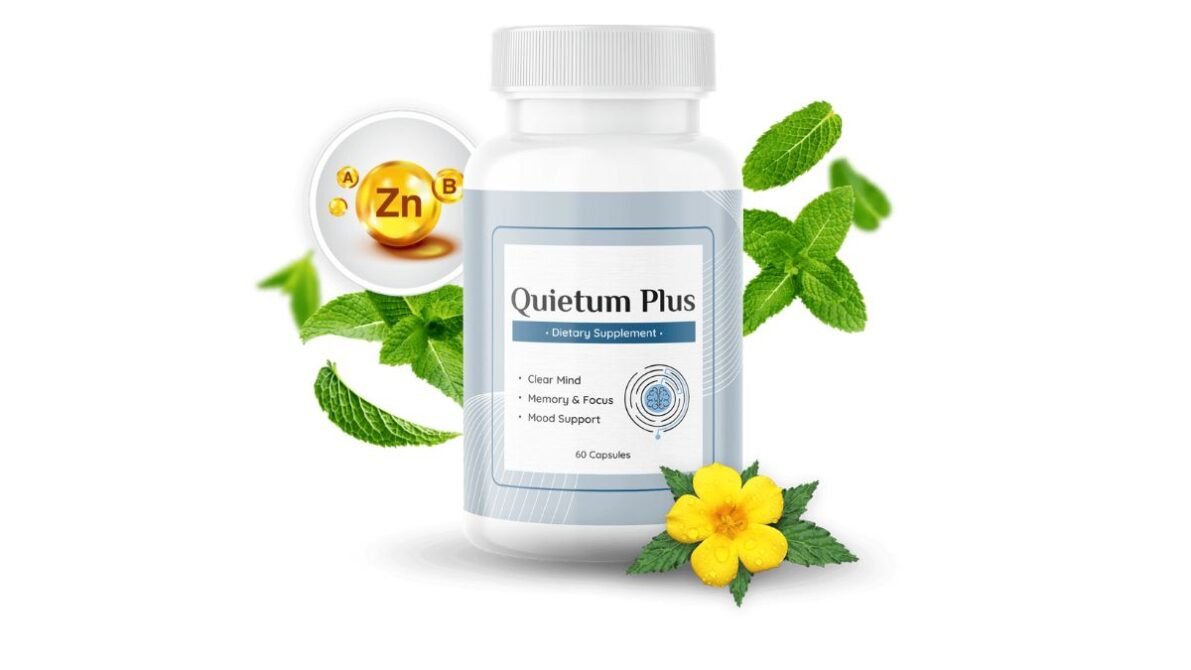
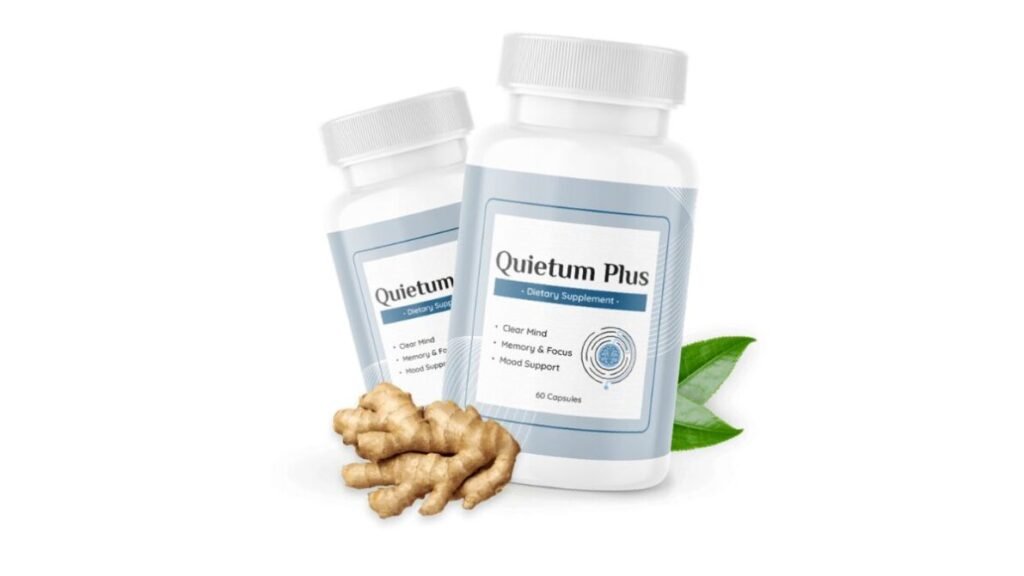
This Quietum Plus review begins where the sales page ends: at the list of what’s actually in the capsule.
Eighteen ingredients, presented in pairs. Mucuna pruriens and maca root. Epimedium and Tribulus terrestris. Dong quai. Muira puama and ginger. Catuaba and damiana. Ashwagandha and piperine. Sarsaparilla root and asparagus. Vitamin A, vitamin B and zinc. L-tyrosine and L-arginine.
Read that list without the ear-health framing around it and it reads like something else entirely. Maca, epimedium, tribulus, muira puama, catuaba, damiana and mucuna are the standing cast of the male vitality aisle. Epimedium is sold everywhere as horny goat weed. Muira puama is marketed as “potency wood.” L-arginine is the nitric-oxide precursor that built the erectile-support category. Damiana’s own botanical synonym — the one the page’s own bibliography uses, in Kumar 2008 — is Turnera aphrodisiaca.
Quietum Plus is sold for ringing ears. Seven of its botanicals, plus one of its two amino acids, come from a different catalogue.
New to this category? Our guide to hearing and vision supplements breaks down how these products actually differ, and which claims hold up.
The Quietum Plus Review Problem: 56 References, Zero Hearing Outcomes
The page carries a long bibliography, and a long bibliography is the most effective trust signal a supplement funnel has. This one has fifty-six entries. It looks like homework.
Here’s what’s in it.
Seven entries are not studies at all. They’re news and web articles: a LADbible piece headlined “Scientists make breakthrough with potential new tinnitus cure,” a Metro piece headlined “New Breakthrough Pill Could Cure tinnitus,” a BBC Ouch feature, a LiveScience explainer about the inner ear, a hearing-advocacy site page, a News-Medical article, and a 2010 Telegraph item titled “Relaxed people ‘heal twice as quickly’.”
Nine entries are human studies. Five are ashwagandha studies — four trials and one systematic review — measuring memory, anxiety, depression, sleep and general well-being. Two are maca studies: a randomised trial of tolerability and an observational study of interleukin-6 in people living at altitude. One is a ginger trial measuring cognition in middle-aged women. The ninth is a 1992 paper on parkinsonian features after eating broad beans — a plant that isn’t in the formula.
One entry is a book chapter. One is a 2005 paper in Medical Hypotheses, a journal for publishing hypotheses. The remaining thirty-eight are animal studies, cell-culture work, chemical antioxidant assays, and one computer-modelling paper on ginger compounds as potential Alzheimer’s drug leads.
Across all fifty-six, the number of human studies measuring hearing, hearing thresholds, or tinnitus severity for any ingredient here is zero. That’s checkable in about ten minutes by anyone willing to open the reference list and read the titles.
The Only Reference That Touches an Ear Is a 1998 Rat Study About an Ingredient That Isn’t in the Product
One entry does reach the cochlea. It’s worth quoting in full, because of what it is:
Zheng H, Tai H, Zeng S. The Effect of Astragalus Membranaceus and Angelica Sinensis on Grafted Cochlea Stem Cells Apoptosis in Hearing Impaired Rats. Journal of Audiology and Speech Pathology. 1998.
No volume. No page numbers. No DOI. A 1998 journal listing, a rat model, grafted stem cells — and the lead botanical, Astragalus membranaceus, is not one of the eighteen ingredients.
The whole bibliography has no reference for zinc, either. Zinc appears on the ingredient list under the claim “May assist in enhancing auditory acuity,” which is the single most hearing-specific promise on the page, and the page cites nothing at all to support it.
What the Page Says Causes Tinnitus, and What’s Actually Established
The headline reads: “Scientists Discover The Real Root Cause of Ear Ringing (Hint: Has Nothing To Do With Loud Noises Or Genetics).”
Noise exposure is the best-established modifiable cause of hearing damage and tinnitus there is. It’s why industrial hearing-conservation programs exist, why earplugs are standard at concerts and ranges, and why occupational noise limits are law in most countries. A page that opens by telling you noise has nothing to do with it is contradicting one of the few things in this field that isn’t in dispute, and it cites nothing for the claim.
The page then describes a “wire” carrying signals from ear cells to brain networks, and says the solution is “to feed, regenerate and rebuild it.” Mammalian cochlear hair cells do not regenerate — when they die, they’re gone. That’s the central fact of the field and the reason hearing loss is managed with amplification rather than repair. Regeneration research is real and active, but it lives in labs, not capsules. No oral supplement rebuilds a cochlear nerve or regrows hair cells, and nothing in those fifty-six references claims otherwise.
Zinc Has Actually Been Tested for Tinnitus, and the Result Was Nothing
Of the eighteen ingredients, zinc is the one with a genuine tinnitus literature. It exists because zinc deficiency was proposed decades ago as a contributor, and it was tested properly.
A Cochrane systematic review by Person and colleagues (2016) pooled three randomised trials with 209 adults and reached a one-sentence conclusion: “We found no evidence that the use of oral zinc supplementation improves symptoms in adults with tinnitus.” The certainty of that evidence was rated very low — meaning the trials were small and weak, not that zinc secretly works.
The clinical guideline is more direct still. The American Academy of Otolaryngology–Head and Neck Surgery Foundation’s tinnitus guideline (Tunkel et al., Otolaryngology–Head and Neck Surgery, 2014) carries a statement that clinicians should not recommend ginkgo biloba, melatonin, zinc, or other dietary supplements for treating patients with persistent, bothersome tinnitus. That is a recommendation against, graded C, from the specialty society that writes the standard of care for this condition.
So the ingredient with the most relevant research is the one the evidence sends away, and the guideline’s language doesn’t stop at zinc — it says “or other dietary supplements,” which covers this product by category.
The Best-Studied Ingredient Here Was Studied for Something Else
Ashwagandha has the most human research on this page: four trials and a systematic review, which makes it the most heavily evidenced ingredient in the formula.
They are stress, sleep and cognition studies: anxiety scores, sleep quality, memory performance, well-being in older adults, depression symptoms in people with schizophrenia. The research is reasonable for what it measures. None of it measures hearing or tinnitus.
That distinction matters more than it sounds, because tinnitus distress and anxiety are genuinely entangled — people under stress report their tinnitus as louder and more intrusive. An adaptogen that reduces anxiety could plausibly make tinnitus feel less unbearable without changing the tinnitus at all. That’s a real and legitimate thing for a product to do. It’s also not what “supports a healthy hearing” implies.
The same logic covers L-tyrosine, muira puama and catuaba, all of which have preclinical cognition and mood data here. This is a coherent nootropic-adaptogen stack, and for a product built honestly around cognition it would be a reasonable foundation — our Phytomem One review works through a formula aimed at exactly that target. The problem isn’t the ingredients. It’s the aisle they’ve been moved to.
No Doses, and Not Even a Blend Total
Dose is where a supplement review either lands or doesn’t, and this Quietum Plus review has nothing to land on.
The page calls it “a bespoke proprietary formula that includes 18 special high-quality plant extracts.” No milligram amount for any ingredient, and no total weight for the blend — which is worse than the typical proprietary blend. Normally a blend total lets you do ceiling arithmetic: the first ingredient listed holds at least the total divided by the number of ingredients, and the ingredient in position N holds at most the total divided by N. With no total, even that bound is gone. There is no number on this page to reason with.
Two specific gaps follow. “Vit. B” is not a vitamin, it’s a family — B1, B6 and B12 have different doses, functions and risk profiles, and B6 causes sensory neuropathy with high chronic intake. The page states neither which one nor how much. And zinc has an upper limit: sustained intake above the adult tolerable upper level interferes with copper absorption, so without a figure you can’t tell a trace amount from a meaningful one, or stack it safely with a multivitamin.
Also worth noting: the page calls all eighteen “plant extracts,” but vitamin A, vitamin B, zinc, L-tyrosine and L-arginine are none of those things.
None of this proves the doses are too low. Undisclosed dose proves uncertainty, not underdosing — the amounts could be generous. The point is that no reader, pharmacist or physician can check, and in a formula containing what this one contains, checking is not optional.
The Safety Problem That Hidden Doses Create
This formula contains three ingredients where an unknown amount is a genuine clinical problem, not a theoretical one.
Mucuna pruriens is a natural source of levodopa — not a compound that resembles it, the actual molecule used to treat Parkinson’s disease. Katzenschlager and colleagues, in the Journal of Neurology, Neurosurgery and Psychiatry (2004), ran a randomised double-blind crossover study in eight Parkinson’s patients comparing mucuna against 200/50 mg of levodopa/carbidopa. The 30 g mucuna dose produced a peak plasma levodopa concentration 110% higher than the drug, an area under the curve 165% larger, and a faster onset. The amount also varies by product: a conference abstract from Soumyanath and colleagues found four of six commercial mucuna formulations diverged sharply from their label claims, two containing under 10% of what was stated.
If you take carbidopa/levodopa, a dopamine agonist, an MAO inhibitor, or an antipsychotic, an undeclared quantity of levodopa in a daily capsule is a dosing variable your neurologist doesn’t know about.
Ashwagandha has a liver signal. The NIH LiverTox monograph on ashwagandha assigns it a likelihood score of B — a likely cause of clinically apparent liver injury. The pattern is usually cholestatic or mixed, onset typically falls between two and twelve weeks, most cases are mild to moderate and resolve within one to four months of stopping, and fatal liver failure has been described, mainly in people with pre-existing liver disease. LiverTox advises against use in cirrhosis or advanced chronic liver disease, and against rechallenge. Ashwagandha has also been reported to affect thyroid hormone levels in some people, and it may add to the effect of sedatives.
Piperine is an absorption enhancer, and that’s the point of it. Black pepper extract inhibits some drug-metabolising enzymes, which is exactly why formulators include it — it can raise blood levels of other compounds it’s taken with, including some prescription drugs. With no disclosed piperine dose, you can’t estimate how far it might shift a drug level.
Two more, with a lower level of certainty. Dong quai contains coumarin-type constituents, and a 1999 case report described a woman on stable warfarin whose INR more than doubled after four weeks of dong quai, returning to range after she stopped it. One case is a signal, not proof, but it is the reason pharmacists ask about it. Tribulus is murkier: the LiverTox entry on tribulus says it has not been linked convincingly to clinically apparent liver injury in people, and that isolated case reports of kidney injury exist, one of which was more likely explained by undisclosed anabolic steroid use. I include it only as one more ingredient where an undisclosed dose leaves you unable to judge.
When to See a Doctor Instead of Ordering Capsules
Some ear and hearing symptoms are time-critical, and the window closes in days to weeks.
Go the same day for sudden hearing loss in one ear. The NIDCD says to treat sudden deafness as a medical emergency: corticosteroids are the most common treatment, they work best when started early, and treatment delayed beyond two to four weeks is less likely to reverse the loss. Waiting to see whether a supplement helps can cost permanent hearing.
Get evaluated promptly for:
- Tinnitus in only one ear, especially with hearing loss on that side — unilateral findings warrant imaging to rule out a vestibular schwannoma
- Pulsatile tinnitus that beats in time with your heartbeat — this points at a vascular cause, not a cochlear one
- Vertigo with new neurological signs: double vision, slurred speech, facial weakness, limb numbness. That combination is a stroke workup, not an ear appointment
- New tinnitus after starting any medication — aminoglycosides, loop diuretics, high-dose salicylates, cisplatin and others are ototoxic, and the fix is a prescription review
And for persistent bothersome tinnitus with no red flags, the AAO-HNSF guideline’s positive recommendations are worth knowing, because they’re what the evidence actually supports: cognitive behavioural therapy is recommended with grade A evidence, the highest grade in the guideline; education and counselling are recommended; hearing-aid evaluation is recommended for patients with hearing loss; and sound therapy is listed as an option. None of those are products you order from a video.
Pricing, the Guarantee, and Who Sells It
| Package | Supply | Price on the sales page | Shipping on the sales page |
|---|---|---|---|
| 2 bottles | 60 days | $158 (from $358) | + $9.99 |
| 2 + 1 bottles | 90 days | $207 (from $537) | Free |
| 3 + 3 bottles | 180 days | $294 (from $1,074) | Free |
The sales page says shipping is free on the six-bottle package. The checkout I opened in October 2026 for that package added $15.95 in shipping and handling to the $294 price, for a total of $309.95. The same checkout lists a “normal price” of $594 for the package, not the $1,074 shown on the sales page.
The six-bottle order adds three bonus ebooks, each assigned a $109 retail price, plus “a surprise gift,” and carries the line “97% Of Customers Order 6 Bottles (Our Recommended Option).” At the 30 days per bottle the page states, that’s a six-month commitment made before you’ve taken one capsule.
The page shows “100% Satisfaction,” “based on 11,388 reviews,” and three named testimonials tagged “Verified Purchase” — one describing five years of noise that is “now all silence.” There’s no link to Trustpilot, Amazon, Google or any platform where those reviews could be read, and the page’s own footer then states that testimonials “may not reflect the typical purchaser’s experience.” The page contradicts itself there, and nothing in this article characterises what users report, because there’s no verifiable body of reviews to characterise.
The guarantee is 60 days, called “iron-clad,” with a promise to “refund every single cent.” The retailer of record is BuyGoods, a Delaware company in Wilmington, named in the footer as the contact for order support, and the checkout states the order is covered by BuyGoods’ 60-day money-back guarantee. BuyGoods also states explicitly that its role as retailer is not an endorsement of the product or any claim made for it.
No manufacturer is named. The page doesn’t state where the product is made, or that the facility is FDA-registered or GMP-certified. The copyright line reads 2026, and the page is dated “October 2026 – New Scientific Discovery.”
What I Liked
- Every ingredient is named openly, though “Vit. B” is not specific. The transparency failure is dose, not identity, which at least lets you check each one against your own medication list.
- Ashwagandha is a legitimately well-studied botanical, and four human trials and a systematic review on it are cited.
- The retailer is named with a corporate address, so there’s a traceable party for refunds.
- A 60-day guarantee on a 60-day supply means the entry package can be finished inside the refund window.
- Stimulant-free, non-GMO and gluten-free are stated.
- The reference list is real and complete enough to be audited, which is more than some funnels offer.
Things to Consider
- Seven of the eighteen ingredients, plus L-arginine, are standard male-vitality catalogue items being sold for hearing.
- Across fifty-six references, zero human studies measure hearing or tinnitus for any ingredient — and seven of those references are news articles, including two tabloid pieces headlined around a tinnitus “cure.”
- The single cochlea-related reference is a 1998 rat study with no volume, pages or DOI, about a botanical that isn’t in the product.
- Zinc, the one ingredient with real tinnitus trials, has no reference on the page, a Cochrane review found no benefit, and the specialty guideline recommends against dietary supplements for this condition as a category.
- No milligram dose for any ingredient and no blend total, so even ceiling arithmetic is impossible, and “Vit. B” isn’t specified.
- Mucuna delivers active levodopa, ashwagandha carries a LiverTox likelihood score of B, and piperine can raise drug levels — all at unknown amounts.
- The opening claim that ear ringing has nothing to do with loud noise contradicts established evidence and is uncited.
- No manufacturer, no manufacturing location, and no GMP or third-party testing statement.
- “11,388 reviews” and “97% order 6 bottles” are unverifiable, and the footer disclaims the testimonials the page displays.
- The page cites no clinical trial of the finished formula.
- The sales page says free shipping on the six-bottle package, and the checkout added $15.95.
Quietum Plus Review: The Verdict
The ingredients in this capsule are not junk. Ashwagandha has decent human data for stress and sleep. Maca has human safety and tolerability work. Ginger has a cognition trial. Mucuna is pharmacologically active enough to compete with a Parkinson’s drug in a crossover study. Taken together, this is a competently assembled adaptogen-and-vitality stack.
It is being sold for the wrong thing. The condition on the label — ringing ears — is the one condition no ingredient in the formula has been tested against in a human being, by the page’s own bibliography. The ingredient that has been tested for tinnitus is zinc, the trials found nothing, and the specialty guideline recommends against supplements for this problem by name and by category. Meanwhile the formula contains a levodopa source, a botanical with a documented liver signal, and a drug-absorption enhancer, all at amounts the company declines to publish.
If you have tinnitus, the honest ranking of what to do is not close. An audiologist and a hearing evaluation come first, and cognitive behavioural therapy carries a stronger evidence grade than anything in this bottle. If you want an adaptogen for stress and sleep, buy an ashwagandha product with the extract and the milligrams printed on the label, and show it to your pharmacist if you take prescription medication. Current pricing and the refund terms are on the official website, and the 60-day window is the only part of this offer that limits your downside.
Frequently Asked Questions
Can hearing damage from noise be reversed by anything?
Not currently. Mammals don’t regenerate cochlear hair cells, which is why hearing loss is managed with amplification rather than repair.
Birds and fish do regenerate theirs, and that difference drives an active research field — but it’s laboratory biology, not the supplement shelf. What is reversible is the hearing you haven’t lost yet, which is why hearing protection does far more over a lifetime than anything you can swallow.
I take an antidepressant. Does that change anything here?
It’s worth a pharmacist conversation first. Mucuna is a levodopa source and L-tyrosine is a catecholamine precursor, so both sit in dopamine and noradrenaline pathways. The combination that matters most is with an MAO inhibitor, where added levodopa can drive a hypertensive reaction. Ashwagandha’s sedative effect also stacks with medication that already makes you drowsy. With no dose on the label, your pharmacist can’t calculate that risk, which is itself the useful answer.
What does the 60-day guarantee actually require me to do?
The page says to write in within 60 days and promises a full refund, without stating that bottles must be unopened. Refunds and order questions go to BuyGoods, not the product site — that’s the detail people miss when they’re hunting for someone to email. The page doesn’t say who pays return shipping, so ask before you buy if that matters, and keep your order confirmation.
Is there anything for tinnitus with real evidence behind it?
Yes, and it isn’t a pill. The AAO-HNSF guideline recommends cognitive behavioural therapy at its highest evidence grade, recommends education and counselling about management strategies, recommends a hearing-aid evaluation for patients who also have hearing loss, and lists sound therapy as an option. CBT doesn’t make the sound stop; it changes how much the sound costs you, which is what people with chronic tinnitus describe as getting their life back. It’s also often covered differently than supplements are, so it’s worth asking your insurer.
These statements have not been evaluated by the Food and Drug Administration. This product is not intended to diagnose, treat, cure, or prevent any disease. This article is informational and is not medical advice. Consult a qualified healthcare professional before starting any supplement, particularly if you take prescription medication, have liver or thyroid disease, or are pregnant or nursing.

Raphael Albert is the founder and content creator of Nutra Pulse. Passionate about health, nutrition, fitness, and wellness, he spends his time researching scientific studies, health trends, and evidence-based lifestyle strategies to create informative and easy-to-understand content. While he is not a doctor or licensed healthcare professional, his goal is to help readers make more informed wellness decisions. All content is for educational purposes only and should not replace professional medical advice. Always consult a qualified healthcare provider regarding your health concerns.