
This article contains affiliate links, and a purchase made through one of them may earn this site a commission at no additional cost to you. Nothing below is medical advice, and no part of it is a substitute for a conversation with your own doctor or pharmacist.
The Ingredient Carrying the Promise Is Not the One Carrying the Evidence
This PrimeBiome review starts with a single word on the ingredient list, because that word does most of the work in the marketing and almost none of the work in the science: Babchi.
PrimeBiome is a once-daily gummy sold around what its page calls “The Skin-Gut Cell Turnover Breakthrough.” Ten ingredients are named. Skin is half the pitch. And the skin half of the formula rests on one plant, promoted everywhere online as the natural source of bakuchiol, the compound marketed as a gentler retinol.
Here’s the catch. The bakuchiol research that earned that reputation was done with cream, on faces. This is a gummy you swallow. And “Babchi” on a label is not bakuchiol — it’s Psoralea corylifolia, the whole plant, which arrives with a second family of compounds that have their own paper trail. That paper trail is about the liver.
What Babchi Actually Is, and Why the Word Choice Matters
Bakuchiol is a single isolated molecule. Babchi is the seed of the plant it comes from.
The seed also contains psoralen and isopsoralen, two furocoumarins. A 2025 review of the plant in Frontiers in Pharmacology is direct about which compounds matter for safety: it identifies psoralen and isopsoralen as the primary hepatotoxic metabolites of Psoralea corylifolia, notes that the plant’s toxic constituents are mostly fat-soluble, and flags alcohol extracts as higher risk than water extracts. Bakuchiol is not named as a hepatotoxin in that review.
So the two headline compounds in the same seed pull in opposite directions. One has a cosmetic reputation, the other has a safety file, and the label lists neither — it lists “Babchi,” which is the container for both. The page doesn’t say which part of the plant is used, whether the material is an extract or a powder, whether it is standardized to bakuchiol, or how much of it is in a gummy. On doses it says only this: “An optimally dosed proprietary blend of nourishing ingredients.” That sentence asserts the one thing a reader would want verified.
The Skin Study Everyone Cites Was Done With Cream
The trial that put bakuchiol on the map is Dhaliwal and colleagues in the British Journal of Dermatology. Forty-four adults were randomized to 0.5% bakuchiol cream or 0.5% retinol cream, applied to the face, for twelve weeks. Fine wrinkles improved 19.0% with bakuchiol and 23.2% with retinol, with no statistical difference in pigmentation, and the retinol group reported more scaling and stinging.
It’s a good small trial. It is also, start to finish, a trial of a cream.
Nothing in it tells you what happens when bakuchiol goes down your throat instead. A swallowed dose has to survive the stomach, cross the intestinal wall, clear first-pass metabolism in the liver, and then arrive in skin at a concentration that does something. The trial measured none of those steps because it didn’t need to — the cream was already sitting on the target tissue.
That’s the gap, and the honest version of it is narrow: the evidence that bakuchiol improves facial skin is topical evidence, and this is not a topical product.
The Liver Reports: What Exists, and How Much Weight to Give Them
There is a published fatality, and it deserves to be described precisely, because precision is what keeps it from being either dismissed or exaggerated.
Li and colleagues, in BMC Complementary and Alternative Medicine in 2019, reported a 53-year-old woman treated for vitiligo with Qubaibabuqi tablets, a multi-herb Chinese preparation whose principal ingredient is Fructus Psoraleae — the same plant material sold as Babchi. She took fifteen tablets three times daily for roughly seven months, developed acute liver failure, and died five days later. Causality scored 10 points, in the “probable” range, attributed to the Fructus Psoraleae component. The authors counted six prior cases of Psoralea-associated liver injury in the English literature, and no previously described case of outright failure.
Now the counterweight. That was a high-dose, multi-month, multi-herb regimen in a woman also receiving prednisone and UVB phototherapy. It is not a gummy, and seven cases worldwide is a rare-event signal. Anyone claiming this seed reliably destroys livers is overreading the data.
The reason it still matters is the undisclosed dose. A rare dose-dependent hepatic signal is manageable when you know how much you’re taking and can stop at a threshold. Here there’s no number to reason with. The exposure could be trivially small — plausibly it is, in a fruit gummy — and the point is that you can’t confirm that from anything the company publishes.
Psoralens also carry a regulatory-grade record separate from herbal case reports. The NIH LiverTox monograph on psoralens records serum ALT or AST elevations in 2% to 12% of patients treated with methoxsalen plus UV light, usually asymptomatic and self-limited, with rare clinically apparent injury, a hepatocellular pattern, and latency typically six to eight weeks. Those are pharmaceutical doses, not gummy doses — but they establish that the compound class reaches the liver and registers there.
Psoralens Are Photosensitizers — That Is Literally Their Medical Use
This part is easy to miss and simple to act on.
Psoralens are not incidentally light-sensitive. Photosensitization is the mechanism they were developed for: PUVA therapy pairs a psoralen with ultraviolet A on purpose, to treat psoriasis and vitiligo. The LiverTox entry above describes exactly that pairing.
A daily oral furocoumarin at an unstated dose, taken by adults who then go outside, is worth a sentence on the label. PrimeBiome’s page carries none — no mention of sun exposure, photosensitivity, tanning beds, or light therapy. If you burn faster than you expect on this product, that’s a reason to stop and ask a pharmacist, not a coincidence to push through. Anyone already on light therapy, a tetracycline, amiodarone, a sulfonamide, or St. John’s wort is stacking photosensitizers, and that stack should be cleared with a prescriber first.
Seven Probiotic Citations, Several Different Strains, and No Strain on the Label
The gut half rests on B. Coagulans, and here the problem isn’t route. It’s identity.
With probiotics, a species name is an address with no house number. Only an alphanumeric code links a product to published research, because effects do not transfer between strains of the same species. The page names the species and stops: no strain code, no CFU count at manufacture or at expiry.
What makes this awkward rather than merely vague is that the page’s own reference list does the opposite. It cites, by name, work on several distinct strains:
| Reference on the page | Strain actually studied | Dose in that study |
|---|---|---|
| Hun 2009, Postgraduate Medicine | GBI-30, 6086 (BC30) | dose not stated here |
| Dolin 2009, Methods Find Exp Clin Pharmacol | GBI-30, 6086 (BC30) | dose not stated here |
| Nyangale 2014, Anaerobe; Nyangale 2015, J Nutr | GBI-30, 6086 | dose not stated here (elderly volunteers) |
| Majeed 2016, Nutrition Journal | MTCC 5856 (LactoSpore) | 2 billion CFU/day, 90 days, 36 patients |
| Minamida 2015, Biosci Biotechnol Biochem | lilac-01 | with dietary fiber, constipation |
| Haldar and Gandhi 2016, Veterinary World | B37 and B9 | rat model |
Several named strains, studied in different trials, and the product declares none of them. A reader who trusts that bibliography can’t tell which of those trials, if any, describes what’s in the gummy. The honest reading: the probiotic here is unverifiable at the level the page’s own sources operate on — not that it’s absent or inert. Small aside on care, since it’s the same list: the page dates the Majeed paper to 2015, and it was published in 2016.
What the PrimeBiome Review Found in the Bibliography
Twenty-six entries look rigorous at a glance. Read them one by one and the composition shifts.
Roughly eleven are consumer blog posts, ingredient-supplier marketing pages, or wellness articles — a Healthline piece on dandelion, a page from an ingredient company about inulin in personal care, a lemon balm salve recipe, a listicle on fenugreek, a “top 10 benefits” post on fennel. One entry, an inulin study in children with obesity, is listed twice, once with authors and once without.
Of the remaining journal citations, several are not human studies of the thing being claimed: fenugreek in mice, B. coagulans B37 and B9 in rats, dandelion root constituents on human skin fibroblasts in a dish, dandelion lipase inhibition in vitro and in rodents, and five psoriasis case reports from 2004.
And the single most distinctive ingredient on the label has no reference at all. Search that list for Babchi, bakuchiol, or Psoralea corylifolia and you find nothing. The references that are genuinely strong sit in one place, probiotics and fiber, and that’s the half of the formula with the least to do with the name on the bottle.
Where the Evidence Does Travel by Mouth
Not everything here is on shaky ground, and a review that pretended otherwise would be as unreliable as the sales page.
Inulin is the most defensible ingredient in the formula: a soluble prebiotic fiber with a large human literature for bowel function and satiety, working in the gut lumen, which is exactly where a swallowed dose lands, with no absorption required. The dose is still undisclosed, and that’s the real caveat — effective inulin doses in trials run in grams, which is a lot of mass for one gummy to carry alongside nine other ingredients.
B. coagulans as a species is a reasonable choice, strain question aside. It is spore-forming, so it survives stomach acid in a way most Lactobacillus products don’t, and that property doesn’t depend on which strain you have.
Ginger, fennel, lemon balm, slippery elm, and dandelion are all traditional digestive herbs with modest, mostly supportive human evidence, taken by mouth, acting in the gut. Lion’s Mane has a growing oral cognitive literature. None of them is a problem. None of them is the reason anyone buys a product sold on skin — and that is the uncomfortable conclusion of this PrimeBiome review: the best-supported ingredients are the ones nobody is advertising.
Pricing, the Guarantee, and Who Actually Sells It
The page lists three options:
| Package | Supply | Price | Shipping |
|---|---|---|---|
| 2 bottles | 60 days | $158 (from $358) | + $9.99 |
| 2 + 1 bottles | 90 days | $207 (from $537) | Free |
| 3 + 3 bottles | 180 days | $294 (from $1,074) | Free |
The six-bottle option adds three bonus ebooks and carries the line “96% Of Customers Order 6 Bottles (Our Recommended Option)” — a claim about other buyers that no reader can check. Same for “based on 19,479 reviews,” which appears twice with no link to Trustpilot, Amazon, Google, or any platform where those reviews could be read. That’s why nothing here characterizes what users report: there’s no verifiable body of reviews to characterize.
The sales page says shipping is free on the six-bottle package. The checkout I opened in October 2026 for that package, titled “PrimeBiome – 3+3 Bottles + 3 Free Ebooks,” showed $294.00 plus $15.95 in shipping and handling, for a total of $309.95.
The guarantee is 60 days, called “iron-clad,” with the page promising a refund of “every single cent” on request. The retailer of record is BuyGoods, a Delaware company in Wilmington, named in the page’s own footer, and BuyGoods states explicitly that its role as retailer is not an endorsement of the product or its claims.
No manufacturer is named anywhere, and no facility. The checkout banner shows “Made in USA,” “FDA Registered,” “Non GMO” and “GMP Certified” badges, but none of them comes with a facility name, a certifying body, a certificate number or a third-party test result. “FDA Registered” means a facility has registered with the agency; it is not an approval of the product. The copyright line reads 2026.
What I Liked
- Ten ingredients are named openly, which is more than many funnel products do. The transparency failure is dose, not identity.
- B. coagulans is a sensible species choice for a shelf-stable gummy, because spore formers survive gastric transit.
- Inulin is a legitimately well-evidenced prebiotic working in exactly the compartment a swallowed dose reaches.
- A 60-day guarantee, administered by a named retailer with a traceable corporate address, gives a buyer real recourse.
- The gummy format solves a real adherence problem for people who won’t take capsules.
- Non-GMO, stimulant-free, one gummy a day: nothing complicated to get wrong.
Things to Consider
- The skin claim rides on topical evidence. A 0.5% cream trial does not establish what an oral dose does.
- “Babchi” is the whole plant, bringing psoralen and isopsoralen alongside bakuchiol — different compounds, different risk profiles — and psoralens are photosensitizers by design, with no sun-exposure warning on the page.
- There is a published fatality associated with high-dose, long-term Fructus Psoraleae, and no dose on this label to reason against it.
- No strain code and no CFU count for the probiotic, while the page’s own references name several different strains.
- Roughly eleven of twenty-six references are blog or marketing pages, one entry is duplicated, and nothing on that list supports Babchi, bakuchiol, or Psoralea corylifolia at all.
- No manufacturer or facility identified, “GMP Certified” and “FDA Registered” badges at checkout with no certificate or certifier behind them, no third-party testing or COA statement, and no trial on the finished formula.
- “19,479 reviews” and “96% order 6 bottles” are unverifiable from any public source.
- The sales page promises free shipping on the six-bottle package, and the checkout added $15.95 in shipping and handling.
Who Should Not Start This Without Talking to a Doctor First
- Anyone with liver disease, elevated liver enzymes, hepatitis, or fatty liver. An undisclosed dose of a plant whose principal metabolites are hepatotoxic is not a reasonable gamble when the liver already works at a disadvantage. Same for anyone on methotrexate, isoniazid, amiodarone, high-dose acetaminophen or certain antifungals, and anyone who drinks heavily.
- Anyone undergoing light therapy, or taking another photosensitizing drug — tetracyclines, sulfonamides, amiodarone, St. John’s wort. Psoralens add to that effect.
- Pregnant or nursing women. Psoralens are not established as safe in pregnancy, fenugreek has traditional uterine-stimulant use, and neither dose is disclosed.
- Anyone on warfarin, apixaban, or rivaroxaban. Ginger has mild antiplatelet activity at higher intakes.
- Anyone on insulin or an oral hypoglycemic. Fenugreek lowers blood glucose, which is additive with medication doing the same.
- Anyone with Asteraceae allergy — ragweed, chrysanthemum, marigold — since dandelion belongs to that family.
- Anyone immunosuppressed, or with a central line. Live-organism products carry a small but real bacteremia risk in that setting, whatever the strain.
- Anyone with significant FODMAP sensitivity. Inulin is a FODMAP and reliably provokes bloating in sensitive people.
When to See a Doctor Rather Than Adjust a Supplement
Stop the product and get medical attention promptly for any of these: yellowing of the skin or eyes, dark urine with pale stools, pain under the right ribs, unexplained nausea with profound fatigue, or easy bruising. Those are the presenting signs of drug-induced liver injury, and the published Psoralea cases ran on a latency of weeks to months, not days.
Also worth a same-day call: a sunburn far out of proportion to your exposure, or a blistering reaction after ordinary daylight.
And separately from this product entirely — a skin change that is new, asymmetric, growing, bleeding, or changing color is a dermatology appointment, not a supplement question. No gummy evaluates a mole.
PrimeBiome Review Verdict
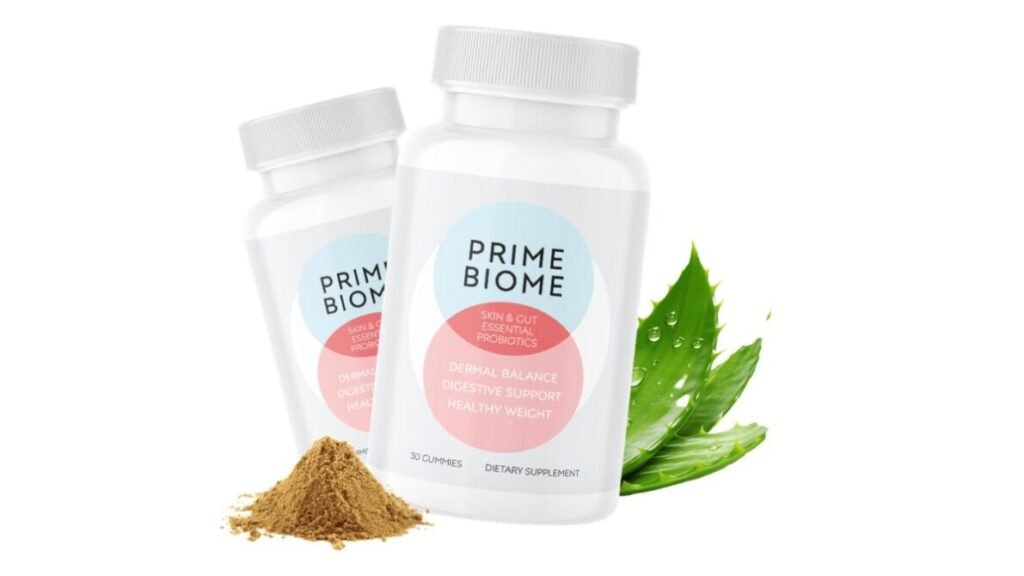
PrimeBiome is built on a real idea. The gut-skin axis is an active research area, and pairing a spore-forming probiotic with a prebiotic fiber is a coherent way to approach it. That half of the formula is defensible in principle, and inulin is among the better-evidenced ingredients in this category.
The skin half falls down on route before it ever reaches dose. Bakuchiol earned its reputation in a cream trial. Swallowing the whole plant it comes from is a different proposition, and that plant carries furocoumarins with a documented hepatic signal and a photosensitizing mechanism that happens to be their actual clinical use. A label that disclosed how much Babchi sits in a gummy would let a reader weigh all of that. This one says “optimally dosed,” which is a claim dressed as a specification.
If your interest is digestive comfort and you can live with an unverifiable probiotic strain, there are worse options, and a 60-day guarantee through a named retailer limits the downside to your time. If you bought it for your skin, the research behind bakuchiol was done with a cream, and a cream is still the delivery route that evidence supports. Current pricing and refund terms are on the PrimeBiome official website.
Two related reads if you’re evaluating this category: our Synaptigen review works through the same strain-code problem in a product that names three probiotic species, only one with a strain code, and our Sugar Defender review covers what happens when the right ingredients appear at a dose the bottle can’t physically hold.
Frequently Asked Questions
Is oral bakuchiol regulated differently from the cream version?
In the United States a bakuchiol cream is a cosmetic and an oral Babchi gummy is a dietary supplement, and neither is approved by the FDA before sale. The practical difference is that cosmetic safety is assessed for skin contact, while a swallowed botanical passes through your liver. The safety work behind topical bakuchiol was never designed to answer questions about systemic exposure.
Can I take this with a probiotic I already use?
Most likely without harm, but it defeats the point of either one. Probiotic effects are strain-specific and dose-specific, so layering an undeclared strain on top of a declared one means you can no longer attribute any result to anything. If you already take a product with a strain code and a CFU count, that’s the one you can actually evaluate.
Does the 60-day guarantee cover opened bottles, and who do I contact?
The page promises a full refund on request and does not restrict it to unopened product. Refund and order support go through BuyGoods, the retailer named in the footer, not through the product’s own site — a useful distinction when you’re trying to reach a human. Keep your order confirmation email, since that’s what the retailer will ask for.
How long would a hepatic reaction take to show up?
The LiverTox data on psoralens put typical latency at six to eight weeks. That breaks the intuition that a supplement you tolerated for a month is therefore safe. If you take this and have any reason to watch your liver, a baseline and a follow-up liver panel through your own doctor is cheap and settles the question. This PrimeBiome review would not be worth writing if the dose were on the bottle, because then you could answer that question yourself.
These statements have not been evaluated by the Food and Drug Administration. This product is not intended to diagnose, treat, cure, or prevent any disease. This article is informational and is not medical advice. Consult a qualified healthcare professional before starting any supplement, particularly if you take prescription medication or have an existing liver condition.

Raphael Albert is the founder and content creator of Nutra Pulse. Passionate about health, nutrition, fitness, and wellness, he spends his time researching scientific studies, health trends, and evidence-based lifestyle strategies to create informative and easy-to-understand content. While he is not a doctor or licensed healthcare professional, his goal is to help readers make more informed wellness decisions. All content is for educational purposes only and should not replace professional medical advice. Always consult a qualified healthcare provider regarding your health concerns.
3 thoughts on “PrimeBiome Review: Bakuchiol’s Skin Evidence Is Topical”