Standard disclosure, non-standard outcome: two links below go to the seller and earn this site a commission. This review spends a section explaining why the refund policy may not cover you, which is not what a commission usually buys.
These statements have not been evaluated by the Food and Drug Administration. This product is not intended to diagnose, treat, cure, or prevent any disease. Moringa may lower blood sugar and can interfere with thyroid medication — if you take anything for diabetes or your thyroid, talk to a pharmacist before starting, not after.
This should have been the easiest review I’ve written.
Most supplements I look at hide behind proprietary blends — twenty ingredients, no amounts, no way to check anything. Moringa Magic isn’t that. It’s one plant. Dried moringa leaves, ground into powder, put into capsules. Nothing else. That kind of simplicity is genuinely refreshing, and it ought to make evaluation straightforward: find the milligrams per capsule, compare against the trials, done.
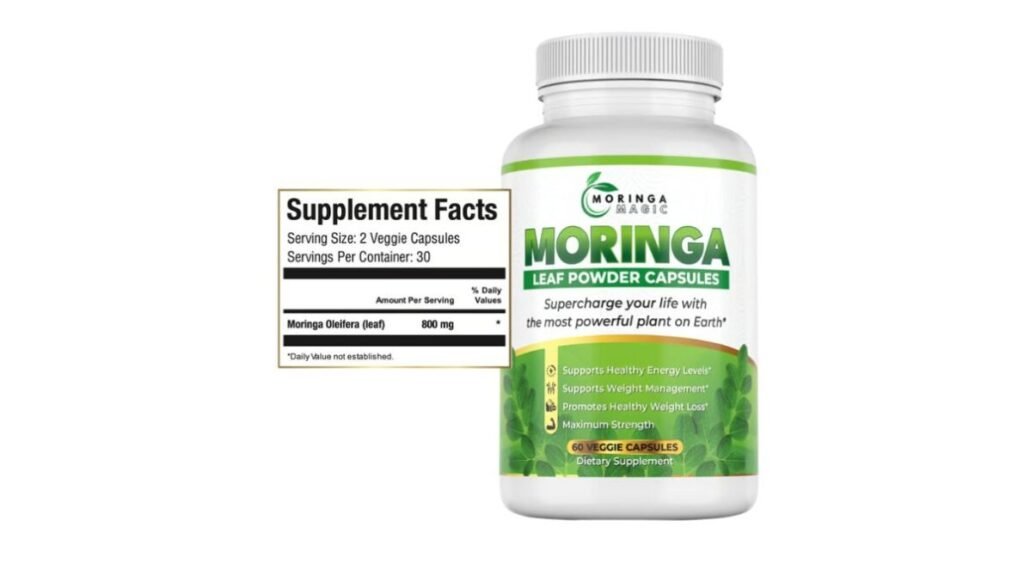
Except the page never states a dose. Not per capsule, not per serving, not anywhere. A single-ingredient product, and you still can’t find out how much of the single ingredient you’re getting.
That turns out to be the shape of this whole Moringa Magic review. Moringa is a legitimately nutritious plant with modest, real human research behind it. Almost everything wrapped around it here — the fourteen promised benefits, the reference list, the bonus books, the pricing, and particularly the refund terms — deserves a much closer look than most buyers will give it.
What Moringa Actually Is
Moringa oleifera is a fast-growing tree native to the sub-Himalayan region, widely cultivated across the tropics. The leaves are eaten as a vegetable in parts of India, the Philippines, and West Africa, and they’re genuinely nutrient-dense — vitamins A and C, B vitamins, calcium, iron, potassium, plus polyphenols and flavonoids.
None of that is marketing. Moringa is a real food with a real nutritional profile, which is more than can be said for a lot of what gets called a superfood.
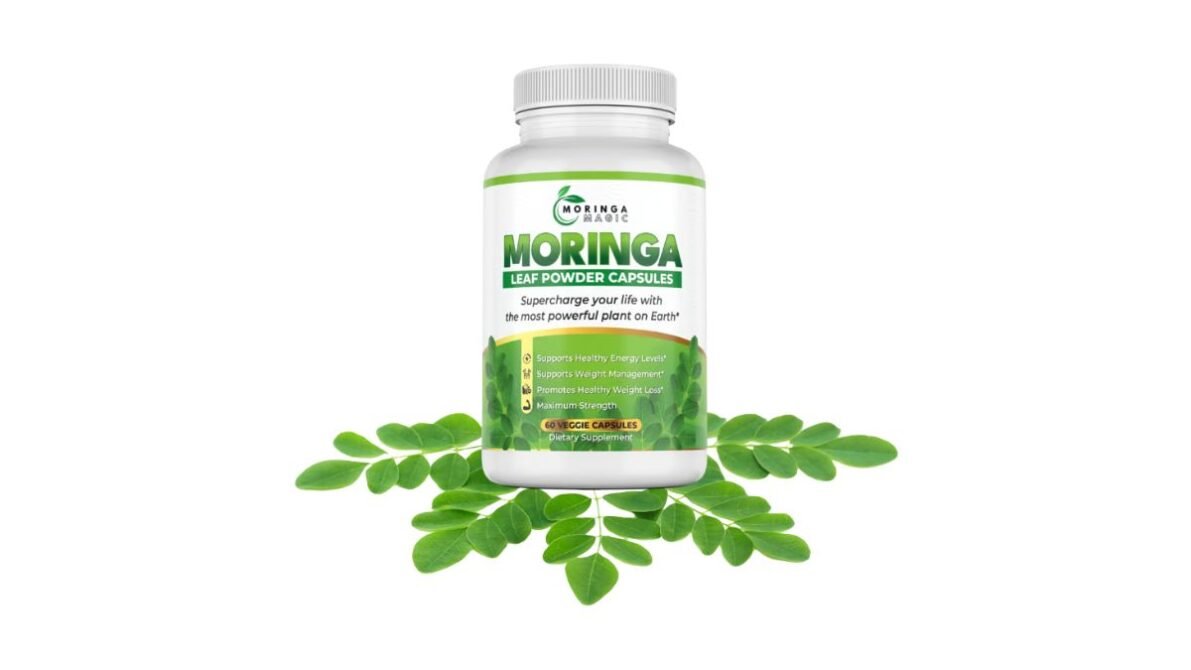
Moringa Magic packages it as capsules, sold through the Moringa Magic official website with Digistore24 processing payment. The instruction is two capsules once daily, twenty to thirty minutes before a meal. The company is Ancient Energies LLC, registered to a private mailbox address in Wilmington, Delaware.
And that’s the sum of what the page tells you about what you’re taking. No milligrams. No standardisation. No third-party testing mentioned.
What the Human Research Genuinely Supports
Let me be fair to the plant before I’m hard on the product, because moringa does have human evidence and it’s worth knowing what it actually says.
A 2026 narrative review compiled 22 human clinical trials and 8 case reports and concluded that moringa is a safe and accessible functional food with potential as an adjunct therapy, particularly for metabolic markers, inflammation, and malnutrition. The same review is candid about the limits: no standardised preparations, wildly variable dosing, and real difficulty translating laboratory findings into consistent clinical outcomes.
The strongest signal is in blood sugar. A double-blind, placebo-controlled trial in 65 adults with prediabetes found that fasting glucose and HbA1c moved in opposite directions between groups over 12 weeks — improving on moringa, drifting the wrong way on placebo. Fifty-eight percent of the moringa group improved their HbA1c versus 38% on placebo. A modest, real result in a population that was already metabolically off-track.
Now the counterweight, and it matters. A 2025 meta-analysis of randomised trials, with formal GRADE assessment, found no statistically significant reductions in fasting blood glucose or HbA1c from moringa supplementation, and rated every outcome low to very-low certainty. An earlier systematic review of animal and human studies reached similarly cautious conclusions.
So the honest summary is: promising, inconsistent, low certainty, concentrated almost entirely in glycemic markers among people with metabolic problems. Not “the most powerful plant on the planet.”
The Trial They Cite Used Three Times as Many Capsules
Here’s the detail that decides whether any of the above applies to what’s in this bottle.
That prediabetes trial — reference number seven on Moringa Magic’s own list — used six capsules per day, totalling 2,400 mg of dry leaf powder. Twelve weeks. The broader safety literature describes moringa leaf as well tolerated at roughly 2 to 6 grams daily.
Moringa Magic instructs you to take two capsules once daily.
Even assuming a generous 500 mg fill per capsule, that’s 1,000 mg — under half the trial dose. At a more typical 400 mg fill it’s 800 mg, a third. And I have to assume, because the page won’t say.
That’s the crux of it. The one ingredient in the bottle is the one thing the company could easily disclose, the disclosure would take a single line, and the number would let you check the product against the very study they cite as evidence. Its absence isn’t an oversight in a product this simple.
Fourteen Benefits, Twelve References — Matching Them Up
The page lists fourteen benefit areas: nutrient density, antioxidants, heart health, blood sugar, digestion, brain health, weight management, prostate health, liver support, immunity, anti-inflammatory effects, skin and anti-aging, bone health, and antibacterial-antifungal action.
Fourteen distinct claims from one leaf powder. So I read all twelve citations to see which ones are supported.
Two are cell-culture studies on cancer cell lines — one on liver hepatocellular carcinoma cells, one on esophageal cancer cells. Petri dishes. Nothing about liver support in a living person.
Roughly six are review articles, several of them summarising animal work.
Around four are human studies. One is the prediabetes trial. One examined quality of life in people living with HIV. One concerned milk output in breastfeeding women — a real research question, and not one relevant to a supplement marketed to middle-aged adults for energy. One looked at overweight individuals with hyperlipidemia, and it’s worth noting that the 2025 meta-analysis describes that study as reporting non-significant reductions across all lipid parameters. That’s the citation supporting “promotes healthy cholesterol levels.”
And here’s what’s missing. There is no citation for prostate health. None for brain health or neurons. None for skin, wrinkles, or acne. None for bone health. None for antifungal activity. Five of the fourteen claimed benefit areas have no supporting reference at all in the company’s own evidence file.
One more thing. The page’s opening story describes “a notable study published in the Journal of Food Science and Technology” showing significant antioxidant increases in healthy humans. That study doesn’t appear anywhere in the twelve references.
Also worth flagging: “Clean your body of the chemicals and toxins accumulated from food, medications, alcohol, and environmental exposure” is the liver support claim. Detoxification is what your liver and kidneys already do, continuously, and “detox” has no clinical definition. It’s a marketing word, not a mechanism.
The Bonus Books Have an Author Problem
Order three or six bottles and you receive two ebooks. The page names their source: Barbara O’Neill.
That name deserves context, and it comes from a regulator rather than from me.
On 24 September 2019, the New South Wales Health Care Complaints Commission issued a Permanent Prohibition Order against Barbara O’Neill, barring her from providing any health service in any capacity, paid or voluntary, anywhere in the state. The Commission’s investigation found she had breached the Code of Conduct for Unregistered Health Practitioners, that she held no recognised health qualifications, and that she was providing advice in complex areas — cancer treatment, antibiotics for Strep B, immunisation — far beyond her training.
The Commission’s stated concern was that she was misleading vulnerable people, including mothers and cancer sufferers, and that her advice discouraged mainstream cancer treatment, antibiotics, and vaccination. The specific claims documented included recommending bicarbonate of soda in place of chemotherapy, and unpasteurised goat milk for infants.
The bonus book descriptions on the sales page invite you to “discover the secrets doctors won’t tell you.” The second one promises to teach you how to lose 2.5 inches in 24 hours — a claim no dietary intervention can deliver, and one that would only ever reflect fluid loss.
I’m not suggesting the moringa in the bottle is unsafe. I am saying that a company choosing to bundle its product with material from a person subject to a permanent prohibition order — and framing it as insight doctors are hiding from you — has told you something about its editorial judgement that no ingredient list can.
The Refund Policy Contradicts the Guarantee
This is the section I’d most want you to read before clicking buy, because it’s about your money and it takes two minutes to verify.
The guarantee on the sales page is emphatic: an ironclad 60-day money-back guarantee, and if you’re “less than absolutely delighted with our product, the results, or your overall experience,” you send the product back and get a full refund, no questions asked.
Now open the Return/Refund Policy linked in the footer. It says something different.
Under that policy, if you received the wrong item, or something damaged or defective, you’re covered. But if you “no longer want the product,” the terms are explicit: you may return unopened, sealed bottles in original packaging, and return shipping is at your own cost, with no prepaid label provided.
Think about what that means in practice. To find out whether you’re delighted with the results, you have to open a bottle and take the capsules. Once you’ve done that, the bottle isn’t unopened. By the written policy, a customer who tried the product for eight weeks, felt nothing, and wants their money back does not obviously qualify — because the thing the headline guarantee invites you to test is the thing that voids the return condition.
I’d also note that the company’s own affiliate recruitment page advertises a refund rate under 1% as a selling point to marketers. A sub-1% refund rate and an unopened-bottles-only return policy are not unrelated facts.
If you buy, buy the smallest package, keep bottles sealed until you’ve decided, screenshot both the guarantee and the policy page on the day you order, and get the terms confirmed in writing by email before you send anything back.
Interactions Worth Checking First
Moringa is food, and mostly benign. There are still three conversations worth having with a pharmacist.
Thyroid medication. Moringa may reduce absorption of levothyroxine and appears to influence thyroid hormone handling. Given how common hypothyroidism is among women over 40 — squarely this product’s audience — this is the interaction most likely to matter. If you take levothyroxine, separating doses by several hours is the usual advice, and your levels are worth monitoring.
Diabetes medication. Moringa’s best-evidenced effect is lowering blood glucose. Stacked on metformin, a sulfonylurea, or insulin, that’s additive, and additive glucose lowering means hypoglycemia risk. The irony is worth naming: the one thing moringa most plausibly does is the one thing that requires supervision if you’re already medicated for it.
Blood pressure medication, for the same reason in a different system.
There’s also evidence moringa may affect CYP3A4 and P-glycoprotein, the enzyme and transporter systems that handle a large share of prescription drugs — so if you take anything with a narrow therapeutic window, mention it.
Pregnancy and breastfeeding: avoid supplemental doses. Moringa root, bark, and flowers have documented uterine-stimulating effects, and while this product uses leaf only, the safety data in pregnancy isn’t sufficient for a blanket all-clear.
And one genuine credit: moringa root and root bark contain compounds that are seriously toxic and should never be self-administered. Moringa Magic uses leaves. That’s the correct choice and worth acknowledging plainly.
What I Liked
One ingredient, honestly stated. No proprietary blend, no twenty-plant mystery mix, no exotic-sounding filler. What’s in the bottle is what the label says.
Leaf, not root. The right part of the plant, and the safe one.
Moringa is genuinely nutritious. This isn’t a fabricated mechanism or an invented deficiency. It’s a real food with real micronutrients and a real, if modest, evidence base.
The references are real papers. Poorly matched to the claims, but genuine — with authors, titles, and findable records.
One-time payment, no subscription. Clearly stated, no auto-rebill.
The safety FAQ says the right thing. It advises consulting a healthcare provider if you take medication, which — given the thyroid and glucose interactions — is exactly correct.
Things to Consider
No dose stated, for a single-ingredient product.
Two capsules daily against a trial dose of six.
Five of fourteen claimed benefits have no citation at all.
Two of the twelve references are cell-culture cancer studies, used to support human health claims.
The guarantee and the refund policy don’t match.
The bonus material is attributed to a person under a permanent prohibition order from a state health regulator.
“Lose 2.5 inches in 24 hours” is not a claim any legitimate weight intervention supports.
“Detox” has no clinical meaning.
“13,176 reviews” appears three times with no link to where a single one of them lives. As does “98% of our customers order 6 bottles.”
The Spinning Wheel and the $199 Nobody Paid
Two pieces of the page are worth naming for what they are.
A pop-up invites you to spin a wheel to unlock a discount, with the note that any coupon you win expires in 30 minutes and can be used once. It’s a WordPress plugin — you can see the plugin path in the page source — and its function is to convert hesitation into an email address and a deadline. Whatever you “win” is a discount the seller decided in advance to offer.
Then the anchor pricing. A single bottle is listed at $79, struck through from $199. The six-bottle package is $294, struck through from $1,194, with “YOU SAVE $900!” beside it. Nobody has ever paid $199 for one bottle of moringa capsules. A reference price that exists only to be crossed out isn’t a discount; it’s a framing device.
On independent reviews: there’s no reliable pool. The product is sold direct through Digistore24, so there are no verified-purchase reviews to read. There are at least two near-identical sales domains — the one this review examined and a second with the same company behind it — and their refund policy pages don’t even name the same payment processor. Treat any Moringa Magic testimonial you find as unverified.
What a Month of Moringa Actually Costs
Pricing is $79 for one bottle, $59 each for three ($177), and $49 each for six ($294). Current pricing is on the Moringa Magic site.
Here’s the comparison that matters, and I’d encourage you to run it yourself before deciding.
Moringa leaf powder is one of the least expensive botanical ingredients on the market. It’s a fast-growing tree, the leaves are harvested and dried with minimal processing, and bulk powder and capsules are widely available from ordinary supplement retailers — including products that print the milligrams per capsule on the label, which this one doesn’t. Search “moringa leaf powder capsules” at any major retailer and compare the per-month cost against $49 to $79.
I’m not going to quote a figure, because prices move and I’d rather you check than take my word. But run the search. The difference is the entire argument of this section.
Final Verdict
Moringa is a good plant. Moringa Magic is a marketing operation wrapped around it.
The evidence for moringa in humans is real but narrow and low-certainty — mostly glycemic markers, in people with metabolic problems, at 2.4 grams a day. This product asks you to take an unstated fraction of that dose, promises fourteen benefits when its own citations support perhaps three, bundles ebooks from someone permanently barred from giving health advice in New South Wales, and offers a guarantee that its own policy page appears to limit to bottles you haven’t opened.
Who this might suit: honestly, nobody at this price. If moringa appeals to you — and there are reasonable grounds for that, particularly if you’re managing prediabetes with your doctor’s knowledge — buy a product that prints the milligrams on the label, at a dose near the 2 to 4 gram range the research used, from a retailer with a return policy that covers opened bottles. That product exists and costs a fraction of this one.
If you buy this anyway: take one bottle, not six. Leave the rest sealed. Screenshot the guarantee and the refund policy the day you order.
And the unglamorous part: moringa’s nutritional profile is impressive relative to other leaves, but a varied diet with actual vegetables in it delivers the same vitamins and minerals in larger quantities for less money. If your goal is better blood sugar, the interventions with strong evidence are dietary pattern, physical activity, and weight management — and if you’re prediabetic, that’s a conversation worth having with a doctor rather than a supplement worth buying online.
If you’re comparing options in this category, our Tonic Greens review covers another superfood formula, and the same two questions apply to it: what’s the dose, and does the refund policy cover a bottle you’ve actually opened.
Frequently Asked Questions
How much moringa should I actually take?
The human trials with the clearest results used 2,400 mg of dry leaf powder daily, taken as six capsules, over 12 weeks. Broader safety literature describes moringa leaf as well tolerated in the range of roughly 2 to 6 grams a day. Moringa Magic’s two-capsule instruction almost certainly falls well below that, and since no milligram figure is published, there’s no way to confirm.
Can I take moringa with my thyroid medication?
Ask a pharmacist first. Moringa may reduce levothyroxine absorption and can influence thyroid hormone levels. It isn’t necessarily a hard no — separating doses by several hours is the usual approach — but it’s a conversation to have before starting, with thyroid labs checked afterwards.
Does the 60-day guarantee really cover me if it doesn’t work?
Read the refund policy page linked in the site’s footer before you assume so. It states that returns for “no longer wanting the product” require unopened, sealed bottles, with return shipping at your expense. Testing whether the product works requires opening a bottle. Get the terms confirmed in writing by email before you order.
Is moringa safe?
Moringa leaf, at food-like amounts, is generally well tolerated, and this product uses leaf rather than the genuinely toxic root and root bark. The cautions are about interactions rather than the plant itself: thyroid medication, diabetes medication, and blood pressure medication all warrant a check, and supplemental doses should be avoided in pregnancy and breastfeeding.

Raphael Albert is the founder and content creator of Nutra Plus. Passionate about health, nutrition, fitness, and wellness, he spends his time researching scientific studies, health trends, and evidence-based lifestyle strategies to create informative and easy-to-understand content. While he is not a doctor or licensed healthcare professional, his goal is to help readers make more informed wellness decisions. All content is for educational purposes only and should not replace professional medical advice. Always consult a qualified healthcare provider regarding your health concerns.