Housekeeping: a couple of links here go to the seller and pay this site a commission if you buy. What follows includes a section explaining why a pharmacy product might serve you better — which should tell you how much the commission influenced it.
These statements have not been evaluated by the Food and Drug Administration. This product is not intended to diagnose, treat, cure, or prevent any disease. Macular degeneration, cataracts, and glaucoma are medical conditions diagnosed by an eye care professional, and no supplement substitutes for a dilated eye exam. If your vision has changed, book the exam first.
Let me give you the conclusion first and then earn it, because you probably arrived here from an ad and you’d rather not read three thousand words to find out.
The formula is genuinely better than most of what’s sold in this category. Somebody at Science Genics read the ophthalmology literature — the AREDS2 nutrients are in there, saffron is in there, and those are the two things in eye nutrition with real trial evidence behind them. That’s more than I can say for most of the supplements I look at.
The problem is threefold. iGenics doesn’t publish a single dose. It describes the AREDS2 nutrients as “vision restoring,” which is the one thing the AREDS2 trials specifically established they don’t do. And its stated main ingredient is ginkgo — an odd headline choice for eye health, and one that carries a specific warning if you have cataract surgery on the horizon.
So this iGenics review lands somewhere unusual for this category: a decent formula, an overreaching claim, and a cheaper way to get most of the same benefit. Here’s the detail.
What AREDS2 Actually Is — and Who It’s Actually For
This matters more than anything else on the page, so let’s be precise.
The Age-Related Eye Disease Studies were run by the National Eye Institute, and they’re the gold standard in this field — thousands of participants, years of follow-up, publicly funded. The AREDS2 formula that came out of them contains vitamin C, vitamin E, zinc, copper, lutein, and zeaxanthin. Real evidence, not marketing.
Now the findings, in the NEI’s own plain language. AREDS and AREDS2 supplements reduce the risk of progression from intermediate to advanced AMD by about 25 percent. They do not prevent AMD from developing. They have no effect on cataract. And they don’t reverse vision that’s already been lost — the benefit is slowing progression, not improving sight.
There’s a second qualification that gets lost even more often. The benefit applies to a specific group: people with intermediate AMD, or advanced AMD in one eye. In participants with early AMD or no AMD at all, the formula showed no measurable benefit, because there was nothing progressing to slow down.
So when a sales page describes “vision restoring AREDS-2 ingredients” that “support clearer vision” for anyone wanting “healthier eyesight,” it’s taking the single best piece of evidence in ophthalmic nutrition and applying it to a population and an outcome the research explicitly excluded. That’s not a small stretch. It’s the whole pitch resting on a misreading.
One more detail worth knowing: the original AREDS formula contained beta-carotene, and AREDS2 replaced it precisely because beta-carotene raised lung cancer risk in current and former smokers. If you’ve ever smoked, that substitution is the reason to check any eye supplement’s label carefully — and iGenics doesn’t publish one.
What’s Inside iGenics
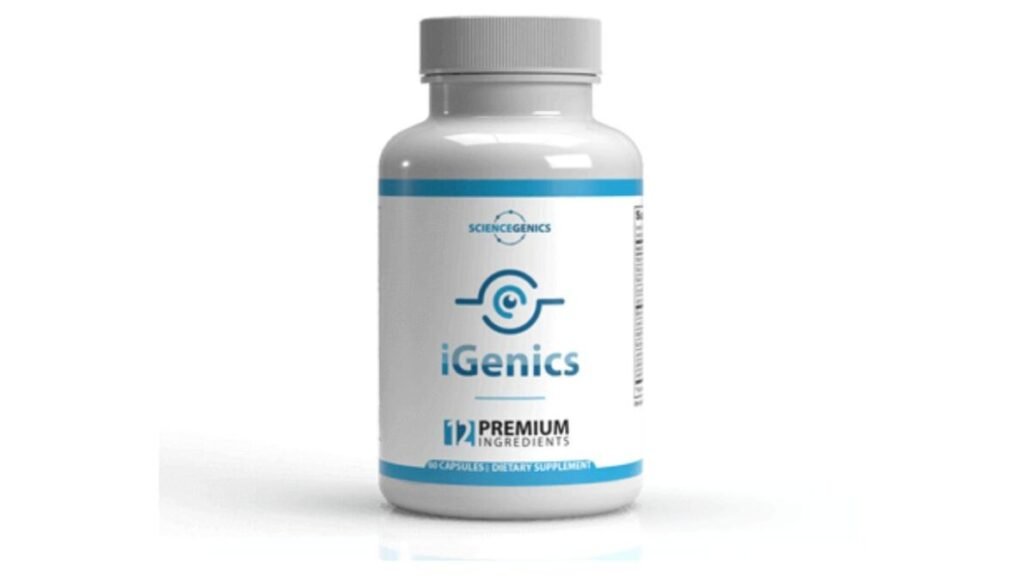
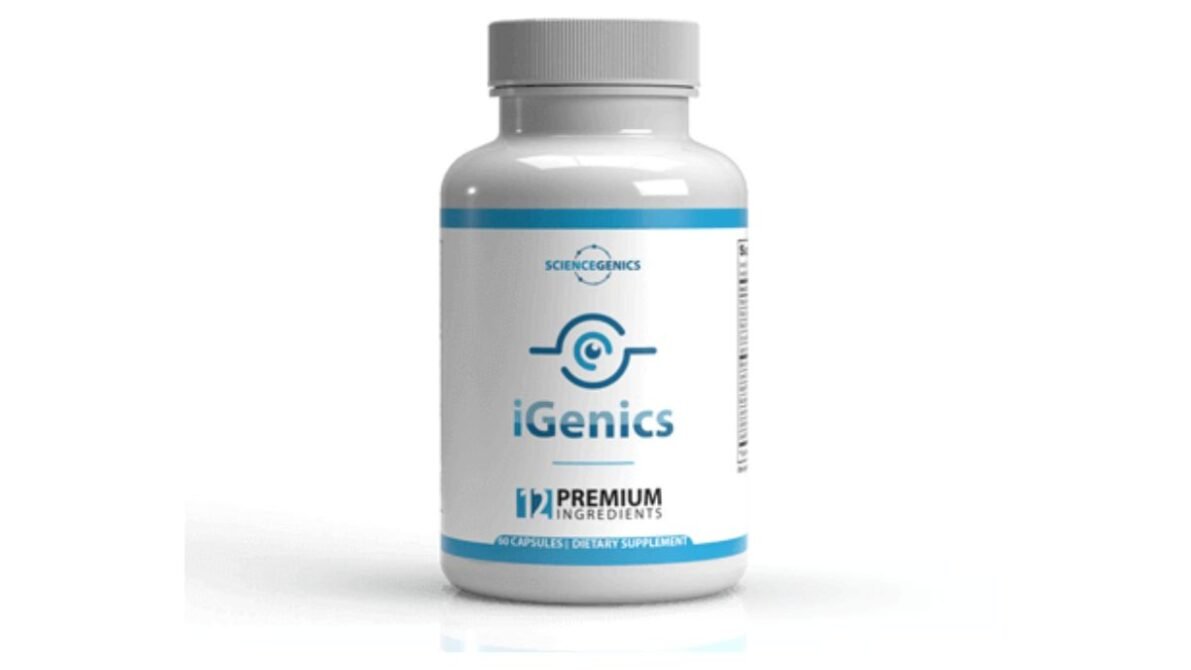
iGenics is a capsule, sold through the iGenics official website and described as containing twelve ingredients.
Only about half are actually named on the page: ginkgo biloba (identified as the main ingredient), the AREDS2 nutrients, bilberry, saffron, and turmeric with Bioperine. The remaining ingredients aren’t listed at all, which is unusual — most sellers at least name what’s in the bottle.
What’s missing entirely is a supplement facts panel. No per-ingredient amounts, no blend total, nothing. For a product whose central claim rests on a trial where the doses were the intervention, that’s a significant gap. I’ll come back to it.
What I Liked
I’m putting this before the criticisms because the formula deserves it.
The ingredient selection is genuinely evidence-led. Lutein, zeaxanthin, zinc, copper, vitamins C and E, plus saffron. If you asked an ophthalmologist which nutrients have human trial support for macular health, that’s roughly the list you’d get. Compare it to the average “vision” supplement full of eyebright and vitamin A and it’s a different class of product.
Saffron is a smart, uncommon inclusion. More on this below, but it’s the one ingredient here that a mainstream pharmacy AREDS2 product won’t give you, and it has real randomised evidence.
Third-party testing is claimed, along with GMP manufacturing. That’s stated rather than documented — no certificate of analysis is published — but stating it at least sets an expectation you can hold them to.
The company doesn’t promise the moon in writing. “Support clearer vision,” “maintain a healthy inflammatory response.” Restrained by the standards of this market, even if “vision restoring” slips through elsewhere on the page.
Vegan capsules, no fillers claimed. A minor point, but it matters to some readers and it’s easy to verify once you have the bottle.
Saffron: The Ingredient That Earns Its Place
This is the part of the formula I’d actually defend.
The largest saffron vision trial randomised 100 adults over 50 with mild to moderate AMD to 20 mg of saffron daily or placebo for three months, then crossed them over. The saffron group showed a significant, modest improvement in visual acuity — and notably, the effect appeared in participants who were already taking AREDS supplements as well as those who weren’t, suggesting the two work additively rather than redundantly.
Earlier work pointed the same way. A separate line of research found that 20 mg daily for 90 days improved macular function on focal electroretinogram measures in early AMD, with a follow-up study reporting the benefit was sustained over longer supplementation.
Not everything is positive — one six-month trial at 30 mg daily found no objective acuity change, though participants reported feeling their vision was better, which the authors suspected might reflect saffron’s known antidepressant effect rather than an ocular one. Worth knowing.
Overall, though: moderate evidence, consistent direction, from real randomised trials in the relevant population. Saffron belongs in an eye formula. The catch, as ever, is that the trials used 20 to 30 mg per day and iGenics won’t tell you what you’re getting.
Ginkgo as the “Main Ingredient” Is a Curious Choice
The page names ginkgo biloba as the primary ingredient and credits it with powerful antioxidant effects. So what does the eye research show?
A Cochrane review looked for randomised trials of ginkgo extract in people with AMD and found two, totalling 119 participants, each running six months. Both reported some positive effect on vision, but they were too small and too short to pool. Cochrane’s conclusion was that research to date has not answered whether ginkgo benefits people with AMD.
That’s not a condemnation — it’s genuine uncertainty, and further trials were called for. But “we don’t know” is a strange thing to build a formula’s identity around, particularly when the same bottle contains nutrients with thousands of participants behind them. If lutein, zeaxanthin, zinc and saffron are in there, why is ginkgo the headline?
The likeliest answer is marketing rather than science. Ginkgo is the most recognisable botanical in the supplement aisle, and consumers respond to it. Fair enough as a commercial decision. Just don’t mistake the billing for the evidence.
If You Have Eye Surgery Coming Up, Read This
Here’s the practical warning that no affiliate page covering this product will give you, and it’s the single most useful thing in this iGenics review.
Ginkgo affects platelet function, and in ophthalmology this isn’t theoretical. The literature includes a documented case of spontaneous hyphema — bleeding into the front chamber of the eye — attributed to ginkgo extract, which resolved when the supplement was stopped. It also includes a retrobulbar haemorrhage in a patient who’d had a retrobulbar injection for cataract surgery. Reviews of supplement-associated bleeding place ginkgo among the agents that should be discontinued roughly two weeks before surgery.
Now put that next to who buys eye supplements. Adults over sixty with age-related vision changes. Which is, almost exactly, the population scheduled for cataract surgery — one of the most commonly performed operations in the world.
And it isn’t only the ginkgo. Turmeric is on the same pre-surgical caution list. So is vitamin E, which is part of the AREDS2 core. iGenics contains three ingredients that ophthalmic surgical teams routinely ask patients to stop beforehand.
None of this makes the product dangerous. It makes it something you must disclose. If you have any eye procedure scheduled, tell your surgeon you’re taking this and follow their timeline for stopping — typically one to two weeks out. And if you’re on warfarin, a DOAC, clopidogrel, or daily aspirin, have the conversation with your pharmacist before you start rather than after.
The Weaker Half of the Formula
Bilberry is the one I’d quietly drop. Its reputation rests largely on a Second World War story about RAF pilots eating bilberry jam to improve night vision — a charming anecdote that placebo-controlled trials have generally failed to support. It’s a perfectly good source of anthocyanins. It isn’t a night-vision aid, and the claim persists mostly because it sells.
Turmeric with Bioperine is a sensible pairing in principle, since piperine improves curcumin absorption. But turmeric’s eye evidence is thin, and it comes with a genuine caveat: turmeric-associated liver injury is documented, rare but real, in exactly this age group. Bioperine, by improving absorption of everything alongside it, also raises the ceiling on drug interactions generally.
The six unnamed ingredients are the real issue in this section. A product marketing “12 clinically-backed ingredients” that names only half of them is asking you to take the other half on faith.
The Dose Problem
Everything above converges here.
AREDS2 wasn’t a study of nutrients. It was a study of nutrients at specific amounts: vitamin C at 500 mg, vitamin E at 400 IU, zinc at 80 mg with 2 mg of copper to offset the copper depletion high-dose zinc causes, plus lutein at 10 mg and zeaxanthin at 2 mg. Those figures are the intervention. A capsule containing the same six nutrients at a tenth of those amounts is not an AREDS2 formula in any meaningful sense — it’s a multivitamin with an AREDS2-shaped ingredient list.
Nor is more automatically better. Zinc at 80 mg daily without copper causes anaemia over time. High-dose zinc has genitourinary and gastrointestinal effects that some people don’t tolerate — which is why AREDS2 also tested a 25 mg dose and found no difference in AMD outcomes. Vitamin E at 400 IU has its own long-running safety debate.
So the amounts matter in both directions, and iGenics publishes none of them. Independent write-ups have noted the same gap. You cannot tell whether you’re taking a trial-equivalent dose, a token sprinkle, or more zinc than you should have unsupervised. That single omission undoes most of the credit the ingredient list earns.
Things to Consider
No supplement facts panel. The central flaw, and the one that makes the rest unverifiable.
“Vision restoring” is not supported. The AREDS trials established the opposite: slowed progression, not restored sight.
AREDS2 is for a specific diagnosis. If you have healthy eyes or early AMD, the evidence behind the core nutrients doesn’t apply to you.
Half the ingredients aren’t named.
Ginkgo is billed above better-evidenced nutrients.
The privacy policy is unusually permissive. The page states the company may share your name, contact details, and purchase history with third-party partners, affiliates, and other companies for marketing and targeted advertising. For a health purchase, that’s worth reading before you type your details in.
The site’s copyright notice still reads 2023. A page that hasn’t been refreshed in a while, selling a product whose pricing and guarantee terms other pages describe three different ways.
Who Should Be Cautious
- Anyone with eye surgery scheduled — disclose this and follow your surgeon’s stop-date
- Anyone on anticoagulants or antiplatelet medication, including daily aspirin
- Current or former smokers — check whether any beta-carotene is present, and you can’t, because there’s no label
- Anyone already taking a multivitamin or a pharmacy AREDS2 product — stacking unknown zinc and vitamin E doses is how people end up above safe upper limits
- Anyone pregnant or breastfeeding — high-dose vitamin A-family and zinc formulations need medical input
- Anyone with liver disease — the turmeric content warrants a conversation
- Anyone whose vision has changed recently — that’s an eye exam, urgently, not a supplement. Sudden changes, floaters, flashes, or a dark curtain in your field of view are same-day problems.
Price, Guarantee, and a Confusing Funnel
Pricing on the page I reviewed: $59 for one bottle plus $9.99 shipping, $49 each for three ($147), and $39 each for six ($234) with free shipping and bonus items including a free bottle of a second product. Current pricing is on the iGenics site.
The guarantee is where things get genuinely messy, and this is the part to take seriously.
The official page I looked at carries a 365-day guarantee badge. Affiliate pages variously describe it as 60 days, 180 days, and 365 days. Refund conditions conflict too: some say you may return even empty bottles, others say unopened bottles only with the customer paying return shipping. Independent coverage has also noted that different order pages route payment through different processors — ClickBank on one funnel, other processors on others — meaning the name on your card statement may not say iGenics.
There’s also a lookalike domain presenting itself as the official iGenics site. And the vendor’s return address in Tallmadge, Ohio is a shared third-party fulfilment centre used by many direct-response supplement brands, so it tells you nothing about who actually makes the product.
Practical advice: whichever page you land on, screenshot the guarantee terms and the total before you pay, and get the refund conditions in writing from support. With terms this inconsistent across the web, your own documentation is the only version that protects you.
As for user reviews — there’s no reliable independent pool. One page claims over 67,000 positive reviews without saying where they live. The rest of the search results are press releases distributed through newswires and republished on finance sites that explicitly disclaim verifying the content. Treat all of it as unverified.
Final Verdict
iGenics is the best-formulated product I’ve reviewed in this category, and I still can’t recommend it over the alternative.
The nutrient selection is right. Saffron is a genuinely valuable addition that pharmacy AREDS2 products don’t offer. If the label published trial-equivalent doses, this would be an easy product to endorse for the right person.
It doesn’t. And that leaves an uncomfortable comparison: a mainstream AREDS2 supplement from any pharmacy gives you the same six core nutrients at the exact amounts the National Eye Institute studied, with every figure printed on the carton, for substantially less than $39 a bottle. You could add a standalone 20 mg saffron capsule and still come out ahead on both cost and certainty.
Who iGenics may genuinely suit: someone who wants the AREDS2 nutrients plus saffron and bilberry in a single vegan capsule, who values convenience over dose transparency, who has no eye surgery coming up and takes no blood thinners, and who has already discussed AREDS-type supplementation with their eye doctor. That’s a real person. It’s just a narrower one than the ad suggests.
Who should look elsewhere: anyone with healthy eyes or early AMD who thinks this will prevent problems — the evidence doesn’t support that. Anyone with surgery scheduled. Anyone who wants to know what they’re swallowing.
If you’re weighing options in eye health, our VisiFlora review covers another formula in this space.
And the part that outperforms every capsule discussed here: get a dilated eye exam on the schedule your optometrist recommends. AMD, glaucoma, and diabetic retinopathy are all far more treatable when caught early, and no supplement finds them. That appointment does more for your sight than anything you can buy online.
Frequently Asked Questions
Will iGenics improve my eyesight?
Probably not in the way the marketing implies. The AREDS2 research it draws on established slowed progression of intermediate AMD, not improved vision — the National Eye Institute states plainly that these formulas don’t reverse vision loss. The saffron component has modest acuity evidence in people who already have mild to moderate AMD. If your eyes are healthy, there’s no measured benefit to reproduce.
Is iGenics a real AREDS2 supplement?
It contains the AREDS2 nutrients. Whether it delivers them at AREDS2 amounts is impossible to say, because no doses are published. Not every product labelled AREDS2 matches the trial formulation, and without a supplement facts panel there’s no way to check this one.
Can I take iGenics with a multivitamin?
Ask a pharmacist first. The specific risk is stacking zinc and vitamin E from two sources and exceeding safe upper limits — and you can’t calculate that without knowing what’s in the iGenics capsule
Do I need to stop it before cataract surgery?
Tell your surgeon you’re taking it and follow their instruction. Ginkgo, turmeric, and vitamin E are all commonly stopped one to two weeks before eye surgery because of bleeding risk, and this formula contains all three.

Raphael Albert is the founder and content creator of Nutra Plus. Passionate about health, nutrition, fitness, and wellness, he spends his time researching scientific studies, health trends, and evidence-based lifestyle strategies to create informative and easy-to-understand content. While he is not a doctor or licensed healthcare professional, his goal is to help readers make more informed wellness decisions. All content is for educational purposes only and should not replace professional medical advice. Always consult a qualified healthcare provider regarding your health concerns.
2 thoughts on “iGenics Review: A Better-Built Eye Formula With One Claim It Can’t Support”