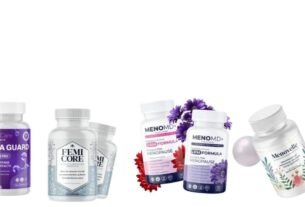
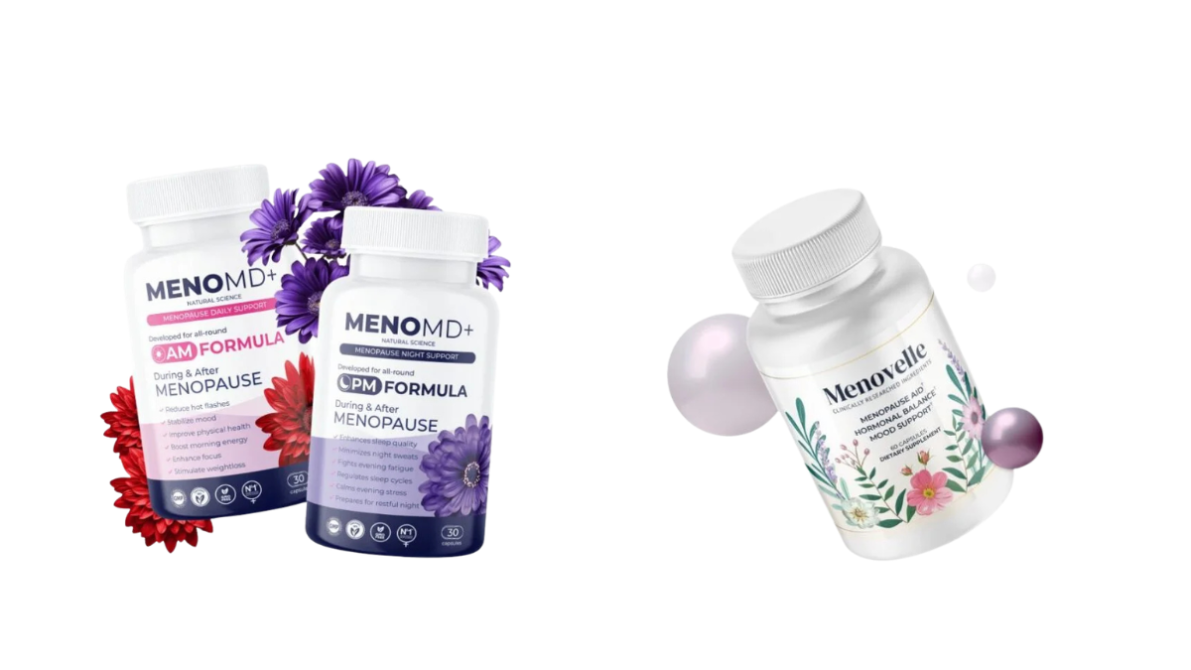
On incentives: this article contains one affiliate link, to Menovelle. There is no link to MenoMD+, and the reason is part of what this comparison is about.
These statements have not been evaluated by the Food and Drug Administration. These products are not intended to diagnose, treat, cure, or prevent any disease. If you take tamoxifen or an aromatase inhibitor, or have any liver condition, read the black cohosh section before you read anything else on this page.
MenoMD+ vs Menovelle produces a result that inverts what you’d expect from a product comparison.
One of these contains a shortlist of botanicals a menopause specialist would recognise — black cohosh, wild yam, ashwagandha, dong quai. Ingredients with centuries of traditional use and real research literature. Sensible-looking, at a glance.
The other is built on a mechanism that runs backwards, includes seven ingredients with no supporting citation, and cites two papers about NASA studying fungi.
And the first one is the more dangerous purchase.
That’s not a paradox. It’s what happens when you separate two questions people usually collapse into one: are the ingredients real? and is this product safe to buy? Real ingredients have real pharmacology, and real pharmacology has real interactions. Ingredients that do nothing are, by definition, unlikely to hurt you.
Here’s how the two actually compare.
What Each One Is
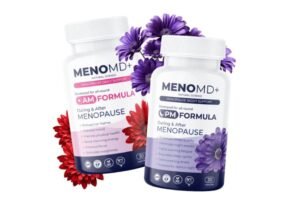
MenoMD+ is an AM/PM capsule system — one in the morning for energy and mood, one before bed for sleep and night-time symptoms. Its named components include black cohosh, wild yam, dong quai, ashwagandha, valerian, rhodiola, panax ginseng, and vitamins D3 and B12. It carries a 30-day money-back guarantee.
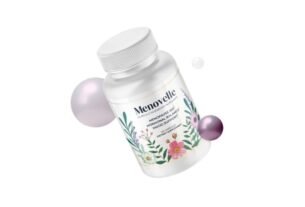
Menovelle is a single daily capsule containing a proprietary blend of ten mushrooms: cordyceps, reishi, shiitake, lion’s mane, maitake, turkey tail, chaga, royal sun agaricus, white button and black fungus. It’s sold with BuyGoods as retailer of record and a 60-day guarantee.
MenoMD+’s Approach: Conventional Menopause Botanicals
This is the traditional route, and the ingredient selection isn’t random.
Black cohosh is the most-used herbal product for menopausal symptoms worldwide. Wild yam appears in countless “natural progesterone” products. Dong quai has a long history in Chinese medicine for women’s health. Ashwagandha and valerian have genuine evidence for stress and sleep respectively.
Somebody assembled this list from real material. That’s the starting point — and also the source of the problem, as the safety sections below show.
Menovelle’s Approach: Ten Mushrooms
A completely different bet, and a harder one to defend.
The stated mechanism is that menopausal symptoms come from “estrogen-eating fat cells” trapping the hormone, and that the formula supports something called the “estro-gene.”
Our Menovelle review works through why both halves of that don’t hold up. The short version is in sections nine through eleven below.
Where MenoMD+ vs Menovelle Actually Separates
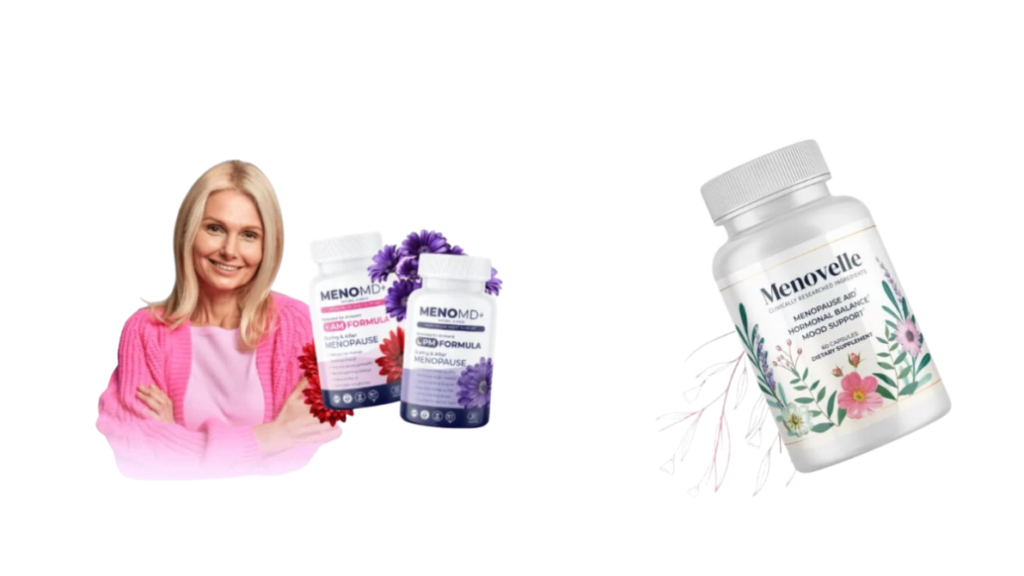
Four dimensions, and they don’t all point the same way — which is what makes this comparison worth doing.
Ingredient plausibility. MenoMD+ ahead, clearly.
Safety profile. Menovelle ahead, and by a wide margin.
Transparency. Menovelle ahead — it publishes a label image; MenoMD+ publishes no Supplement Facts panel on any version we could find.
Commercial structure. Menovelle ahead — an established retailer of record and double the guarantee window.
Here’s how that lays out:
| MenoMD+ | Menovelle | |
|---|---|---|
| Ingredient plausibility | ✅ Recognisable botanicals | ❌ Premise runs backwards |
| Label published | ❌ No panel found | ✅ Image published |
| Retailer of record | ⚠️ Unclear | ✅ Established platform |
| Guarantee | 30 days | 60 days |
| Serious interaction risk | 🔴 Yes — see below | 🟢 Minimal |
| Positioned against medical care | 🔴 Yes | ⚠️ Appearance framing |
Black Cohosh: The Most Serious Finding on Either Page
This is the section that decides the comparison.
The NIH’s LiverTox database states that products labelled as black cohosh have been implicated in many instances of clinically apparent acute liver injury, some severe enough to lead to emergency liver transplantation or death. More than fifty case reports have been published, with onset typically between two and twelve weeks after starting. The US Pharmacopeia has recommended that these products carry a hepatotoxicity warning.
Proportion matters, and I want to be fair. These events are uncommon relative to how widely black cohosh is used, and causality has been debated — some cases may involve misidentified plant material. Trials at standard doses report adverse events in a small minority.
But the efficacy side doesn’t offset the risk. The Menopause Society doesn’t recommend black cohosh, citing low-quality evidence, and several randomised trials found no benefit for menopausal symptoms.
Uncertain benefit, uncommon but genuinely serious risk, and — in this product — an undisclosed amount.
Menovelle contains nothing comparable.
The Tamoxifen Problem
The interaction that makes the above urgent rather than theoretical.
Black cohosh may reduce the effectiveness of tamoxifen.
Read that in context. Tamoxifen is prescribed after certain breast cancers, and one of its most common side effects is severe hot flashes. Women on tamoxifen are therefore among the most motivated buyers of non-hormonal menopause supplements — they have intense symptoms and, usually, a firm reason not to take hormone therapy.
So a woman takes tamoxifen to reduce her chance of recurrence, buys a supplement to cope with the hot flashes tamoxifen causes, and the supplement may work against the drug keeping her well.
If you take tamoxifen or an aromatase inhibitor, do not start either product without your oncology team’s sign-off — and this applies with particular force to MenoMD+.
Wild Yam and the Progesterone That Isn’t
MenoMD+’s PM formula contains wild yam, and the belief around it is worth correcting because it’s so widespread.
Wild yam contains diosgenin, a steroid precursor. In a laboratory, chemists genuinely can convert diosgenin into progesterone — that’s historically how some steroid hormones were manufactured. An enormous consumer market grew from the idea that taking wild yam gives your body progesterone.
There is no biochemical pathway for that conversion in the human body. Your body is not a chemistry lab; the reaction that works in a flask doesn’t happen in your liver.
Wild yam isn’t harmful. It’s inert for the purpose most people buy it for.
Menovelle’s Mechanism Runs Backwards
Now the other side, and its problem is different in kind.
Before menopause, your ovaries make most of your oestrogen. After menopause they largely stop — and the body shifts production to peripheral tissues using an enzyme called aromatase, which converts adrenal androgens into oestrone.
Where is most of that aromatase activity? In fat.
Adipose tissue is abundant enough that even its low aromatase levels make it the chief source of oestrogen in the postmenopausal woman, which is why postmenopausal oestrogen levels often correlate with body fat.
So fat cells aren’t a prison holding your oestrogen. After menopause they’re the factory.
There’s also no gene called the “estro-gene.” The real genes in this space are ESR1 and ESR2, which code for the oestrogen receptors, and CYP19A1, which codes for aromatase.
The Paper on Their Own Reference List
The detail that makes this more than a technicality.
Menovelle’s references page includes a 2021 paper in the Journal of Steroid Biochemistry and Molecular Biology on adipose tissue oestrogen production and metabolism — a study about fat tissue making oestrogen, measured by mass spectrometry.
That’s the accurate description of the process, on the seller’s own list, pointing the opposite direction from the sales copy.
The Mushroom That Points the Other Way
And one more, which is the most interesting finding in either product.
Of Menovelle’s ten mushrooms, one has well-documented activity on oestrogen — the humblest of them. White button mushroom, Agaricus bisporus, the ordinary supermarket variety.
Research published in Cancer Research describes white button mushrooms as a potential breast cancer chemopreventive agent because they suppress aromatase activity and oestrogen biosynthesis. Earlier work in the Journal of Nutrition found Agaricus bisporus the most potent aromatase inhibitor among the vegetables screened.
Aromatase is the enzyme that makes your oestrogen after menopause. This mushroom inhibits it — in a product sold on the promise of freeing up your oestrogen.
Why That Probably Doesn’t Matter
And here’s the counterweight, which matters as much as the finding.
The clinical work on white button mushroom used substantial quantities — a dose-finding trial in postmenopausal breast cancer survivors gave 5 to 13 grams of extract daily. A single capsule shared among ten mushrooms cannot deliver anything close to that.
So the realistic reading is not that Menovelle will lower your oestrogen. It’s that the amount is almost certainly too small to do anything in either direction — which leaves the formula inert rather than harmful.
That is, in a strange way, Menovelle’s strongest safety credential. And it’s exactly why this comparison inverts.
Transparency: A Label Image Versus No Panel
Menovelle publishes a supplement facts image on its references page. You can look at what’s in the capsule.
We could not find a Supplement Facts panel with amounts on any MenoMD+ version. The formula components are described in marketing copy rather than published as a label.
Our MenoMD+ review documents the search across the brand’s several web addresses.
The Soy Contradiction
Which leads to MenoMD+’s second transparency problem, and it’s checkable in a couple of minutes.
One brand page states plainly that the formula contains no hormones, no soy, and no artificial fillers. A separate listing for the AM formula describes the hormonal-balance component as coming from dong quai and soy isoflavone.
Those can’t both be true of the same capsule.
It matters in three ways. Soy is a major allergen — a woman avoiding it for allergy reasons is being told opposite things on two pages. Soy isoflavones are phytoestrogens, which makes “no hormones” technically accurate and practically misleading. And for a woman with a history of oestrogen-sensitive cancer, phytoestrogen content is the first thing her oncologist would want to know.
Reference Lists: Tampons and NASA
Both products have reference lists worth examining, and both have the same category of problem.
Menovelle’s 31 entries include seven about tampons and menstrual products — heavy metals, endocrine disruptors, an FDA investigation — and two about NASA studying fungi for space materials. Neither topic concerns any ingredient in the capsule. Seven of its ten mushrooms have no citation at all.
We’ve documented the same tampon-contamination material in another women’s health product’s reference list. It’s a fear narrative filed under scientific references.
The check that applies to both: do the citations name the ingredients in the bottle?
Guarantees and Retailer of Record
Menovelle: 60 days, with BuyGoods as retailer of record — meaning refunds run through an established payment platform rather than the seller’s own desk.
MenoMD+: 30 days, the shortest window in this category, alongside brand pages describing continued use throughout perimenopause and into postmenopause. That’s a multi-year framing wrapped around a one-month refund.
Advantage: Menovelle, on both.
What the Professional Body Says About Both
Neither product escapes this, and it’s worth stating once for the category.
The Menopause Society’s 2023 position statement on non-hormonal treatments places supplements and herbal remedies in the not-recommended column for vasomotor symptoms, naming soy foods, soy extracts and equol specifically.
What it does recommend, at the strongest evidence level: cognitive behavioural therapy, clinical hypnosis, certain antidepressants, gabapentin, and fezolinetant.
The same body describes hormone therapy as the most effective treatment for vasomotor symptoms — and notes that it prevents bone loss and fracture.
Why One of These Has No Affiliate Link
You’ll notice this article links to Menovelle and not to MenoMD+. That’s deliberate, and explaining it is part of the comparison.
This site earns a commission when readers buy through our links. We published the MenoMD+ review with no purchase link because of one thing: the product positions itself as meeting a woman’s needs “without the need for HRT.”
Hormone therapy is the most effective treatment for vasomotor symptoms, and it protects bone. A woman who buys capsules instead of booking an appointment doesn’t only forgo symptom relief — she forgoes years of bone protection during the window when loss is fastest. That cost doesn’t appear in a refund request. It appears a decade later, in a fracture.
Add the black cohosh interaction with tamoxifen, and it isn’t a click we’re willing to earn from.
Menovelle kept its link because the realistic worst case there is money spent on something inert, which is a different order of harm — and the review says so plainly before the link appears.
Which Case Is Stronger, and For Whom
Neither is recommended for treating menopausal symptoms, and the professional consensus is the reason.
Menovelle is the safer purchase, for reasons that don’t flatter it: its ingredients are unlikely to do much of anything. Culinary mushrooms are food. There’s no hepatotoxicity signal, no tamoxifen interaction, no phytoestrogen ambiguity. It has a real retailer, double the guarantee, and a published label. If you’re going to buy one of these, this is the one that can’t hurt you.
MenoMD+ has the more plausible ingredient list and the more serious problems. Black cohosh carries a documented liver injury file and may interfere with tamoxifen. The soy question is unresolved between the brand’s own pages. And the positioning against hormone therapy is the most consequential framing on either product.
Who should avoid both: anyone with a history of breast or endometrial cancer, anyone taking tamoxifen or an aromatase inhibitor, anyone with liver disease, and anyone pregnant or breastfeeding.
What we’d suggest instead. Book a menopause consultation. Hormone therapy remains the most effective option and protects bone — whether you’re a candidate depends on your history, and that’s a conversation. If you’re not a candidate or don’t want it, the non-hormonal options the Menopause Society does recommend are real and available on prescription or referral.
Where That Leaves You
The useful thing here isn’t which product wins. It’s the inversion.
Real ingredients mean real pharmacology, and real pharmacology means real interactions. A formula built from recognisable botanicals looks more credible and carries more risk. A formula built from culinary mushrooms at trivial doses looks less credible and carries almost none.
That’s the question worth asking of any supplement: if this actually does something, what else does it do? And if the honest answer is “probably nothing,” what am I paying for?
For the full analysis of each, see our MenoMD+ review and our Menovelle review. Both sit inside our guide to women’s health supplements, which sets out the four checks that sort this category.
Frequently Asked Questions
Which is safer, MenoMD+ or Menovelle?
Menovelle, and for an unflattering reason — its ingredients are unlikely to do much. Culinary mushrooms are food, and the amounts are far below anything studied. MenoMD+ contains black cohosh, which has a documented association with serious liver injury and may reduce tamoxifen’s effectiveness. If safety is your deciding factor, that’s the difference.
Is black cohosh dangerous?
For most women at standard doses, adverse effects are uncommon. But it has been implicated in cases of acute liver injury, some requiring transplantation, and the US Pharmacopeia has recommended a hepatotoxicity warning on labels.
The Menopause Society doesn’t recommend it, citing low-quality efficacy evidence. If you have liver disease, take liver-affecting medication, or take tamoxifen, this needs medical input first.
Do fat cells trap oestrogen after menopause?
The opposite is closer to true. Once the ovaries largely stop producing oestrogen, the enzyme aromatase in fat tissue converts adrenal androgens into oestrone — making adipose tissue the chief source of oestrogen in postmenopausal women. That’s why postmenopausal oestrogen levels tend to correlate with body fat, and it’s the reverse of what Menovelle’s marketing describes.
Should I take either instead of hormone therapy?
That’s a decision for you and a doctor, not a website — but the framing matters. The Menopause Society describes hormone therapy as the most effective treatment for vasomotor symptoms, and notes it prevents bone loss and fracture.
It also places supplements and herbal remedies in the not-recommended column for those same symptoms. A product positioned as making that conversation unnecessary is making a significant decision on your behalf.

Raphael Albert is the founder and content creator of Nutra Pulse. Passionate about health, nutrition, fitness, and wellness, he spends his time researching scientific studies, health trends, and evidence-based lifestyle strategies to create informative and easy-to-understand content. While he is not a doctor or licensed healthcare professional, his goal is to help readers make more informed wellness decisions. All content is for educational purposes only and should not replace professional medical advice. Always consult a qualified healthcare provider regarding your health concerns.