On incentives: two links below go to the seller and pay this site a commission. This is the most transparent product I’ve reviewed, and the review still concludes the per-mushroom doses fall short of the research — so you can judge what the commission bought.
These statements have not been evaluated by the Food and Drug Administration. This product is not intended to diagnose, treat, cure, or prevent any disease. Persistent fatigue or brain fog that doesn’t improve with rest deserves a proper look — thyroid problems, anaemia, sleep apnoea and depression all present that way, and all are treatable. That’s a doctor’s appointment, not a coffee decision.
I’ve reviewed a lot of supplements, and the routine is always the same. Find the ingredient list. Hunt for the doses. Usually fail, because they’re hidden inside a “proprietary blend,” or published as an image you can’t copy, or simply absent.
Bryt’s website has a link that says READ THE LABEL.
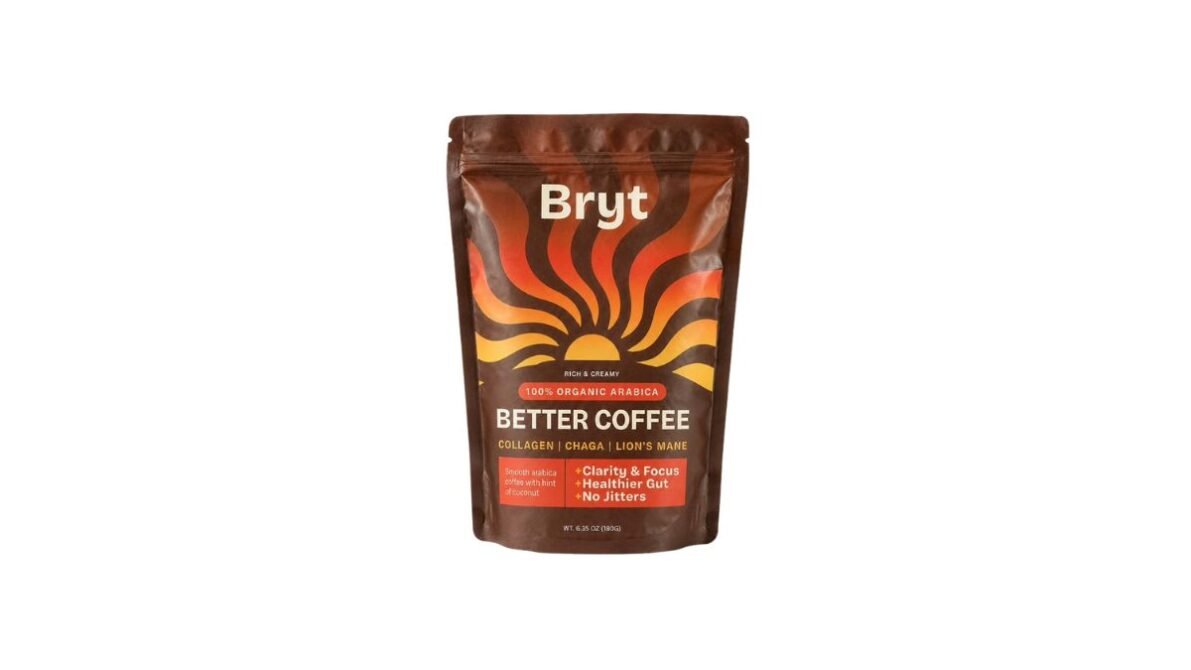
Click it and you get what’s in the tin: hydrolysed collagen, organic instant Arabica coffee powder, and a named list of organic mushrooms. Alongside it, three numbers stated plainly — 48 mg of caffeine, 2,500 mg of mushroom blend, 3,600 mg of collagen — plus a specification most brands avoid: the mushrooms are fruiting bodies, not mycelium.
After thirty-seven products where the doses were the thing I couldn’t get, a brand that invites you to check is worth noting before anything else.
That doesn’t mean it works. This Bryt coffee review spends most of its length on where the numbers fall short of the research. But the numbers exist, which means the conversation can be about evidence rather than about what’s being withheld — and that’s a different kind of review.
What Bryt Actually Is — and What It Isn’t
Bryt is instant coffee. Not a capsule, not a nootropic, not a memory supplement. You add a scoop to hot water and drink it, once or twice a day.
It’s sold through the seller’s site, and it’s positioned as a replacement for your existing coffee rather than an addition to your supplement shelf.
That framing matters more than it might seem, because it sets the comparison. If you evaluate Bryt against a clinical nootropic, it fails — the mushroom doses aren’t close to trial levels. If you evaluate it against the cup of coffee you’re already drinking, the question becomes different and more interesting: is this a better version of a thing you do anyway?
The named ingredients are hydrolysed collagen, organic instant Arabica, and a mushroom blend listing Agaricus, chaga, king trumpet, lion’s mane, maitake, reishi, shiitake, turkey tail and willow bracket. It contains tree nuts (coconut), which is disclosed. It’s gluten-free, soy-free, dairy-free and sugar-free — and not vegan, since the collagen is animal-derived.
One small inconsistency worth flagging: the marketing describes ten functional mushrooms, and the ingredient list I found names nine. Some affiliate pages also mention cordyceps, which doesn’t appear on the brand’s own list. If the tenth matters to you, ask before ordering.
The Caffeine Number Is the Honest Part
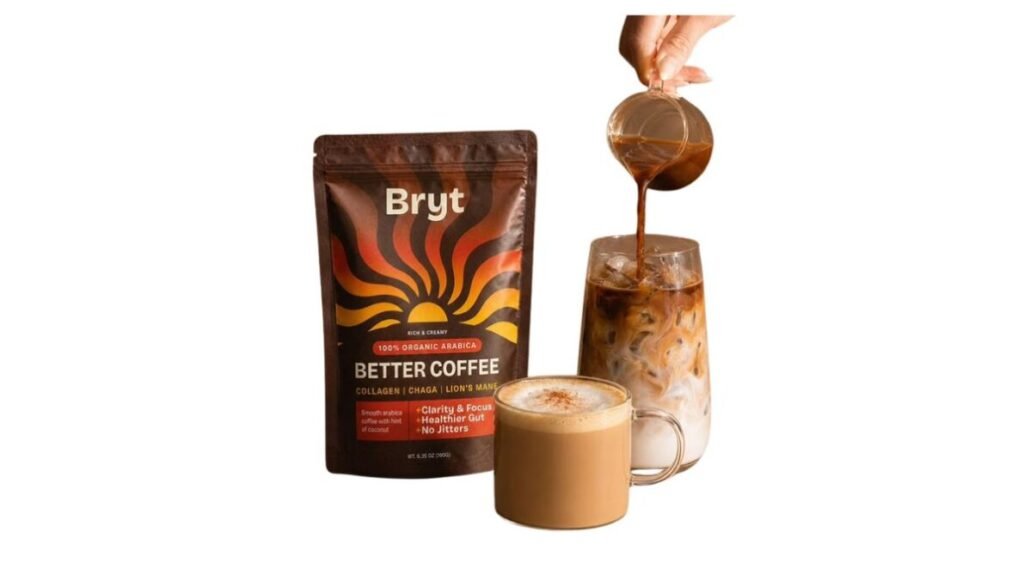
Forty-eight milligrams per serving, stated on the label.
That’s roughly half a standard cup of brewed coffee, and about the same as a cup of tea. The brand doesn’t hide it or bury it — it’s the headline feature, framed as the reason you get “energy without the jitters.”
I want to give this specific credit, because caffeine content is exactly the kind of thing this market usually obscures. Products sold on “clean energy” frequently contain more caffeine than coffee and don’t say so; others contain almost none and imply the effect comes from something exotic. Bryt tells you, and the number is consistent with the claim.
Two honest observations follow.
The reduced-jitter claim is plausible for a simple reason. Less caffeine means less caffeine. If you currently drink strong coffee and switch to something with half the dose, you’ll likely feel steadier — not because of adaptogenic synergy, but because you’ve halved your stimulant intake. That’s a real benefit, achieved by the least exotic mechanism available.
And if you’re caffeine-dependent, expect an adjustment. Halving your intake abruptly can produce headache and fatigue for a few days. That’s withdrawal, not the product failing.
2,500 mg Across Nine or Ten Mushrooms
Here’s where the transparency becomes double-edged, and it’s the central finding.
Twenty-five hundred milligrams sounds substantial, and as a total it’s a real dose. Divided across nine mushrooms, it averages about 278 mg each — and the blend almost certainly isn’t split evenly.
Now compare that to the research on the individual mushrooms.
Lion’s mane, the one with the most cited cognitive data, was studied at 3,000 mg daily for 16 weeks in a small trial of adults with mild cognitive impairment, which found improvement on a cognitive scale that faded after supplementation stopped. That’s roughly ten times what a proportional share of this blend would deliver.
Reishi, turkey tail, maitake and chaga all have research programmes, mostly in immune and metabolic contexts, and the doses used are typically measured in grams rather than hundreds of milligrams.
So the honest position: the total is real and disclosed, the individual amounts are well below what any single-mushroom trial used, and no research exists on this specific nine-mushroom combination at these proportions.
One ingredient worth a specific note. Agaricus is ambiguous — it could be Agaricus blazei, common in functional blends, or Agaricus bisporus, the ordinary white button mushroom. That distinction matters because white button mushroom is a documented aromatase inhibitor, studied specifically because it suppresses oestrogen biosynthesis. At the amounts in a shared blend that’s almost certainly immaterial, but if you take an aromatase inhibitor or have a history of oestrogen-sensitive cancer, it’s worth asking which species is used.
Fruiting Bodies, Not Mycelium — and Why That Matters
This is the most useful thing in the article, and it’s a check you can apply to any mushroom product you ever buy.
Functional mushrooms are sold in two very different forms.
Fruiting body is the mushroom itself — the cap and stem, the part you’d recognise. It contains the beta-glucans and other compounds the research is built on.
Mycelium on grain is the root-like network grown on a grain substrate, typically rice or oats, and sold with the substrate included. The finished powder can be largely starch. Analyses of commercial mushroom products have repeatedly found high starch content and low beta-glucan content in mycelium-based products, and the labelling often doesn’t make the distinction obvious.
Bryt specifies fruiting bodies. That’s a meaningful quality decision that costs the manufacturer more, and it’s the single most informative word on a mushroom supplement label.
If you take nothing else from this review: when comparing mushroom products, find the words “fruiting body.” If a product doesn’t say, assume mycelium on grain and price it accordingly.
The Collagen Dose Is Genuinely in Range
Something unusual for this series: a dose that actually matches the research.
Bryt contains 3,600 mg of hydrolysed collagen peptides. Clinical trials on collagen for skin elasticity and joint comfort typically use somewhere between 2.5 and 10 grams daily, with much of the skin research clustering around 2.5 to 5 grams.
Three point six grams sits inside that range.
I want to be measured about what that means. The collagen evidence base is real but modest — meta-analyses generally find small improvements in skin hydration and elasticity, with joint outcomes less consistent, and much of the research is industry-funded. Collagen is also digested into amino acids like any other protein, so the mechanism by which specific peptides survive to act at target tissue is still debated.
But “the dose matches what was studied” is a sentence I’ve written perhaps three times in thirty-eight reviews. It deserves acknowledgement.
Practical notes: the collagen is bovine, so this isn’t vegan, and 3.6 g of protein is nutritionally trivial — it’s there for the peptides, not the protein.
What I Liked
The label is published and the brand links to it. After thirty-seven products, this is the differentiator, and it’s the reason this review could evaluate anything properly.
Caffeine is stated at 48 mg. Honest, verifiable, and consistent with the “no jitters” claim.
Fruiting bodies specified. A real quality decision, and the most informative word on any mushroom label.
The collagen dose is inside the studied range, which is rare in this market.
Allergens are disclosed — tree nuts (coconut) — as is the fact that it isn’t vegan.
It’s a beverage, not a pill. That matters for adherence: replacing something you already do daily is far easier to sustain than adding a supplement you must remember.
Third-party lab testing is claimed, though I couldn’t locate published certificates.
No artificial sweeteners or additives, per the label.
Things to Consider
The mushroom total divides to roughly 278 mg each, against single-mushroom trials using grams.
No research exists on this specific blend at these proportions.
Ten mushrooms are advertised; nine are named.
“Agaricus” doesn’t specify the species, and the two candidates behave differently.
The subscription model is the default path — see below.
Two different websites operate under the brand: a retail-style storefront and a separate affiliate funnel page, which is set to noindex.
The affiliate content around this product is unusually poor — press releases, auto-generated review sites, and pages titled “Scam or Legit? Must Read.” That reflects the marketing, not the product, but it makes independent verification harder.
Collagen means this isn’t vegan, and 48 mg of caffeine may be too little if you’re used to strong coffee.
The Subscription Is the Thing to Watch
You asked me to look specifically at this, and it’s the most practical risk here.
The brand’s FAQ answers the question “is a subscription required?” with: no, but we recommend it — subscriptions save you money and guarantee you never run out.
That’s the standard direct-to-consumer beverage model, and it isn’t inherently a problem. Recurring delivery of something you drink daily is a reasonable arrangement, and it’s how most coffee subscriptions work.
The risk is the same one that recurs across this category: the discounted price you see is often the subscription price, and the one-time purchase price is higher and less prominent. People select the cheaper option without registering that it recurs.
If you order:
Read the checkout page line by line and confirm whether you’re buying once or subscribing.
Screenshot the checkout, including price, frequency and cancellation terms, on the day you pay.
Find the cancellation method before you buy, not after. If it requires a phone call rather than a click in your account, factor that in.
Diarise a reminder a few days before the second shipment bills.
I was not able to load the funnel page’s pricing or guarantee terms directly, so verify these yourself rather than relying on any figure quoted in affiliate content — those varied considerably across the sources I found.
Who Should Be Careful
Anyone with a tree nut allergy. The label discloses coconut. Coconut is classified as a tree nut for allergen labelling purposes in the US, though true coconut allergy is uncommon — check with your allergist if you’re unsure.
Anyone avoiding animal products. The collagen is bovine-derived, so this isn’t vegan or vegetarian.
Anyone sensitive to caffeine, or advised to limit it — 48 mg is modest but not zero, and it’s cumulative if you drink two cups.
Anyone pregnant or breastfeeding. Caffeine limits apply, and safety data for a nine-mushroom blend in pregnancy doesn’t exist.
Anyone taking an aromatase inhibitor, or with a history of oestrogen-sensitive cancer — ask which Agaricus species is used before ordering.
Anyone on immunosuppressants or with an autoimmune condition. Several of these mushrooms are marketed as immune-modulating, which is exactly the property worth reviewing with your clinician.
Anyone taking anticoagulants. Reishi in particular has been associated with effects on platelet function.
Anyone with a mushroom or mould allergy, or asthma triggered by fungal spores.
And the general one: fatigue and brain fog that persist despite adequate sleep deserve investigation rather than caffeine management. Thyroid dysfunction, anaemia, sleep apnoea, vitamin D deficiency and depression all present that way, and all are treatable. A blood test answers more than a coffee switch.
What This Actually Competes With
The fairest way to judge Bryt isn’t against a nootropic. It’s against the alternatives you’d realistically choose instead.
Against your current coffee: Bryt costs considerably more per cup and delivers half the caffeine plus mushrooms at sub-trial doses and collagen at a real dose. Whether that’s worth it depends on how much you value the collagen and the reduced caffeine.
Against other mushroom coffees: this is where Bryt does well. The fruiting-body specification and the published per-category doses put it ahead of products that disclose neither. Compare on those two points and you’ll separate the category quickly.
Against buying the components separately: collagen peptides and a fruiting-body mushroom extract sold individually will almost always cost less per gram, and let you dose each independently. What you lose is convenience, which is a genuine thing to pay for if it’s the difference between doing it and not.
Against doing nothing: if your goal is steadier energy, the interventions that outperform any coffee are sleep duration and regularity, not drinking caffeine after early afternoon, and dealing with whatever is disrupting your sleep. Those are free.
Price, Guarantee, and Which Site You’re On
I was not able to load pricing or guarantee terms directly from the funnel page, so I’m not going to quote figures I couldn’t verify. Affiliate sources describe a 60-day money-back guarantee; confirm that on the seller’s site before ordering, along with the current price and whether it’s a subscription rate.
One structural note worth knowing. The brand operates a retail-style storefront and a separate affiliate landing page. The landing page is set to noindex, nofollow, meaning the seller has asked search engines not to list it — which is normal for paid-traffic funnels but does mean the page you land on may differ in price and terms from the main store. Screenshot whichever one you buy from.
On reviews: the brand cites a large number of cups served and displays star ratings. I couldn’t find an independent verified-purchase pool. What fills the search results is affiliate content of unusually low quality, including auto-generated pages and press releases. Treat it as advertising and rely on the label instead — which, in this case, you can actually read.
Final Verdict
Bryt is a well-made functional coffee sold with more honesty than almost anything else I’ve reviewed, at doses that work for one ingredient and fall short for the others.
The collagen is in range. The caffeine is stated and the reduced-jitter logic follows from it directly. The fruiting-body specification is a genuine quality decision. And the brand invites you to read the label rather than hiding it — which, after thirty-seven products, I don’t take for granted.
The mushrooms are the gap. Twenty-five hundred milligrams across nine of them is a fraction of what any individual mushroom trial used, and no research exists on this blend at these proportions. If you’re buying Bryt expecting the cognitive effects attributed to lion’s mane in the literature, you’d need roughly ten times the amount.
Who this suits: someone who drinks coffee daily, wants less caffeine without giving up the ritual, likes the idea of collagen and is happy with a real dose of it, and treats the mushrooms as a pleasant extra rather than the reason to buy. On that basis it’s a reasonable purchase — and it’s the first product in this series I’d describe that way without heavy qualification.
Who should look elsewhere: anyone buying it for the mushroom doses specifically, anyone vegan, anyone who needs a full caffeine hit, and anyone who’d struggle to spot and cancel a recurring charge.
And the unglamorous alternative: ordinary coffee, half as much of it, plus a collagen peptide powder if you want the collagen at a stated dose. Cheaper, same caffeine reduction, same collagen. What you’d lose is the convenience of one scoop — which is worth something, just be clear that’s what you’re paying for.
For contrast on how differently this category can be handled, our NeuroPrime review covers a product aimed at similar buyers — nine botanicals in a single daily drop, with no dose published for any of them. Reading the two together is the fastest way to see why “read the label” is a feature.
Frequently Asked Questions
How much caffeine is in Bryt?
Forty-eight milligrams per serving, stated on the label — roughly half a standard cup of brewed coffee and comparable to a cup of tea. If you currently drink strong coffee, expect a few days of adjustment when you halve your intake.
Do the mushrooms in Bryt actually do anything?
The total is 2,500 mg across nine mushrooms, which averages under 300 mg each. Single-mushroom research generally uses grams — the most cited lion’s mane cognitive trial used 3,000 mg daily. So the amounts are well below studied levels, and no research exists on this specific blend. The fruiting-body specification means what’s there is real mushroom rather than grain substrate, which is a genuine quality point.
What’s the difference between fruiting body and mycelium?
Fruiting body is the mushroom itself, containing the compounds the research is based on. Mycelium is typically grown on grain and sold with the substrate, so the powder can be largely starch with low beta-glucan content. It’s the most useful check you can run on any mushroom product, and Bryt specifies fruiting bodies.
Is Bryt a subscription?
The brand recommends subscribing and the discounted price is typically the subscription rate. Read the checkout carefully, confirm whether you’re buying once or recurring, screenshot the terms, and find out how cancellation works before you order rather than after.

Raphael Albert is the founder and content creator of Nutra Pulse. Passionate about health, nutrition, fitness, and wellness, he spends his time researching scientific studies, health trends, and evidence-based lifestyle strategies to create informative and easy-to-understand content. While he is not a doctor or licensed healthcare professional, his goal is to help readers make more informed wellness decisions. All content is for educational purposes only and should not replace professional medical advice. Always consult a qualified healthcare provider regarding your health concerns.
1 thought on “Bryt Coffee Review: The First Label I Didn’t Have to Hunt For”