
This article contains affiliate links, and a purchase made through one of them may earn this site a commission at no extra cost to you. Nothing here is medical advice, and nothing here replaces a conversation with your own doctor or audiologist.
Start With the Supplement Facts Panel, Not the Sales Page
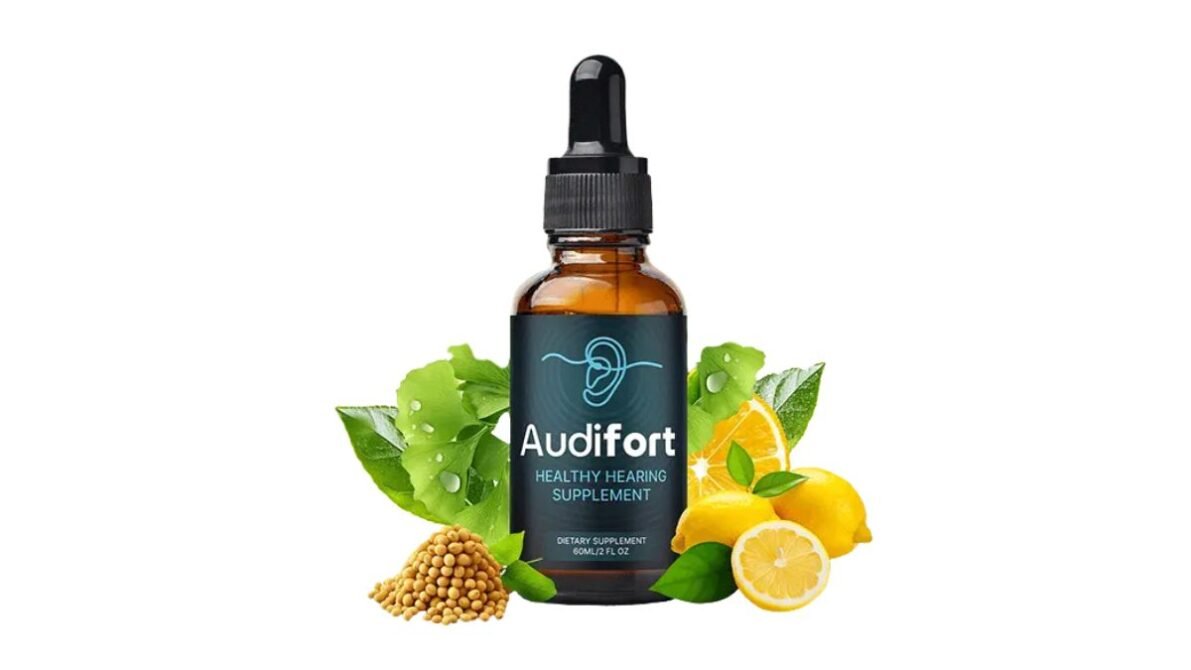
Most of the work in this Audifort review comes down to one box on the label image behind the site’s “VIEW LABEL” button: Serving Size 1 ml. Proprietary Blend 200 mg. Twenty-two ingredients listed underneath.
The sales page promises “Over 20 Carefully-Selected Ingredients That Support Healthy Hearing” and names six. The label names all of them, and then shares a single 200 mg weight between them. That’s the whole problem, and seeing it doesn’t require a laboratory. It requires division.
New to this category? Our guide to hearing and vision supplements breaks down how these products actually differ, and which claims hold up.
What the Page Names, and What the Label Adds
Audifort is a liquid sold in a 1 fl oz (30 ml) dropper bottle, positioned around “Supports Healthy Hearing.” The sales page names six ingredients, each with a one-line claim:
| Ingredient | The page’s claim |
|---|---|
| Maca Root | “Boosts Your Energy” |
| Grape Seed | “Antioxidants protect the ear” |
| Green Tea | “Improves blood flow to the ears” |
| Capsicum Annuum | “Supports a healthy inflammatory response” |
| Gymnema Sylvestre | “Supports hearing” |
| GABA | “Supports relaxation and relieves anxiety” |
The label adds the other sixteen, in this order: guarana seed, African mango seed, Eleutherococcus (Siberian ginseng) root, astragalus root, coleus forskohlii root, grapefruit fruit extract, Panax ginseng, raspberry ketones, L-glutamine, L-tyrosine, L-arginine, beta-alanine, monoammonium glycyrrhizinate, L-ornithine, L-tryptophan and L-carnitine. Maca is first and L-carnitine is last. Chromium (as chromium picolinate) sits outside the blend at 0.7 mcg, 2% of the Daily Value, and is the only ingredient on the panel with its own number.
None of those sixteen appears with a hearing claim anywhere in the sales copy.
Twenty-Two Ingredients in 200 Milligrams: What the Ceiling Arithmetic Says
Federal rules require the ingredients inside a proprietary blend to be listed in descending order by weight. That gives two bounds even when no individual dose is printed: the first ingredient holds at least the total divided by the number of ingredients, and the ingredient in position N holds at most the total divided by N.
Here the total is 200 mg and the count is 22. Maca, first on the list, holds at least 9.1 mg. The blend averages about 9 mg per ingredient. Gymnema sylvestre, the ingredient the page credits with “Supports hearing,” is eighth, so it holds at most 200 ÷ 8 = 25 mg per serving.
The Egyptian Drug Authority’s 2023 herbal monograph on Gymnema sylvestre gives the studied adult doses: 400 to 600 mg daily of a dry extract standardised to 24% gymnemic acid, or 3.6 to 11.0 millilitres daily of a 1:1 liquid extract. Set the ceiling against the low end of the dry-extract range and Gymnema in Audifort cannot exceed about 6% of the lowest studied daily dose. The entire 200 mg blend, all twenty-two ingredients together, weighs half of that 400 mg.
The label’s suggested use is “Take 1 or 2 droppers full daily.” If a dropper is the 1 ml serving size, two droppers doubles every ceiling, to 50 mg for Gymnema, which is still 12.5% of the lowest studied dose. It also halves the supply the page advertises: the serving panel lists 30 servings per bottle, so the “60 days, 2 bottles” and “180 days, 6 bottles” figures only hold at one dropper a day.
This doesn’t prove the formula does nothing. Extract potency varies, and some compounds are active at small doses. What the arithmetic shows is narrower: the label caps how much of any one ingredient can be in the bottle, and the cap sits far below the amounts used in the research that gives these ingredients their reputations. Amino acids make the same point from the other side. L-arginine, L-carnitine and L-tyrosine are commonly sold in doses of hundreds of milligrams to grams, and here each is capped at around 9 to 13 mg.
The Formula Reads Like a Weight-Loss and Energy Stack
Read the label without the hearing frame around it.
Raspberry ketones, African mango, coleus forskohlii, guarana, L-carnitine and capsicum are fixtures of fat-burner products. Green tea extract is the other half of that aisle. Beta-alanine, L-arginine, L-ornithine and L-glutamine are staples of sports-performance products. Maca is a vitality herb, ginseng and Eleutherococcus are energy adaptogens, and gymnema is the blood-sugar herb. Its Indian name, gurmar, translates roughly as “sugar destroyer,” and the Egyptian monograph lists its indications as sweet-taste suppression, weight control, adjunct therapy for diabetes, and lipid-lowering in type 2 diabetes. Hearing is not among them.
That doesn’t make the ingredients bad. It means the formula reads as a metabolic and energy blend with an ear claim attached, and the claim the page hangs on Gymnema is simply “Supports hearing,” with nothing behind it on the page and nothing in the regulator’s monograph.
The Fourteen “Scientific References”
The order page closes with a section called “Scientific References,” fourteen entries long, with a line noting the company is “not endorsed by, sponsored by, or affiliated with any of these organizations.” Here’s what’s in it, judging by the titles as printed.
Five are about tinnitus itself rather than any ingredient: a news item on “rebooting the brain” to stop ringing in rats, a Georgetown University item from 2011, two papers on cortical networks in tinnitus (Schlee and colleagues, 2009; Sedley and colleagues, 2015), and a paper on tinnitus epidemiology in the United States. One is a 2006 Nature paper on cochlear supporting cells dividing and becoming hair cells, which is mouse biology, and one links hearing loss to Alzheimer’s disease. A general review of the neuroprotective potential of phytochemicals and a paper on free radicals in ischemic brain damage are about the brain, not the ear.
Then there are the oddities. One entry is a blog-style article titled “What Herbs are Good for Hearing Loss?” One concerns plants of Urmia, Iran, for gastrointestinal disorders. One is “The Benefits of California Poppy,” an ingredient that isn’t on the label. One is a review of B vitamins and the brain, and there are no B vitamins on the label either. And one is “A Course in Miracles by Helen Schucman,” a spiritual self-study text from the 1970s, listed as a scientific reference.
Across the fourteen, none tests any of the twenty-two ingredients for an effect on hearing or tinnitus in a human being. That’s checkable in about ten minutes by anyone willing to read the titles.
Swallowed, Not Sublingual
The label’s directions are “Shake well before each use. Take 1 or 2 droppers full daily. Place in mouth and swallow.”
Swallowed is swallowed. A liquid that goes through the stomach and the liver gets no shortcut from being a liquid, and whether a given molecule crosses the gut wall depends on its chemistry, not its packaging. Several of the named compounds are the sort that struggle: grape seed proanthocyanidins are large polyphenol polymers, green tea catechins are polar polyphenols with poor oral bioavailability, and gymnemic acids are bulky triterpene saponins. Any marketing that leans on under-the-tongue absorption is working against the bottle’s own instruction.
GABA raises a different question: whether meaningful amounts of ingested GABA cross the blood-brain barrier in adults is genuinely unsettled, which is why careful GABA products talk about relaxation rather than brain chemistry. Delivery route comes before efficacy, and nothing on this page addresses whether these particular molecules travel the route the bottle prescribes.
What the Evidence Actually Says About Supplements and Tinnitus
Everything above is specific to one product. This part isn’t, and it’s the context any Audifort review has to sit inside.
The National Institute on Deafness and Other Communication Disorders, the federal institute for this field, addresses the category directly: vitamins, herbal extracts and dietary supplements are often advertised as cures for tinnitus, and “none of these has been proven to be effective.”
The best-tested candidate shows what that looks like. A 2022 Cochrane review of Ginkgo biloba for tinnitus by Sereda and colleagues pooled twelve studies with 1,915 participants — far more evidence than exists for anything in this dropper — and found uncertainty about benefits and harms versus placebo, with certainty rated low to very low. The most-studied supplement ingredient in the category, with nearly two thousand trial participants behind it, still has no demonstrated benefit over placebo.
The guideline follows from that. The American Academy of Otolaryngology–Head and Neck Surgery Foundation’s tinnitus guideline (Tunkel et al., 2014) states that clinicians should not recommend ginkgo biloba, melatonin, zinc, or other dietary supplements for persistent, bothersome tinnitus. That is a recommendation against, graded C. “Or other dietary supplements” covers this product by category, not by name. What the same guideline does recommend: cognitive behavioural therapy with grade A evidence, education and counselling, a hearing-aid evaluation for patients who also have hearing loss, and sound therapy as an option.
The Order Page, the Guarantee, and Who Sells It
The order page names ClickBank as the retailer, and the checkout says the charge will appear on your statement as “CLKBANK*Audifort x 6.” ClickBank’s own footer on the checkout adds that it “will allow for the return or replacement of any product within 90 days from the date of purchase,” which is a backstop that doesn’t depend on the product’s own site.
Pricing, from the order page:
| Package | Supply | Per bottle | Total | Shipping |
|---|---|---|---|---|
| 2 bottles | 60 days | $79 | $158 | “+ shipping,” amount not stated |
| 3 bottles | 90 days | $69 | $207 | Free US shipping |
| 6 bottles | 180 days | $49 | $294 | Free US shipping |
The six-bottle checkout showed $294.00, shipping and handling listed as FREE, and a total of $294.00, with an optional $6.95 shipping-insurance add-on offered above the pay button. A countdown banner reads “Your order is reserved for” ten minutes. The three- and six-bottle options add two free ebooks, “The Deep Sleep Activation Protocol” and “The Brainwire Regeneration Blueprint,” and the page says 96% of customers order six bottles, a claim about other buyers nobody outside the company can check.
The guarantee is 90 days, and the order page spells out the terms: “simply return the product, even your empty bottles, anytime within 90 days of your purchase and you’ll receive a full, no-questions-asked refund (minus shipping and handling fees),” issued “within 48 hours of the product being returned.” That’s a real guarantee with real conditions. The conditions are that you ship the product back, and the page never says what that costs or who pays it. On a free-shipping six-bottle order it also doesn’t say what “minus shipping and handling fees” would deduct.
The page carries two named testimonials tagged “5 Stars – Verified Purchase,” dated May and June 2025, one of them three weeks into use. A footer line notes that “some names and personal identifying information on this site have been changed,” and there is no link to Trustpilot, Amazon, Google or any platform where reviews could be read. Nothing in this article characterises what users report, because there’s no verifiable body of reviews to characterise.
Who Makes It

The label says “Made in the USA with globally sourced ingredients” and, in small print, “This product has been manufactured in an FDA registered facility.” It doesn’t name the facility. The sales page’s FAQ says the product is “assembled in the USA from the finest of foreign and domestic ingredients.” Assembled, made and manufactured are three different words for three different claims. FDA registration means a facility has registered with the agency; it is not an approval of the product, and it says nothing about quality testing.
The label also says “Distributed by audifort.com,” with a Miami address that includes a “PMB” number, which usually indicates a private mailbox rather than an office. The sales page credits the formula to “Andrew Ross – Creator, Audifort,” with no stated credentials, and its copyright line reads “Audifort Research 2026.” No GMP or third-party testing statement appears in the page text or on the label.
Safety: Small Amounts Cut Both Ways
The same arithmetic that caps how much of an ingredient can be in the bottle also caps how much of it you’re exposed to. No single ingredient here can exceed 200 mg per serving, and most are far below that. That makes a serious interaction less likely than it would be at research doses. It doesn’t make it impossible, because the label gives ceilings, not values, and the label itself allows two droppers a day. Several ingredients are worth a pharmacist’s look.
Anyone taking medication for blood sugar. The Egyptian monograph says to use Gymnema cautiously in diabetic patients on hypoglycaemic drugs, because the effects may be potentiated, with glucose monitored and doses adjusted under supervision. It also notes hypoglycaemia may occur in non-diabetic patients. Panax ginseng and other adaptogens in the blend are also discussed in the context of blood sugar.
Anyone with surgery scheduled. The monograph advises stopping Gymnema at least two weeks beforehand, because it may affect blood sugar control during and after an operation.
Pregnant or nursing women. Gymnema is listed as contraindicated in pregnancy and lactation, with no fertility data available. Hypersensitivity to the Asclepiadaceae family is the other listed contraindication. The label’s own caution tells pregnant or nursing mothers, children under 18, and anyone with a medical condition to consult a physician first.
Anyone on antidepressants, blood thinners, blood pressure medication or other prescriptions. The blend includes L-tryptophan, L-tyrosine, GABA, coleus forskohlii, L-arginine, Panax ginseng and astragalus, each of which has interaction questions with some drug classes. Grapefruit fruit extract is also on the list, and grapefruit products can affect how the body handles a long list of medications. The label doesn’t say whether the compounds responsible have been removed.
Anyone sensitive to stimulants, licorice or blood pressure swings. Guarana and green tea are caffeine-containing plants, and the label gives no caffeine figure. Monoammonium glycyrrhizinate is a licorice derivative, and licorice-derived glycyrrhizin can raise blood pressure and lower potassium at high intakes.
Beyond the ingredients: the “other ingredients” include xylitol, which is toxic to dogs. Keep the bottle out of reach of pets as well as children.
When to See a Doctor, Not a Dropper
Some ear symptoms are time-critical, and the window is measured in days to weeks.
Go the same day for sudden hearing loss in one ear. The NIDCD says to treat sudden deafness as a medical emergency: corticosteroids are the most common treatment, they work best when started early, and treatment delayed beyond two to four weeks is less likely to reverse the loss. Waiting to see whether a supplement helps can cost permanent hearing.
Get seen promptly for tinnitus in only one ear, especially with hearing loss on that side, which warrants imaging to rule out a vestibular schwannoma; for pulsatile tinnitus that beats with your heartbeat, which points at a vascular cause; and for new tinnitus after starting any medication, since several drug classes are ototoxic and the fix is a prescription review.
Treat as an emergency vertigo arriving with neurological signs — double vision, slurred speech, facial weakness, limb numbness. That’s a stroke workup, not an ear appointment.
The NIDCD tinnitus page also lists the mundane causes worth ruling out first, because they’re the ones that actually resolve: earwax blocking the canal, ear infection, and jaw joint problems.
What I Liked
- The label lists all twenty-two blend ingredients, the “other ingredients,” and the chromium dose, which is more than the sales page admits to and more than many funnel products publish at all.
- The affiliate link goes straight to the order page with prices visible and no email, name or phone gate before the content.
- The 90-day guarantee is longer than the 60 days most products in this category offer, accepts empty bottles, and has ClickBank’s own 90-day return policy behind it at checkout.
- The six-bottle checkout showed free shipping, with the total matching the advertised price.
- The label’s own caution advises pregnant and nursing mothers, children under 18 and anyone with a medical condition to talk to a physician.
Things to Consider
- Twenty-two ingredients share one 200 mg proprietary blend, about 9 mg each on average, with no dose printed for any of them.
- Gymnema, the ingredient the page credits with “Supports hearing,” is eighth on the list, so it can hold at most 25 mg per serving, against a studied dose of 400 to 600 mg of dry extract.
- The sales page names six ingredients; the other sixteen appear only on the label image.
- The formula reads as a weight-loss, energy and sports stack, and the one ingredient with an ear claim is a blood-sugar herb.
- None of the fourteen “Scientific References” tests an ingredient for hearing or tinnitus in people, and the list includes “A Course in Miracles” and entries on ingredients not on the label.
- The label says “Take 1 or 2 droppers full daily” and “Place in mouth and swallow,” while the advertised supply only works at one dropper a day.
- The label says “manufactured in an FDA registered facility” without naming it, and the distributor address carries a PMB number.
- The 90-day guarantee requires returning the product, deducts shipping and handling, and never states the return postage.
- Gymnema carries a documented interaction with blood-sugar medication, a pregnancy contraindication and a pre-surgery warning.
- The page cites no clinical trial of the finished formula, and NIDCD states no supplement has been proven effective for tinnitus.
The Verdict on This Audifort Review
Audifort is better built than the worst of its category. The funnel is straightforward, the affiliate link lands on a real order page instead of a lead-capture form, prices are stated, the six-bottle checkout showed free shipping, and the guarantee window is ninety days rather than sixty. The label is also more forthcoming than the sales copy: it lists every ingredient, which many funnels never do.
What the label reveals is a formula that doesn’t match its pitch. Twenty-two ingredients share 200 mg. The ingredient the page credits with supporting hearing can hold at most 25 mg of it, against a studied dose of 400 to 600 mg. The rest of the list reads like a fat-burner and energy stack, and the fourteen references at the bottom of the order page don’t test a single one of those ingredients for hearing. That’s not a verdict on whether the ingredients do anything. It’s a statement that the product’s own label makes the research doses impossible, and that nothing on the page connects the formula to the condition it’s sold for.
The category evidence, meanwhile, is what it is. The federal institute for hearing disorders says no supplement has been proven effective for tinnitus. The most-studied candidate ingredient in the field still has no demonstrated benefit over placebo across nearly two thousand participants. The specialty guideline recommends against supplements here by category, and recommends cognitive behavioural therapy, with grade A evidence, instead.
So if you have tinnitus or new hearing difficulty, the first appointment is with an audiologist, and the ninety-day return window is the only part of this offer that genuinely limits your downside. If you want to try it anyway, show the label to whoever manages your prescriptions first, particularly if any of them are for blood sugar. Current pricing and refund terms are on the official website, and for a formula in the same category that does publish its panel, our VisiFlora review covers what a disclosed label lets a reader check.
Frequently Asked Questions
Can 22 ingredients really fit in 200 mg?
Physically, yes. Extracts can be potent and some compounds act at small amounts, so a small dose isn’t automatically a useless one. The problem is the gap between the amount and the claim. At about 9 mg on average, and 25 mg at most for Gymnema, the label sits far below the doses studied for the ingredients it advertises. The label doesn’t tell you the extract strength or standardisation either, so there’s no way to translate 25 mg of “Gymnema Leaf Extract” into gymnemic acid.
Does liquid absorb better than capsules?
Sometimes, though not for the reason it’s usually sold. A liquid skips the step where a capsule has to break down, which matters for people with slow digestion or trouble swallowing pills. It doesn’t change whether a given molecule can cross the gut wall, which is set by the molecule’s chemistry, not its packaging. Liquid also carries a drawback this category rarely mentions: volume. A capsule holds several hundred milligrams of powder, while a 1 ml dropper is limited by what will actually dissolve.
What should I ask my audiologist that a supplement page won’t tell me?
Sometimes, though not for the reason it’s usually sold. A liquid skips the step where a capsule has to break down, which matters for people with slow digestion or trouble swallowing pills. It doesn’t change whether a given molecule can cross the gut wall, which is set by the molecule’s chemistry, not its packaging. Liquid also carries a drawback this category rarely mentions: volume. A capsule holds several hundred milligrams of powder, while a 1 ml dropper is limited by what will actually dissolve.
The most-studied supplement ingredient in the category, with nearly two thousand trial participants behind it, still has no demonstrated benefit over placebo.
Three things. Whether your tinnitus comes with measurable hearing loss, because that changes the treatment path and makes a hearing-aid evaluation relevant. Whether anything on your prescription list is ototoxic, since that’s a fixable cause people live with for years. And whether your symptom pattern warrants imaging; one-sided and pulsatile tinnitus are the two that do.
What does the 90-day guarantee actually require?
According to the order page, you return the product within 90 days, empty bottles included, and receive a refund within 48 hours of it being returned, minus shipping and handling fees. Nothing says who pays return postage, and on a free-shipping order it isn’t clear what would be deducted. ClickBank’s checkout footer separately promises return or replacement within 90 days. Before buying a multi-bottle package, ask in writing who pays return shipping, and keep your order confirmation. The charge appears on your statement as “CLKBANK*Audifort.”
These statements have not been evaluated by the Food and Drug Administration. This product is not intended to diagnose, treat, cure, or prevent any disease. This article is informational and is not medical advice. Consult a qualified healthcare professional before starting any supplement, particularly if you take medication for blood sugar, have liver or thyroid disease, have surgery scheduled, or are pregnant or nursing.

Raphael Albert is the founder and content creator of Nutra Pulse. Passionate about health, nutrition, fitness, and wellness, he spends his time researching scientific studies, health trends, and evidence-based lifestyle strategies to create informative and easy-to-understand content. While he is not a doctor or licensed healthcare professional, his goal is to help readers make more informed wellness decisions. All content is for educational purposes only and should not replace professional medical advice. Always consult a qualified healthcare provider regarding your health concerns.
2 thoughts on “Audifort Review: 22 Ingredients Share One 200 mg Blend”