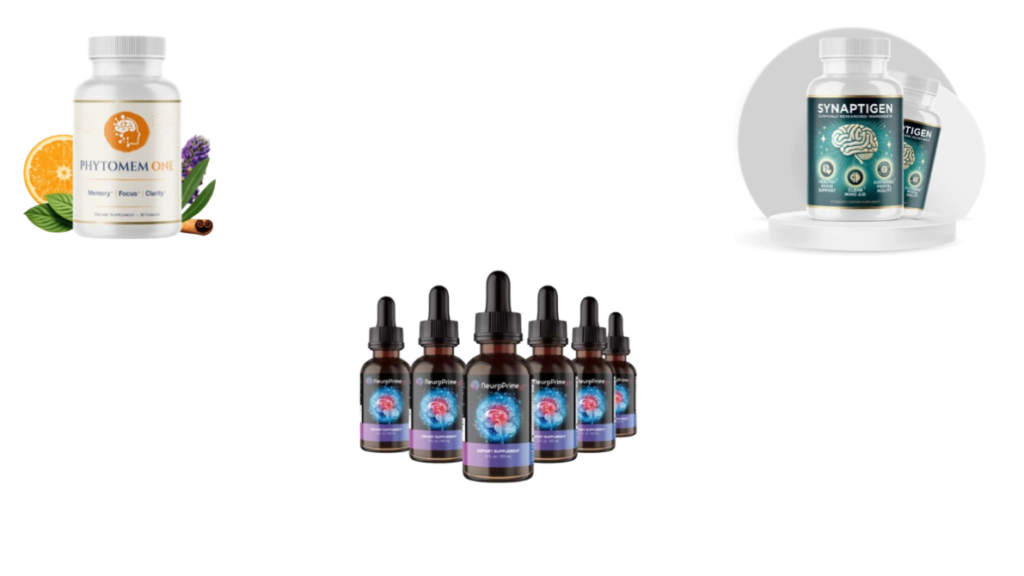
On incentives: three links below go to the sellers and pay this site a commission. All three are held to the same standard, and each fails a different check.
These statements have not been evaluated by the Food and Drug Administration. These products are not intended to diagnose, treat, cure, or prevent any disease. No supplement prevents or treats Alzheimer’s disease or dementia. Memory changes affecting daily life deserve assessment — several common causes are treatable.
These three products target the same outcome by three completely different mechanisms — and that turns out to matter more than any ingredient comparison, because each one requires a different check.
NeuroPrime bets on conventional botanicals. The check is dose arithmetic, and it fails by roughly seventyfold.
Synaptigen bets on the gut-brain axis. Dose arithmetic barely applies — the check is strain identity, and it passes one time out of six.
Phytomem One bets on metabolic pathways. It passes the dose check on its lead ingredient, and fails on whether human evidence exists for its second.
Three bets, three gaps, three different tests. Running the wrong test on the wrong product is how people end up comparing things that aren’t comparable.
Here’s each one.
What Each One Is
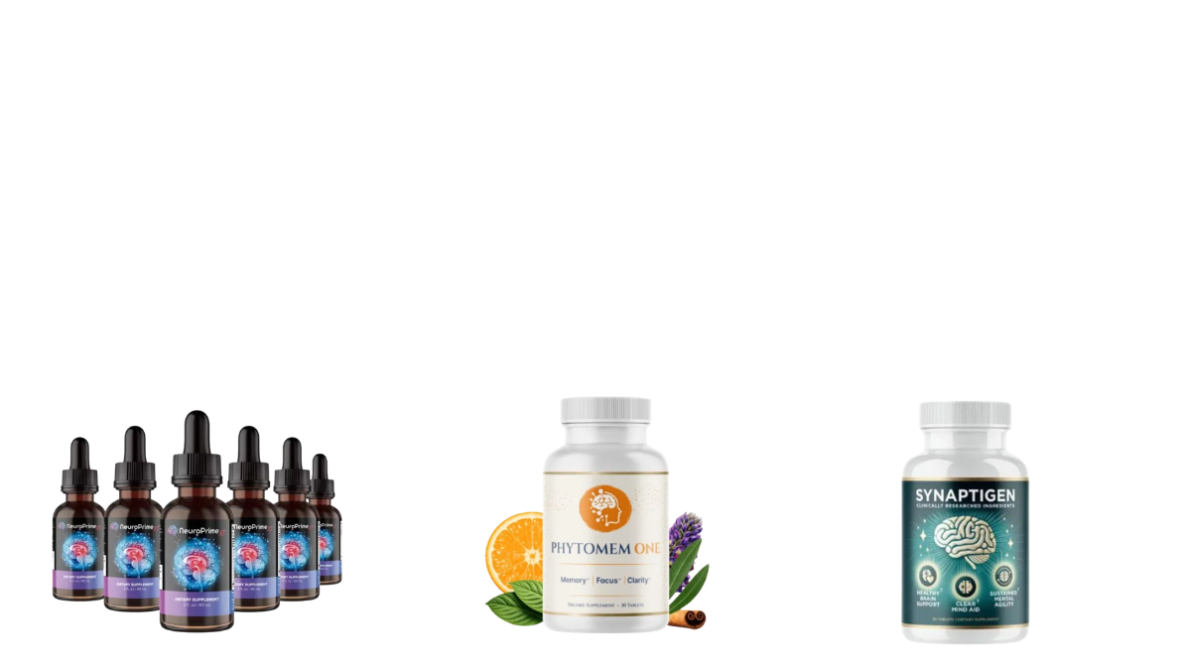
NeuroPrime is a liquid — one drop daily, taken straight or in a drink. Nine botanicals: ginkgo, bacopa, lion’s mane, pine bark, moringa, tamarind, chlorella, spirulina and neem. No amounts published. 365-day guarantee, the longest of the three by a wide margin.
Synaptigen is a melt-in-the-mouth tablet with six probiotic strains — L. paracasei, L. reuteri, L. rhamnosus, L. fermentum, B. lactis BL-04 and S. salivarius subsp. thermophilus — plus prebiotic inulin. No CFU counts published. 60-day guarantee.
Phytomem One is a capsule with a 458 mg proprietary blend of ten ingredients, led by saffron and berberine. Manufactured by Phyto Thrive Labs in Largo, Florida — an identified manufacturer, which is rare here. 60-day guarantee.
NeuroPrime: The Dose Gap
The clearest failure of the three, and it’s arithmetic rather than interpretation.
Our NeuroPrime review works through it. The ingredient shortlist is defensible — bacopa and lion’s mane have genuine human trials, and ginkgo is the most-studied botanical in this category.
The problem is the vehicle.
The Arithmetic
A standard dropper delivers roughly twenty drops per millilitre. One drop is about 0.05 mL — call it 50 mg, and that’s generous, since most of a tincture is carrier: water, glycerin, flavouring.
Nine ingredients share that.
Now the studied doses:
| Ingredient | Studied daily dose |
|---|---|
| Bacopa monnieri | 300–450 mg, 12+ weeks |
| Lion’s mane | 3,000 mg, 16 weeks |
| Ginkgo biloba | 240 mg |
| Three combined | ~3,500 mg |
A meta-analysis of nine randomised controlled trials found bacopa improved speed of attention and reaction time — at 300 to 450 mg daily, over at least twelve weeks.
Three ingredients require roughly 3,500 mg of daily material against a vehicle holding about 50 mg of everything combined. That’s a gap of roughly seventyfold, before accounting for the other six ingredients or the carrier.
No delivery method changes the volume a drop can hold. Sublingual absorption alters what proportion of a dose reaches your bloodstream, not how large the dose is.
Why Ginkgo Makes It Worse
There’s a second problem with the flagship ingredient, and it’s independent of dose.
That’s the studied dose, in a large sample, over years. Ginkgo failed at an amount NeuroPrime cannot approach.
Its reference list compounds this: four of five citations concern melatonin, which isn’t in the product.
What NeuroPrime Gets Right
Two things, and the first is substantial.
A 365-day guarantee is the longest we’ve encountered in this category and materially reduces the financial risk of trying it. A full year is longer than any botanical’s studied timeline.
And the ingredient selection isn’t random. Bacopa, lion’s mane and ginkgo are the three names a nootropic researcher would recognise. Somebody read the right literature; the formulation didn’t follow.
Synaptigen: The Strain Gap
A different bet entirely, and the premise deserves a fair hearing before the criticism.
The Gut-Brain Premise Is Well Supported
Better than I expected when I first looked at it.
Your gut and brain communicate bidirectionally — vagus nerve, immune signalling, and short-chain fatty acids from bacterial fermentation of fibre.
A meta-analysis of 21 randomised controlled trials found probiotics’ effects on cognitive performance appeared primarily in older age groups, with significant effects on overall cognitive performance, processing speed, memory and spatial ability. An earlier pooled analysis of seven controlled human trials found a significant improvement with an effect size of 0.24 and no heterogeneity between studies — the trials agreed with each other, which is unusual.
An effect size of 0.24 is small. It’s also real, consistent, and concentrated in exactly the demographic buying these products.
On premise alone, Synaptigen has the best-supported bet of the three.
Six Strains, One Code
Which makes the gap more frustrating.
Probiotic effects are strain-specific, not species-specific. The trials above were conducted on named strains — L. rhamnosus GG, B. breve A1, B. longum BB68S. Two strains of the same species can behave completely differently.
L. reuteri is a species. L. reuteri DSM 17938 is a strain. Only the second connects to a study.
Our Synaptigen review documents six named organisms, of which one carries an alphanumeric code: B. lactis BL-04. The other five are species-level only.
And no CFU count is published — not as a total, not by organism. So even for BL-04, you can’t tell whether it’s most of the tablet or a trace.
What Synaptigen Gets Right
BL-04 is genuinely earned credit. It’s a real commercial strain with its own research programme, and one of six is more than most products in this category manage.
The premise is the best supported of the three, and the melt-in-the-mouth format is a reasonable choice for organisms meant to reach the gut alive.
What it gets wrong beyond the strains: the manufacturer isn’t publicly identified, and consumer complaint records exist against the company — including reports of difficulty reaching customer support.
Phytomem One: The Human Evidence Gap
The third bet, and the one where the usual check comes out differently.
Our Phytomem One review covers a 458 mg proprietary blend of ten ingredients, led by saffron and berberine, framed around brain insulin resistance.
Saffron Is the Best Ingredient Across All Three
This deserves stating plainly, because it’s the strongest single finding in this comparison.
A systematic review of five randomised controlled trials in 325 patients with Alzheimer’s disease and mild cognitive impairment found saffron at 30 mg daily significantly better than placebo — and non-inferior to donepezil and memantine, two prescription drugs, over 16 to 52 weeks.
Non-inferiority to prescription medication is a remarkable result for a botanical. Nothing in NeuroPrime or Synaptigen has evidence of that quality.
Where the Dose Actually Fits
And here the arithmetic runs the opposite way from NeuroPrime, which is worth working through carefully.
Saffron’s clinical dose is 30 mg. Phytomem One’s blend is 458 mg.
| Saffron’s share of the blend | 6.5% |
| Even split across ten ingredients | 45.8 mg each |
| Saffron’s clinical dose | 30 mg |
The clinical dose is smaller than an even share would give it. It fits comfortably, leaving 428 mg for the other nine.
That’s the opposite of NeuroPrime, where 3,500 mg cannot fit into 50 mg. Same test, opposite result — and it matters, because applying the arithmetic critique where it doesn’t apply is how a technical reader learns to discount everything else you say.
The correct criticism here is transparency, not capacity. The blend is proprietary: components are ordered by weight but not quantified. So you can’t tell whether saffron is the largest ingredient or a token amount at the bottom of the list. It fits. Whether it’s there at that amount is unknowable.
Berberine’s Missing Human Trials
Phytomem One’s second lead ingredient has the opposite profile — plentiful evidence of the wrong kind.
A 2024 meta-analysis of 22 animal studies in 453 animals found berberine improved spatial learning, amyloid deposition and tau markers. That’s substantial preclinical work.
The Alzheimer’s Drug Discovery Foundation states plainly that no studies have specifically tested whether berberine affects human cognitive function or prevents dementia.
That’s a gap no dose fixes. You can have exactly the right amount of an ingredient whose human cognitive evidence doesn’t exist.
What Phytomem One Gets Right
Three credits, and the first is unusual in this project.
The manufacturer is identified — Phyto Thrive Labs, Largo, Florida. Most products in this category record “manufacturer not identified.”
Saffron is the best-evidenced ingredient across all three products.
And its affiliate link uses the correct tracking format, which — given how many products in this space don’t — is worth noting.
What it gets wrong beyond berberine: the marketing is built on framings called “Plastic Stranglehold” and “Type 3 Diabetes,” neither of which is a recognised clinical diagnosis. And its manufacturing claims are inconsistent between sections — GMP-certified in one place, USDA Organic-certified in two others.
Head to Head
| NeuroPrime | Synaptigen | Phytomem One | |
|---|---|---|---|
| Mechanism | Botanical nootropic | Gut-brain axis | Metabolic |
| Lead ingredient evidence | ⚠️ Real, but ginkgo failed GEM | ✅ 21-RCT meta-analysis | ✅ Saffron non-inferior to 2 drugs |
| Dose test | ❌ ~70× short | N/A — CFU, not mg | ✅ Fits |
| Strain codes | N/A | ⚠️ One of six | N/A |
| Amounts published | ❌ None | ❌ No CFU | ⚠️ Blend total only |
| Manufacturer identified | ❌ No | ❌ No | ✅ Yes |
| Guarantee | ✅ 365 days | 60 days | 60 days |
| Working affiliate format | ✅ Yes | ❌ No | ✅ Yes |
The Three Different Tests
The transferable lesson, and it applies beyond these products.
For a botanical capsule or liquid: run the dose test. Find the anchor ingredient, search it plus “randomized trial,” find the daily amount, compare against the label. NeuroPrime fails this by seventyfold. Phytomem One passes it.
For a probiotic: the dose test barely applies — potency is CFU, not milligrams, and organisms colonise rather than acting purely by mass. Run the strain test instead. Look for letters and numbers after the species name. Synaptigen passes one of six.
And for any of them, run the human-evidence test: does research on this ingredient exist in people, for this outcome? Berberine has 453 animals and zero humans for cognition.
Running the wrong test produces the wrong answer. A probiotic criticised for milligram doses, or a botanical excused because “the strains are proprietary,” are both category errors.
Guarantees and Company Transparency
NeuroPrime’s 365 days is the strongest single commercial term across the three and the best argument for trying it despite everything above.
Phytomem One and Synaptigen both offer 60 days, which is adequate — though worth noting that all three mechanisms are described in terms of weeks to months, and 60 days is at the short end of that.
On company transparency the order reverses. Phytomem One identifies its manufacturer. Neither of the other two does, and consumer complaint records exist against Synaptigen’s company.
Current terms are on the NeuroPrime, Phytomem One and Synaptigen sites.
Safety Across the Three
NeuroPrime contains neem, which has a documented toxicity literature — neem oil is associated with serious adverse effects, particularly in children, and it has no cognitive rationale. Ginkgo carries bleeding risk and warrants stopping before surgery.
Phytomem One contains berberine, which inhibits CYP3A4 and P-glycoprotein — affecting a wide range of prescription medications — lowers blood glucose alongside diabetes medication, and is contraindicated in pregnancy and breastfeeding.
Synaptigen is the lowest-risk of the three. Live bacterial products warrant medical input if you’re significantly immunocompromised, on chemotherapy, post-transplant, or have a central line.
For all three: tell a pharmacist what you’re taking, particularly if you’re on anticoagulants, diabetes medication, or anything with a narrow therapeutic window.
When to See a Doctor
Ordinary and usually not concerning: occasionally forgetting a name and recalling it later, misplacing keys, needing longer to learn something new.
Warranting assessment: memory loss disrupting daily life · difficulty with familiar tasks · getting lost in familiar places · changes in personality or judgement noticed by others · worsening word-finding trouble · confusion about time or place.
Urgently: sudden confusion, memory loss after a head injury, or any of the above alongside weakness, slurred speech or vision changes.
And the part worth knowing before buying anything. Several common causes of memory symptoms are treatable and reversible: vitamin B12 deficiency, thyroid dysfunction, sleep apnoea, depression, and medication side effects. A blood test identifies most of them. No supplement does, and months spent on one are months not spent finding out.
What Actually Protects Memory
With better evidence than anything in these three:
Managing blood pressure — midlife hypertension is among the strongest modifiable risk factors for later cognitive decline. Treating hearing loss — hearing aids are associated with better cognitive outcomes. Physical activity, which has more consistent cognitive data than any supplement here. Sleep, including getting apnoea assessed. And staying socially and mentally engaged.
None of that is a product, which is why it isn’t marketed.
Which Case Is Strongest, and For Whom
Phytomem One, narrowly — and for reasons that don’t include its marketing.
It contains saffron, which has the best cognitive evidence of any ingredient across all three products. Its blend can accommodate saffron’s clinical dose. It identifies its manufacturer. That combination is more than either competitor offers.
What holds it back: the amount isn’t verifiable, and berberine — its co-lead — has no human cognitive research at all.
Synaptigen has the best-supported premise and the worst company transparency. If the gut-brain approach appeals and you have digestive symptoms anyway, the potential upside is broader than cognition alone. BL-04 is real. The unidentified manufacturer and the complaint record are real too.
NeuroPrime has the longest guarantee and the largest gap. A year to change your mind is genuinely valuable. Seventyfold short of the studied doses is not something a guarantee compensates for.
Who any of these might suit: someone with ordinary age-related memory changes, already assessed by a doctor, taking no interacting medication, who understands they’re buying an unverified quantity and treats it as an addition rather than a strategy.
Who should skip all three: anyone with new or worsening memory symptoms who hasn’t had a B12 and thyroid panel, anyone on anticoagulants or diabetes medication without a pharmacist’s input, and anyone pregnant.
Where That Leaves You
If saffron is what appeals, it’s sold standalone at the studied 30 mg with the milligrams printed on the bottle, for less than any of these. If bacopa appeals, it’s sold at 300 mg. Both let you and a pharmacist see exactly what you’re taking.
And the three tests transfer. Botanical, run the dose check. Probiotic, run the strain check. Either one, ask whether the human evidence exists for the outcome claimed.
Those three questions sorted these three products completely, and they’ll sort the next one too.
For the full analysis of each, see our Synaptigen review, our Phytomem One review and our NeuroPrime review. All three sit inside our guide to brain and memory supplements, which explains why this category has five mechanisms and the dose test only applies to three of them.
Frequently Asked Questions
Which of these three has the best evidence?
Phytomem One, because of saffron — a systematic review of five randomised trials in 325 patients found 30 mg daily significantly better than placebo and non-inferior to donepezil and memantine. Nothing in the other two products has evidence of that quality. The caveat is that Phytomem One’s blend is proprietary, so you can’t verify saffron is present at 30 mg.
Is one drop of NeuroPrime enough?
No, and the gap is arithmetic rather than interpretive. A drop is roughly 50 mg including carrier, shared among nine ingredients. Bacopa trials use 300 to 450 mg, lion’s mane 3,000 mg, ginkgo 240 mg — roughly 3,500 mg for three ingredients alone. That’s about seventyfold. No absorption route changes how much fits in a drop.
Does the gut-brain approach actually work for memory?
The pathway is real and the evidence is better than you might expect. A meta-analysis of 21 randomised trials found significant effects on cognitive performance, processing speed and memory, concentrated in older adults, and a pooled analysis of seven trials reported an effect size of 0.24 with no heterogeneity. Small but consistent. For a specific product, the check is strain codes — Synaptigen names one of six.
Why does Phytomem One pass the dose test when NeuroPrime fails it?
Because the numbers genuinely differ. Saffron’s clinical dose is 30 mg, which is 6.5% of Phytomem One’s 458 mg blend — less than an even split across ten ingredients would give it, so it fits comfortably. NeuroPrime needs roughly 3,500 mg in a vehicle holding about 50 mg. One is a capacity problem; the other isn’t. The remaining question for Phytomem One is transparency: it fits, but a proprietary blend doesn’t tell you whether it’s there.
What’s the difference between a probiotic strain and a species?
A species is the broad category; a strain is the specific lineage, written with letters and numbers. Lactobacillus reuteri is a species; L. reuteri DSM 17938 is a strain. Probiotic effects are strain-specific, so a species name alone doesn’t connect to published research. Synaptigen names B. lactis BL-04 with a code — the other five organisms are species-level only.
Should any of these replace a doctor’s visit?
No, and this is the most important point here. Several common causes of memory symptoms are treatable and reversible — B12 deficiency, thyroid dysfunction, sleep apnoea, depression and medication side effects all cause cognitive difficulty, and a blood test identifies most of them. Memory changes that disrupt daily life, difficulty with familiar tasks, or personality changes noticed by others all warrant assessment first.

Raphael Albert is the founder and content creator of Nutra Pulse. Passionate about health, nutrition, fitness, and wellness, he spends his time researching scientific studies, health trends, and evidence-based lifestyle strategies to create informative and easy-to-understand content. While he is not a doctor or licensed healthcare professional, his goal is to help readers make more informed wellness decisions. All content is for educational purposes only and should not replace professional medical advice. Always consult a qualified healthcare provider regarding your health concerns.