On incentives: two links below go to the sellers and pay this site a commission. Both products are examined on the same standard, and neither comes out of it recommended without qualification.
These statements have not been evaluated by the Food and Drug Administration. These products are not intended to diagnose, treat, cure, or prevent any disease. Both contain ingredients that lower blood glucose. If you take medication for diabetes, speak to a pharmacist before either.
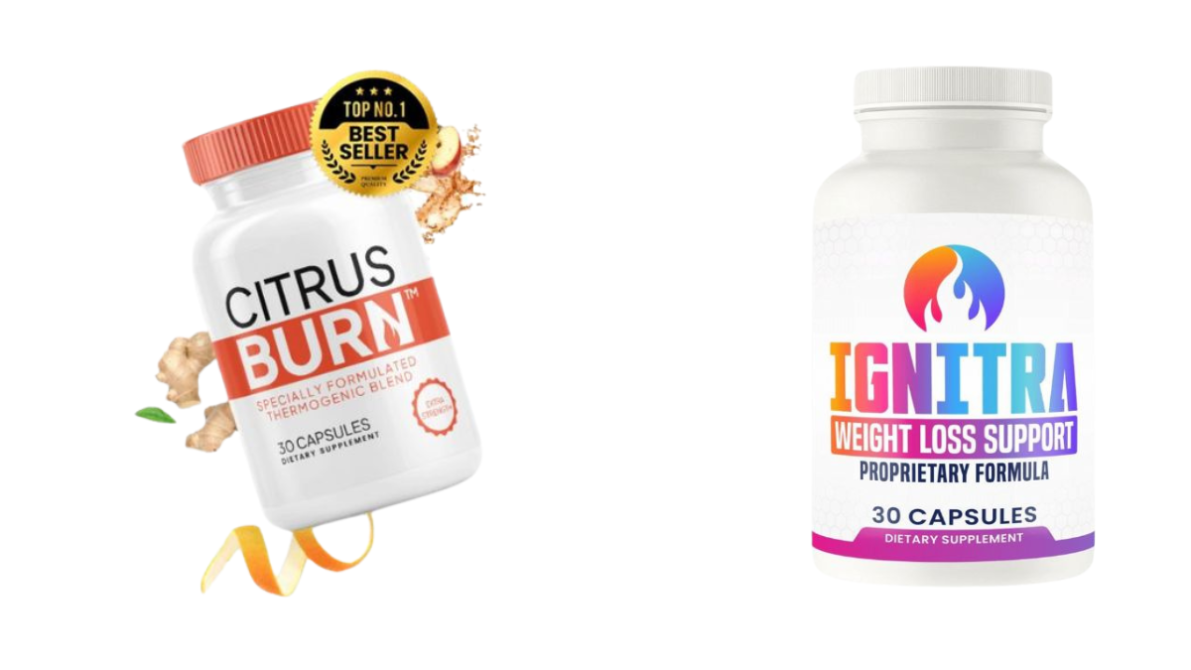
CitrusBurn vs Ignitra is a comparison between two products making the same move in opposite ways.
Neither has a clinical trial on its own formula. Neither publishes an amount for any ingredient. So both need to establish credibility from somewhere else — and each solves that problem differently.
CitrusBurn borrows institutions. Its page attributes a specific thermogenic figure to research from Harvard, the Mayo Clinic and the University of Barcelona, with the logos to match.
Ignitra borrows pharmacology. Its reference list contains sixteen citations, and they’re about GLP-1 receptor agonists — the injectable prescription drugs.
Both approaches work on a reader scanning quickly. Both fall apart in about five minutes. Here’s what each one actually did.
What Each One Is
CitrusBurn is a capsule taken once daily, in the morning before breakfast, built on seven named botanicals: Seville orange peel standardised for p-synephrine, Spanish red apple vinegar, Andalusian red pepper for capsaicin, Himalayan ginger, ceremonial green tea, berberine and Korean red ginseng. It carries a 180-day money-back guarantee.
Ignitra is a capsule marketed on metabolic and appetite support. Its page advertises “11+ ingredients” while naming six, inside a 600 mg proprietary blend.
Both run through ClickBank as retailer of record.
CitrusBurn’s Borrowed Institutions
The page attributes a 74% increase in thermogenesis to research from Harvard, the Mayo Clinic and the University of Barcelona.
Our CitrusBurn review checked the product’s own reference list — twelve real, properly formatted papers. None of them is from any of those three institutions. The 74% figure carries no citation anywhere on the page.
Beneath the logos sits a line stating the product isn’t endorsed by or affiliated with any of them. That disclaimer is legally correct and it’s also an admission: the institutions are there for recognition, not attribution.
What Its Own References Actually Say
Here’s the more interesting part, and it’s to CitrusBurn’s partial credit that it’s checkable at all.
The twelve citations are genuine papers. Read them and they describe effects considerably smaller than the marketing implies:
The vinegar trial used vinegar measured in tablespoons daily — a quantity a capsule cannot hold.
The green tea meta-analysis describes weight effects on the order of a kilogram over months.
The capsaicin and ginger findings are real and small.
And three of the four synephrine references share an author who discloses, in the papers themselves, having consulted for a company that markets bitter orange extracts. That disclosure is properly made — it’s just worth knowing when three of four citations trace to one interested party.
So CitrusBurn cites the right topic and reaches the wrong conclusion. Its references are about its ingredients; they simply don’t support the claims attached to them.
Ignitra’s Borrowed Pharmacology
Ignitra’s approach is different, and it’s the more complete disconnect.
Our Ignitra review documents sixteen references published as bare URLs. Two of them are the same link, duplicated.
That link goes to a 2016 review of GLP-1 biology and liraglutide — the injectable prescription drug marketed for weight management. It discusses dosing, phase III trial results, and adverse events including pancreatitis signals. Other references cover GLP-1 responses to meals.
Sixteen References, Zero About the Product
Not one of the sixteen concerns any ingredient in Ignitra.
A botanical capsule is citing the pharmacology of injectable prescription medication as its scientific backing. The references establish that GLP-1 is a real hormone and that drugs targeting it work — neither of which anyone disputes, and neither of which says anything about the capsule.
CitrusBurn cites the right subject and overstates it. Ignitra cites a different subject entirely.
For scale, since the comparison is invited: prescription GLP-1 medications produced mean body weight reductions of roughly 15% in large randomised trials. Neither of these products has a trial of any kind.
Where CitrusBurn vs Ignitra Actually Separates
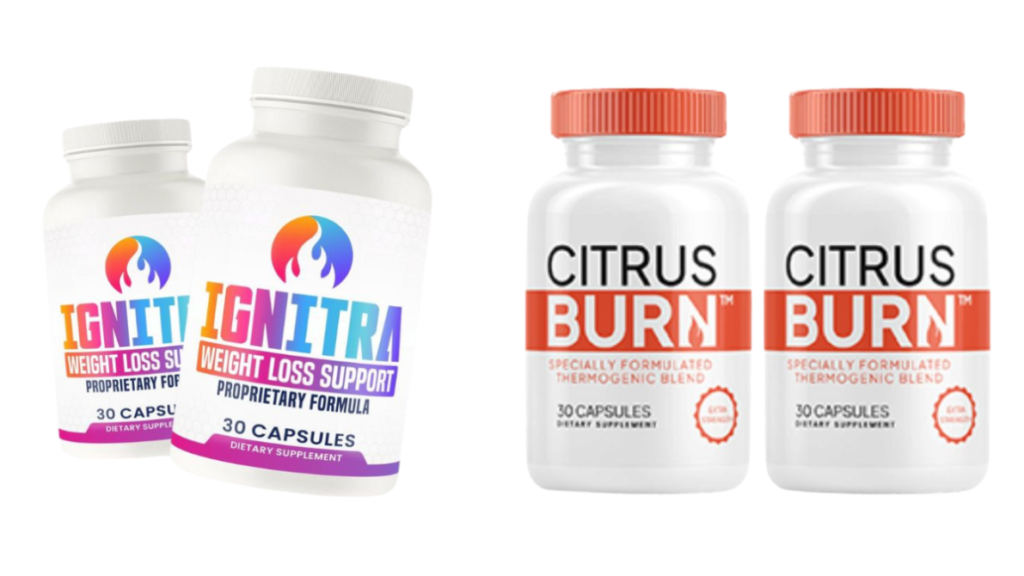
Four dimensions, and one of them genuinely favours each product.
Ingredient disclosure. CitrusBurn names seven; Ignitra advertises “11+” and names six. Advantage CitrusBurn.
Reference relevance. CitrusBurn’s citations are about its ingredients; Ignitra’s are about prescription drugs. Advantage CitrusBurn.
Guarantee. CitrusBurn 180 days. Advantage CitrusBurn.
Marketing restraint. Neither — but they overreach differently.
Setting up the table, the striking thing about CitrusBurn vs Ignitra is how many rows come out negative for both:
| CitrusBurn | Ignitra | |
|---|---|---|
| Ingredients named | 7 | 6, while claiming “11+” |
| Doses published | ❌ No | ❌ No (600 mg blend total) |
| References about its ingredients | ✅ Yes — but they undercut it | ❌ None of 16 |
| Invented condition | ⚠️ “Thermogenic resistance” | — |
| Recycled testimonials | — | ⚠️ Shared with another product |
| Guarantee | 180 days | Shorter |
| Trial on the formula | ❌ None | ❌ None |
The Shared Ingredient: Berberine
Both contain berberine, which is the one ingredient in either formula with genuinely strong evidence — and the one that makes the dosing question concrete.
A meta-analysis of randomised placebo-controlled trials found berberine significantly reduced triglycerides, fasting plasma glucose and waist circumference, along with LDL and total cholesterol.
A necessary counterweight from the same literature: a meta-analysis of nine trials in 547 patients with type 2 diabetes found berberine-family preparations lowered fasting glucose and HbA1c but produced no significant change in weight or BMI.
Berberine is a glucose-and-lipid ingredient with weak weight effects — which is worth knowing when it appears in two weight-loss products.
Berberine’s Real Dose
The trials overwhelmingly use 500 mg two or three times daily — 1,000 to 1,500 mg per day.
Neither product publishes its berberine content.
For Ignitra the arithmetic can be partially inferred: the entire proprietary blend is 600 mg, shared among six or more ingredients. Even if berberine took the whole blend, it would fall below the low end of the studied range. Divided, it’s a fraction.
CitrusBurn publishes no total at all, so nothing can be inferred either way.
Berberine also has under 1% oral bioavailability, which is why the trials use gram quantities in the first place. A small amount of a poorly absorbed compound is a small number twice over.
CitrusBurn’s Invented Condition
The framing device that carries CitrusBurn’s marketing is a condition called “thermogenic resistance.”
It doesn’t appear in the endocrinology literature. There are no diagnostic criteria, no test, and no clinician who can assess you for it.
Thermogenesis is real, and it does decline modestly with age — mostly because muscle mass declines. That’s ordinary physiology with an ordinary answer, not a named disorder requiring a proprietary fix.
Ignitra makes no equivalent claim, which is a point in its favour on this specific dimension.
The Stimulant-Free Claim
CitrusBurn’s feature list includes “Stimulant-Free & Jitter-Free.”
Its headline ingredient is Seville orange peel standardised for p-synephrine — which the NCAA lists on its banned drugs list under stimulants, and which the NFL and MLB also prohibit. The formula also contains green tea, which carries caffeine.
Whatever else is true, a product built on bitter orange and green tea isn’t stimulant-free by the standard sporting bodies apply. If you compete in a drug-tested sport, that matters directly.
Why Synephrine Plus Caffeine Matters
There’s a safety dimension, and it’s specific rather than general.
The evidence on bitter orange is genuinely contested — some research concludes p-synephrine doesn’t produce cardiovascular effects at typical doses, while national health bodies note reports of serious events and describe the evidence as inconclusive.
What both sides agree on is that concern rises when synephrine is combined with caffeine. CitrusBurn contains both.
Add the dosing instruction — one capsule in the morning before breakfast — and there’s a second issue. The European Food Safety Authority concluded that green tea catechins at or above 800 mg of EGCG daily are associated with elevated liver enzymes, and that no supplemental dose could be identified as safe, with EU guidance specifically cautioning against taking green tea extract on an empty stomach.
If you take either product, take it with food.
Ignitra’s Arithmetic Problem
Ignitra’s issue is quantitative, and one ingredient makes it plain.
Glucomannan appears in its formula. Its authorised health claim for weight management requires 3 grams daily, split across three doses, taken with water before meals.
Ignitra’s entire proprietary blend is 600 mg — a fifth of the glucomannan requirement alone, before any of the other ingredients get a share.
That’s not a judgement about whether glucomannan works. It’s arithmetic: the product cannot deliver the amount its own ingredient’s approved claim requires.
The Testimonials That Appear Elsewhere
A detail worth knowing, and it’s checkable.
Our Ignitra review documents customer testimonials — attributed to named individuals with ages and US states — that appear word for word on the sales page of an unrelated prostate supplement. A third quote appears with identical text under a different name.
That doesn’t tell you anything about what’s in the capsule. It does tell you that the social proof was assembled rather than collected.
The Asset Folder
The same review documents university logos on Ignitra’s page served from a directory path named after a different supplement entirely — with two filenames misspelled.
Those exact misspelled files appear on the pages of other unrelated products in other health categories. The same asset kit is being reused across a portfolio.
CitrusBurn’s institutional logos have the same function, though its reference list at least exists. The difference is one of degree, not kind.
What Both Publish: Nothing
Strip away the framing and both fail the same fundamental check.
Neither publishes an amount for any ingredient. CitrusBurn gives no total; Ignitra gives a 600 mg blend total without a breakdown.
That means neither can be compared against the research either invokes — including the berberine evidence both would benefit from if the amounts were there.
A product that publishes doses invites comparison. One that doesn’t avoids it. Both avoid it.
Safety: Where They Differ
CitrusBurn has the longer list. Synephrine plus caffeine is the pairing associated with blood pressure and heart rate effects, and it’s on the NCAA banned list. Berberine and Korean red ginseng both lower blood glucose — two glucose-lowering agents in one capsule, additive with metformin, a sulfonylurea or insulin. Berberine also inhibits CYP3A4 and P-glycoprotein, affecting a wide range of prescription drugs, and is contraindicated in pregnancy. Green tea extract carries the liver caution above, made worse by fasting-state dosing.
Ignitra shares the berberine considerations — glucose-lowering, CYP3A4 and P-glycoprotein interactions, pregnancy contraindication. Without a published ingredient list beyond six names, the rest can’t be assessed.
For both: if you take medication for blood sugar, blood pressure or heart rhythm, speak to a pharmacist first. And if you already take another green tea extract product or fat burner, count your exposures together.
Guarantees and Terms
CitrusBurn’s 180-day guarantee is genuinely generous and the strongest single thing about its offer. Six months is far longer than the category norm.
Both run through ClickBank, which means refunds are administered by an established payment platform rather than the seller’s own returns desk — a real consumer protection in both cases.
Current terms are on the CitrusBurn and Ignitra sites.
Which Case Is Stronger, and For Whom
CitrusBurn is the more defensible of the two, and the margin is clearer than the shared problems suggest.
It names seven ingredients rather than advertising eleven and naming six. Its references are about its own ingredients, which means they can be checked — and checking them is what reveals the overstatement, which is a form of accountability Ignitra doesn’t offer. Its guarantee is 180 days.
Ignitra’s case is weaker on the dimension that matters most here. Sixteen references about prescription drugs that aren’t in the bottle is a more complete disconnect than citing real papers and overstating them. Add testimonials that appear on an unrelated product and logos from a shared asset folder, and the pattern is about assembly rather than formulation.
Who CitrusBurn might reasonably suit: someone who wants a thermogenic botanical blend, takes no glucose-lowering or cardiac medication, doesn’t compete in a drug-tested sport, isn’t pregnant, takes it with food rather than fasted, and understands the doses are unpublished. The 180-day window makes trying it low-risk financially.
Who should skip both: anyone taking diabetes medication without a pharmacist’s input, anyone pregnant, anyone in a tested sport, and anyone buying on the strength of institutional logos or GLP-1 references.
Where That Leaves You
The useful thing here isn’t which product wins. It’s recognising the move.
When a supplement page shows you an institution’s logo, look for the citation. When it shows you a reference list, check whether the papers are about the ingredients in the bottle. Those two checks take five minutes and they sorted this entire comparison.
And the honest hierarchy neither product occupies: a sustainable calorie deficit, protein and fibre high enough to manage hunger, resistance training to protect the muscle that drives your resting metabolism, and adequate sleep. Berberine, if you want it, is sold standalone with the milligrams printed on the bottle at 500 mg two or three times daily — the form every trial used, for a fraction of the price, after a conversation with a pharmacist about its interactions.
For the full analysis of each, see our CitrusBurn review and our Ignitra review. Both sit inside our guide to liver and metabolic supplements, which sets out the four checks that eliminate most of this market in about ten minutes.
Frequently Asked Questions
Which is better, CitrusBurn or Ignitra?
Neither has a trial on its formula and neither publishes doses, so the comparison rests on what can be checked. CitrusBurn names seven ingredients and cites twelve real papers about them — papers that turn out to describe smaller effects than the marketing implies, but which at least concern the product. Ignitra advertises “11+ ingredients” while naming six, and all sixteen of its references are about GLP-1 prescription drugs rather than anything in the capsule. On that basis CitrusBurn is more defensible.
Is CitrusBurn really stimulant-free?
Not by the standard sporting bodies apply. Its headline ingredient is Seville orange peel standardised for p-synephrine, which the NCAA lists under banned stimulants, and the formula also contains green tea, which carries caffeine. If you compete in a drug-tested sport, that matters directly. There’s also a safety dimension: the cardiovascular concern with bitter orange rises specifically when synephrine is combined with caffeine.
How much berberine do you actually need?
Trials overwhelmingly use 500 mg two or three times daily — 1,000 to 1,500 mg per day. Neither product publishes its berberine content. Ignitra’s entire blend is 600 mg shared among six or more ingredients, so even at maximum it falls short. Berberine also has under 1% oral bioavailability, which is why trials use gram quantities.
Should I take these with food?
Yes, and CitrusBurn’s own instruction says otherwise. It directs you to take it in the morning before breakfast, while EU guidance specifically cautions against taking green tea extract on an empty stomach — EFSA concluded that catechins at or above 800 mg of EGCG daily are associated with raised liver enzymes and that no supplemental dose could be identified as safe. Neither product publishes its EGCG content, so both may be well below any threshold — but taking either with food costs nothing.

Raphael Albert is the founder and content creator of Nutra Pulse. Passionate about health, nutrition, fitness, and wellness, he spends his time researching scientific studies, health trends, and evidence-based lifestyle strategies to create informative and easy-to-understand content. While he is not a doctor or licensed healthcare professional, his goal is to help readers make more informed wellness decisions. All content is for educational purposes only and should not replace professional medical advice. Always consult a qualified healthcare provider regarding your health concerns.