Transparency note: this site normally earns a commission when readers buy through our links. There are no purchase links in this article, and we earn nothing whatever you decide. A product that positions itself against a treatment which protects your bones isn’t one we’re willing to take a commission on.
These statements have not been evaluated by the Food and Drug Administration. This product is not intended to diagnose, treat, cure, or prevent any disease. Menopause care is genuinely individual, and the right approach depends on your history, your symptoms, and your risk profile — none of which a website knows. If you’ve had breast cancer, take tamoxifen, or have liver disease, please read the safety sections below before you read anything else.
Most supplements sell you on an outcome. This one sells you on an absence.
Across the pages marketing MenoMD+, the line that does the heaviest lifting isn’t about hot flashes or sleep. It’s the promise that the formula meets a woman’s needs without the need for HRT — hormone replacement therapy.
That framing is worth pausing on, because it inverts the usual sales logic. You’re not being told primarily what the capsules do. You’re being told what you won’t have to do: talk to a doctor about the prescription option.
And that matters more here than in any product I’ve reviewed, because of what hormone therapy actually is. The Menopause Society’s 2022 position statement is unambiguous: hormone therapy remains the most effective treatment for vasomotor symptoms and for genitourinary syndrome of menopause, and it has been shown to prevent bone loss and fracture. For women under 60, or within ten years of menopause onset, without contraindications, the same statement describes the benefit-risk balance as favourable.
So this MenoMD+ review has to do two things. Examine what’s in the bottle — which turns out to be harder than it sounds. And be clear about what you’d be steering away from.
What MenoMD+ Is — and Which Version You’re Getting
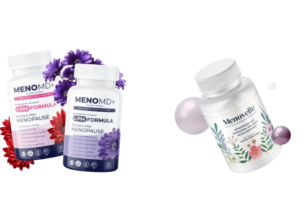
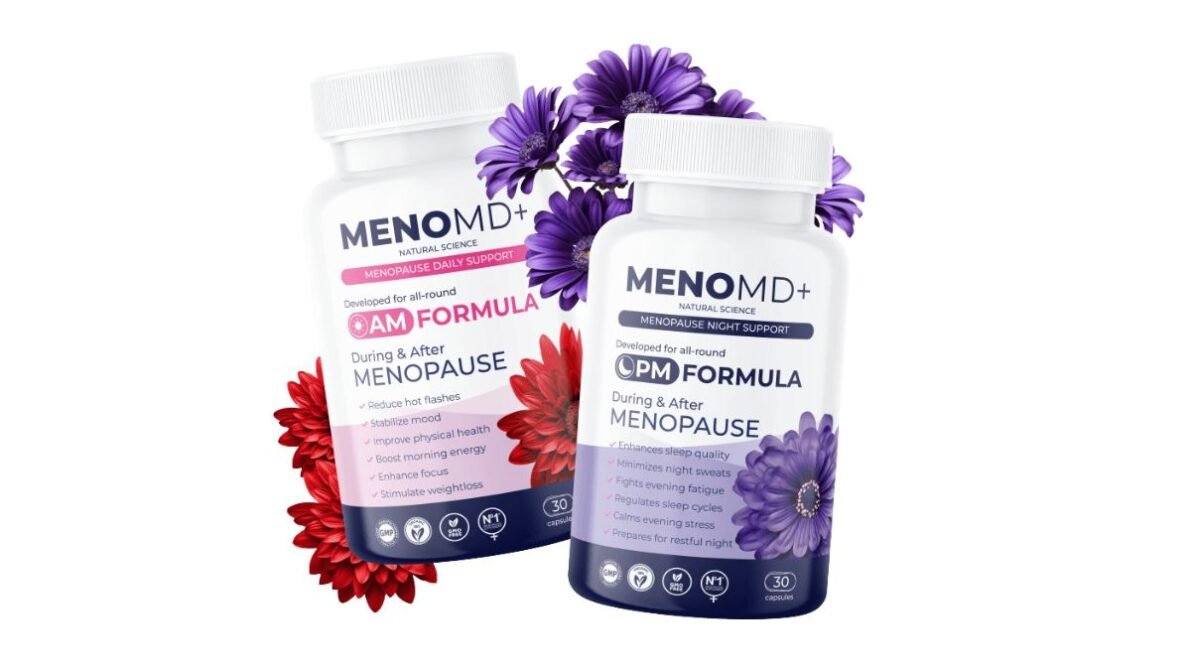
MenoMD+ is sold as an AM/PM capsule system: one capsule in the morning for energy, focus and mood, one before bed for sleep and night-time symptoms. It’s sold direct to consumers online, with a 30-day money-back guarantee.
A first practical problem: there are several. I found the product presented on at least four different web addresses under variations of the brand name — a US-facing site, a UK-facing site describing it for British women, a store subdomain, and a separate retailer listing an “AM Formula”. There’s also a body of promotional content aimed at Canadian buyers, posted on a student note-sharing platform, describing the product as manufactured in Canada under Canadian standards. Meanwhile another brand page describes manufacture in FDA-registered facilities in the US.
Those can’t all be describing the same supply chain. And as the next section shows, they don’t describe the same formula either.
One Page Says Soy-Free. Another Lists Soy Isoflavone.
This is checkable in a couple of minutes and it’s the finding I’d want a reader to have before ordering.
One brand page states plainly that MenoMD contains no hormones, no soy, and no artificial fillers. It’s presented as a reassurance, and for a lot of women it would be a deciding one.
A separate listing for the MENOMD+ AM Formula describes the hormonal-balance component of the product as coming from Dong Quai and Soy Isoflavone.
Those two statements can’t both be true of the same capsule.
Why it matters, in order of seriousness. Soy is one of the major allergens — a woman avoiding soy for allergy reasons is being told this product is safe for her on one page and given the opposite information on another. Soy isoflavones are phytoestrogens, plant compounds with weak oestrogen-like activity, which is precisely why they’re used in menopause formulas. A product that describes itself as containing no hormones while containing phytoestrogens is technically accurate and practically misleading. And for a woman with a history of oestrogen-sensitive cancer, phytoestrogen content is not a footnote — it’s the first thing her oncologist would want to know.
I can’t tell you which page is right, because no version I found publishes a Supplement Facts panel with amounts. Everything below is therefore about ingredients the brand’s own materials name — treated as brand-stated, not verified.
What the Menopause Society Actually Says About This Category
Before going ingredient by ingredient, there’s a shortcut worth knowing about, and it’s authoritative.
The Menopause Society — the leading professional body in this field — published a position statement in 2023 specifically on non-hormonal treatments for menopausal symptoms. The panel graded the evidence and sorted every option into recommended and not recommended.
Recommended, at the strongest evidence level: cognitive behavioural therapy, clinical hypnosis, certain antidepressants, gabapentin, and fezolinetant. Also recommended: oxybutynin, weight loss, stellate ganglion block.
That’s the whole product category, reviewed by the people who treat this for a living, and declined. It doesn’t mean nothing in a menopause supplement can help anyone. It does mean that when a sales page says a formula is “science-backed” or offers “proven relief”, the professional body that reviewed that science reached the opposite conclusion.
Worth noting the same statement is clear that hormone therapy remains the most effective option, and that non-hormonal alternatives matter most for women who can’t take it — because of contraindications like oestrogen-dependent cancers or cardiovascular disease — or who prefer not to.
Black Cohosh Needs a Conversation
Black cohosh is named across MenoMD+’s marketing and it’s the ingredient with the most serious safety file in this category.
The NIH’s LiverTox database states that products labelled as black cohosh have been implicated in many instances of clinically apparent acute liver injury, some severe enough to lead to emergency liver transplantation or death. Over fifty case reports have been published, ranging from self-limited hepatitis to acute liver failure. Onset has been reported anywhere from one to forty-eight weeks after starting, most commonly between two and twelve weeks. The US Pharmacopeia has recommended that black cohosh products carry a warning that they may be toxic to the liver.
Proportion matters, and I want to be fair. These events are uncommon relative to how many women use black cohosh, and causality has been debated — some cases may involve misidentified plant material rather than genuine black cohosh. Trials at standard doses report adverse events in a small minority.
But the efficacy side doesn’t offset it well. The Merck Manual notes that the Menopause Society does not recommend black cohosh because the supporting evidence is low quality, and that conventional treatments offer greater benefit. Data from several randomised trials don’t support its efficacy for menopausal symptoms.
So: uncertain benefit, uncommon but genuinely serious risk, and — in this product — an undisclosed amount inside a formula whose own pages disagree about what else is in it.
If you have liver disease, take medication that’s hard on the liver, or drink regularly, this is a pharmacist conversation before you start. And if you develop fatigue, nausea, abdominal pain, dark urine, or yellowing of the skin or eyes while taking any menopause supplement, stop and get liver enzymes checked.
If You’ve Had Breast Cancer, Read This Twice
This section exists because of a specific and cruel overlap.
Tamoxifen is prescribed after certain breast cancers, and one of its most common side effects is severe hot flashes. Women on tamoxifen are therefore among the most motivated buyers of non-hormonal menopause supplements — they have intense symptoms and, often, a reason not to take hormone therapy.
The Merck Manual notes that black cohosh may reduce the effectiveness of tamoxifen and irinotecan.
Read that in context. A woman takes tamoxifen to reduce the chance of her cancer returning. She buys a supplement to cope with the hot flashes tamoxifen causes. The supplement may work against the drug she’s taking to stay well. And in this product’s case, the amount isn’t published, and one brand page lists a phytoestrogen while another says the formula is soy-free.
That combination is why this section is separate and why I’d put it above every other consideration in this article.
If you have had breast or endometrial cancer, or take tamoxifen or an aromatase inhibitor: do not start any menopause supplement without your oncology team’s sign-off. There are non-hormonal options with real evidence for hot flashes in this exact population, and your team knows which ones fit your treatment. That conversation is free and it’s the right one.
Wild Yam and the Progesterone That Isn’t
The PM formula is described as containing wild yam, alongside valerian and rhodiola. Wild yam deserves its own explanation because the belief around it is widespread and specifically wrong.
Wild yam contains diosgenin, a steroid precursor. In a laboratory, chemists genuinely can convert diosgenin into progesterone — that’s historically how some steroid hormones were manufactured. From this, an enormous consumer market grew around the idea that taking wild yam gives your body progesterone.
The Menopause Society’s position statement addresses it directly: diosgenin is converted to progesterone in vitro, but there is no biochemical pathway for this conversion in the human body. Evidence for wild yam in vasomotor symptoms is limited, and one clinical trial of a yam cream reported no significant benefit.
Your body is not a chemistry lab. The reaction that works in a flask doesn’t happen in your liver.
That doesn’t make wild yam harmful — it’s generally well tolerated. It makes it inert for the purpose most people buy it for.
Dong Quai, Ashwagandha, and the Rest
Dong quai is named in the AM formula. It has a long history in traditional Chinese medicine, usually as part of a multi-herb prescription rather than alone. Its practical issue is interaction: it can increase bleeding risk and matters if you take warfarin or another anticoagulant. It also causes photosensitivity in some people, and it’s contraindicated in pregnancy.
Ashwagandha has reasonable evidence for stress and sleep measures — it’s one of the better-supported adaptogens. It also has a documented, if uncommon, association with liver injury, which is worth knowing when it’s stacked with black cohosh in the same daily routine. It’s generally avoided in thyroid disease without medical input, and in pregnancy.
Valerian has modest, inconsistent evidence for sleep. Broadly well tolerated.
Rhodiola and Panax ginseng have some fatigue and mood data. Ginseng interacts with warfarin and can affect blood glucose.
Vitamins D3 and B12 are sensible inclusions and genuinely matter in midlife — vitamin D for bone health particularly. They’re also inexpensive and available separately at stated doses, which is worth knowing if they’re part of what’s drawing you in.
None of these is absurd in a menopause formula. The recurring problem is the same: no amounts, so no comparison against the doses used in any study, and several ingredients with real interaction profiles sharing one capsule.
What I Liked
The AM/PM split is a sensible design idea. Separating a daytime formula from a night-time one is more thoughtful than one capsule doing everything, and it matches how menopausal symptoms actually distribute across the day.
Some ingredients are legitimate choices. Ashwagandha, valerian, vitamin D3 and B12 aren’t filler picked for exotic names. Someone read something.
The FAQ advises consulting a physician if you take prescription medication or manage a health condition. That’s correct advice and it’s stated.
The FDA disclaimer is present and correctly worded.
A 30-day guarantee exists, and free shipping appears as a real deduction.
The category isn’t dismissible. Menopause symptoms can be genuinely debilitating, and women who can’t take hormone therapy deserve options. Wanting something to try is entirely reasonable — the issue is what’s being offered and how it’s framed.
Things to Consider
Brand pages contradict each other on soy, one of the major allergens.
“No hormones” sits alongside a phytoestrogen ingredient on a different page for the same product.
No Supplement Facts panel with amounts on any version I could find.
The Menopause Society doesn’t recommend this category for vasomotor symptoms, and names soy extracts specifically.
Black cohosh carries a liver injury file and a USP warning recommendation.
Black cohosh may reduce tamoxifen’s effectiveness.
Wild yam cannot become progesterone in your body.
At least four web addresses market the product, with different manufacturing claims.
“Proven relief” and “science-backed” conflict with the professional review of that science.
Positioning against HRT steers women away from the most effective treatment, which also protects bone.
What Hormone Therapy Actually Involves
Since the product defines itself against it, you deserve a fair account rather than either sales pitch.
Hormone therapy is the most effective treatment for hot flashes, night sweats and genitourinary symptoms, and it prevents bone loss and fracture. For women under 60 or within ten years of menopause onset, without contraindications, the Menopause Society describes the benefit-risk balance as favourable.
It isn’t free of risk, and the honest version includes that. Risks vary by type, dose, duration, route and timing. Combined oestrogen-progestogen therapy carries a rare increased risk of stroke, venous thromboembolism and breast cancer; the same statement notes breast cancer risk doesn’t rise appreciably with short-term combined use and may be decreased with oestrogen alone. Starting more than ten years after menopause, or over 60, shifts the balance less favourably. It’s contraindicated for some women outright.
For low-dose vaginal oestrogen, used for genitourinary symptoms, the systemic exposure is minimal — and observational data suggest it appears safe even for selected breast and endometrial cancer survivors who haven’t responded to non-hormonal options.
The point isn’t that every woman should take it. It’s that this is a genuinely individualised decision requiring your history, and a website selling capsules is not equipped to make it for you by implying you won’t need the conversation.
Price, Guarantee, and What to Screenshot
Pricing appears on the seller’s page rather than in this article, because figures differ across the brand’s various addresses and may be generated at page load. Check the total, and treat any struck-through “retail” figure as a reference price rather than evidence of what anyone has paid.
You’ll notice there’s no link to buy in this article. That’s deliberate. This site usually earns a commission when readers purchase through our links, and on most products that’s a fair arrangement — the article tells you honestly what you’d be getting, and you decide. This one is different. Hormone therapy is the most effective treatment for these symptoms and it protects bone, and a product marketed as making that conversation unnecessary is not something we want a financial stake in. If you buy after reading, that’s your decision to make freely — we’re simply not taking a cut of it.
The guarantee is 30 days — the shortest window in this category, where 60 to 180 days is more common. One brand page also states that many women continue using the system throughout perimenopause and into postmenopause, which is a multi-year framing wrapped around a one-month refund.
If you order:
Screenshot the page you buy from, including price and guarantee wording, on the day you pay.
Buy the smallest package and diarise day 20.
Ask for the full Supplement Facts panel before ordering — every ingredient with its amount, and a clear answer on whether the formula contains soy. If that isn’t forthcoming, you have your answer.
Tell your doctor or pharmacist what you’re taking, particularly if you’re on anticoagulants, thyroid medication, tamoxifen, or anything hepatically active.
Final Verdict
MenoMD+ is sold on a promise its own category can’t support, with a formula its own pages can’t agree on.
One brand page says soy-free; another lists soy isoflavone. No version publishes amounts. Black cohosh carries a documented liver injury file and may interfere with tamoxifen. Wild yam cannot do the thing wild yam is bought to do. And the professional body that reviewed this entire category of treatment placed supplements and herbal remedies in the not-recommended column.
Who should not buy this: anyone with a history of breast or endometrial cancer, anyone taking tamoxifen or an aromatase inhibitor, anyone with liver disease or on hepatically active medication, anyone on anticoagulants, anyone with soy allergy — because you cannot confirm what’s in it — and anyone pregnant or breastfeeding.
If you want to try something anyway: buy single ingredients at stated doses from a retailer that prints the label, so you and your pharmacist can actually assess them. Vitamin D and B12 are cheap and separately available. Ashwagandha and valerian are sold on their own with amounts on the bottle.
And what I’d genuinely suggest first. Book the appointment. Menopause care has changed considerably, and a doctor who’s up to date can talk you through hormone therapy honestly — including whether you’re a candidate and what the risks look like for you specifically. If you’re not a candidate or don’t want it, the non-hormonal options the Menopause Society does recommend are real: cognitive behavioural therapy, certain antidepressants, gabapentin, and newer non-hormonal medications developed specifically for hot flashes. Those are prescriptions and referrals, not purchases, and they have evidence behind them that no capsule in this category can match.
If you’re comparing products in women’s midlife health, our FemiCore review covers another formula in this space, and the questions from this article carry over: does the label state every ingredient with an amount, and does the page position itself against a treatment your doctor should be discussing with you?
Frequently Asked Questions
Does MenoMD+ contain soy?
The brand’s own pages disagree. One states the formula contains no soy; a listing for the AM formula names soy isoflavone as a hormonal-balance ingredient. Since no Supplement Facts panel with amounts appears on any version I could find, there’s no way to resolve it from the outside. If you have a soy allergy, that uncertainty is itself the answer — ask the company in writing before considering it.
Is black cohosh safe?
For most women at standard doses, adverse effects are uncommon. But it has been implicated in cases of serious liver injury, some requiring transplant, and the US Pharmacopeia has recommended a hepatotoxicity warning on labels. The Menopause Society doesn’t recommend it, citing low-quality efficacy evidence. If you have liver disease or take liver-affecting medication, discuss it with a pharmacist first.
Can I take this if I’m on tamoxifen?
Ask your oncology team before you take anything. Black cohosh may reduce the effectiveness of tamoxifen. Women on tamoxifen often have severe hot flashes caused by the drug itself, which makes them a common buyer for products like this — and that’s precisely why this needs a specialist conversation rather than a self-directed purchase.
Does wild yam give my body progesterone?
No. Diosgenin, the compound in wild yam, can be converted to progesterone in a laboratory, but there is no biochemical pathway for that conversion in the human body. It’s one of the most persistent misunderstandings in this market.

Raphael Albert is the founder and content creator of Nutra Pulse. Passionate about health, nutrition, fitness, and wellness, he spends his time researching scientific studies, health trends, and evidence-based lifestyle strategies to create informative and easy-to-understand content. While he is not a doctor or licensed healthcare professional, his goal is to help readers make more informed wellness decisions. All content is for educational purposes only and should not replace professional medical advice. Always consult a qualified healthcare provider regarding your health concerns.