
Transparency note: this site normally earns a commission when readers buy through our links. There are no purchase links in this article, and we earn nothing whatever you decide. We chose not to monetise this one, for reasons the section on stopping prescribed medication makes clear.
These statements have not been evaluated by the Food and Drug Administration. This product is not intended to diagnose, treat, cure, or prevent any disease. If you are currently prescribed a GLP-1 medication, do not stop or reduce it because of a supplement. Stopping is associated with substantial weight regain, and that decision belongs to you and your prescriber together.
There is a genuine, well-conducted human study on the bacterium at the centre of this product. It was published in Nature Medicine, it came out of a serious research group, and its findings were encouraging.
It also, specifically and measurably, did not find the effect this product is named after.
In that study, 32 overweight and obese insulin-resistant volunteers took Akkermansia muciniphila daily for three months. Pasteurised A. muciniphila improved insulin sensitivity by about 29%, reduced insulinaemia by around 34%, and lowered total cholesterol by roughly 9% compared with placebo. Real results, in real people, from a properly randomised design.
Now the part that matters here. A commentary in Cell Metabolism reviewing this field states it plainly: in humans, both live and pasteurised Akkermansia improved several cardiometabolic risk factors, including insulin resistance, without increasing circulating GLP-1 levels.
Without increasing GLP-1.
The GLP-1 story attached to this bacterium comes from a different line of work — a secreted protein called P9, which stimulated GLP-1 release in obese mice. The same commentary notes that those researchers did not demonstrate the physiological relevance of P9, only that giving it pharmacologically improved metabolic health in mice.
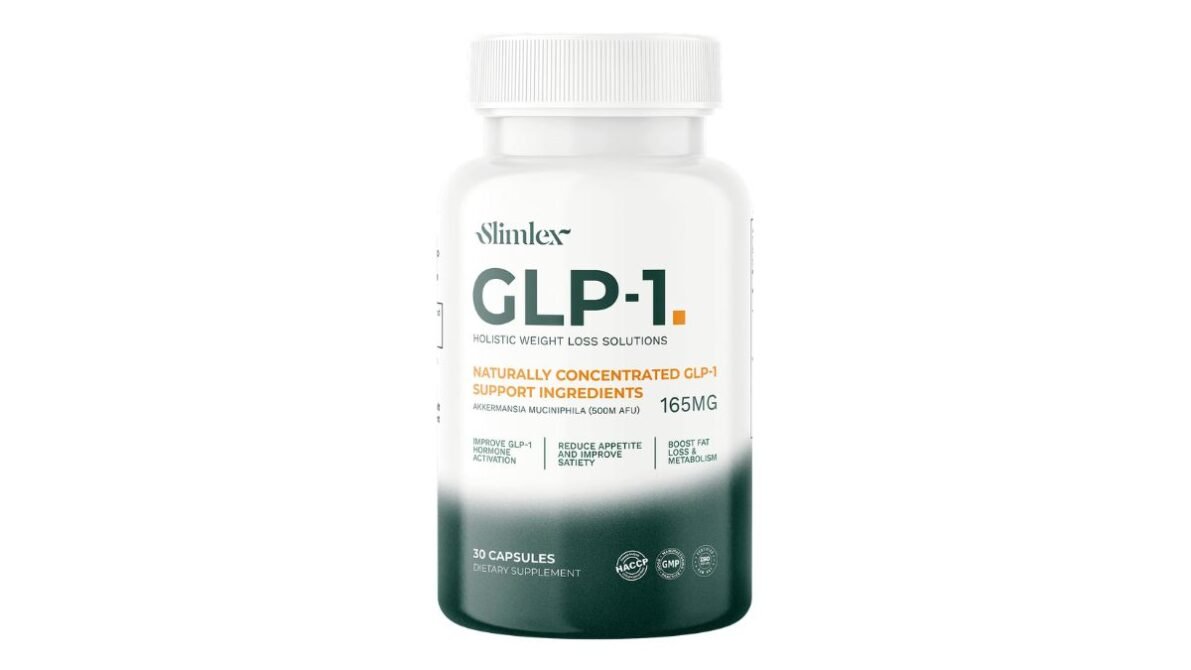
So this Slimlex GLP-1 review starts from an unusual position. The ingredient is legitimate. The research behind it is decent. And the specific mechanism the product is named for, marketed on, and compared to prescription medication over is the one thing the human evidence didn’t show.
What Slimlex Is
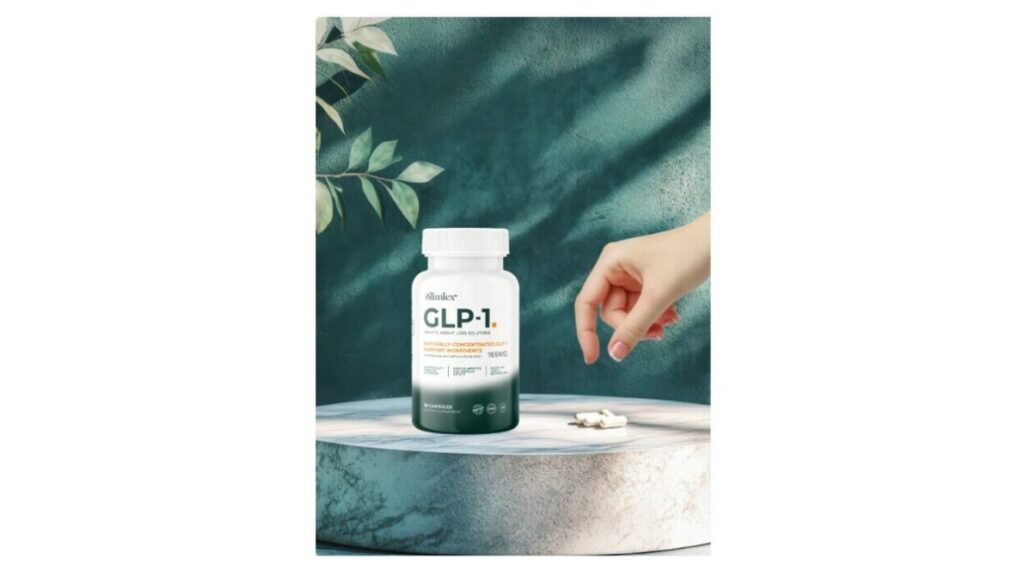
A capsule taken twice daily — one with breakfast, one with dinner — sold direct to consumers online rather than through pharmacies or retailers.
The formula, as published across the brand’s pages:
Akkermansia muciniphila — 500 million AFU. The headline ingredient.
A Satiety Support Blend containing resistant soluble corn fibre, fructooligosaccharides (FOS), and cranberry 10:1 extract. Amounts for the individual fibres aren’t consistently published.
The product is described as vegan, gluten-free, sugar-free, and manufactured to GRAS standards.
A note on that measurement unit. AFU — active fluorescent units — is not the same as CFU, the colony-forming units most probiotics use. AFU is measured by flow cytometry rather than by growing colonies on a plate, and it’s a legitimate choice for organisms like Akkermansia that are genuinely difficult to culture. It also means direct comparison with CFU-labelled products isn’t straightforward, and comparison with the trial dose requires care. I’ll come back to that.
What “Natural Alternative” Is Being Compared With
The product is marketed as a natural alternative to prescription GLP-1 medication, naming those drugs directly. So it’s worth knowing what’s on the other side of that comparison.
In the STEP 1 trial — 1,961 adults, 68 weeks, randomised and placebo-controlled, published in the New England Journal of Medicine — once-weekly semaglutide 2.4 mg produced mean weight loss of 14.9% of body weight, against 2.4% on placebo. Around 86% of participants lost at least 5% of their body weight, compared with about 32% on placebo.
That’s the benchmark being invoked. For a person weighing 100 kg, it’s roughly 15 kg over about sixteen months.
I want to be fair about the medication too, because presenting it as a miracle would be its own distortion. A follow-up analysis of STEP 1 found that after treatment stopped, participants regained about 11.6 percentage points of the weight they’d lost within a year, and most cardiometabolic improvements drifted back toward baseline. These drugs work while you take them; they’re treatment for a chronic condition, not a cure. They also carry real side effects, mostly gastrointestinal, and they’re expensive.
Those are legitimate reasons someone might want an alternative. What they aren’t is a reason to believe a probiotic delivers a comparable effect. The honest framing is that no supplement has produced anything close to those numbers in a randomised trial, and this one has produced no published trial at all under its own name.
500 Million Against 10 Billion
Here’s the arithmetic, and it’s the practical heart of this review.
The Nature Medicine trial used a daily dose of 10^10 — ten billion — of Akkermansia. That’s the amount that produced the insulin sensitivity and cholesterol results described at the top of this article.
Slimlex provides 500 million AFU per capsule.
Even taking two capsules daily, that’s one billion — a tenth of the trial dose. On a per-capsule basis it’s a twentieth.
The AFU-versus-CFU distinction complicates a precise comparison, and I don’t want to overstate the precision. Flow cytometry counts cells that are metabolically active, including ones that wouldn’t form colonies, so AFU figures aren’t directly interchangeable with CFU figures. But the gap here is an order of magnitude, and no measurement convention closes an order of magnitude.
If the Akkermansia is doing the work the marketing describes, it’s doing it at a fraction of the only amount anyone has tested in people.
Live or Pasteurized? The Trial Says It Matters
This is a subtle point and it’s genuinely important, because it’s counterintuitive.
The Nature Medicine trial had three arms: placebo, live Akkermansia, and pasteurised — that is, heat-killed — Akkermansia. The significant improvements in insulin sensitivity, insulinaemia and cholesterol came from the pasteurised arm. The live bacteria arm didn’t reach significance on those endpoints.
That’s not a quirk. Follow-up work has explored why a heat-killed preparation might outperform a live one, with attention to a membrane protein that survives pasteurisation. The finding has held up well enough that pasteurised Akkermansia is what subsequent clinical trials have used.
Slimlex is marketed as a probiotic — a word that means live organisms by definition, and the brand’s pages describe a “beneficial probiotic strain” and measure it in active units. If what’s in the capsule is live Akkermansia, it corresponds to the arm of the trial that didn’t produce the significant results.
I can’t confirm which preparation is used, because no page I found specifies. It’s a question worth asking the company before ordering, and the answer would tell you a lot.
The Satiety Blend: Fibre, at Fibre Doses?
The second half of the formula is more straightforward and, in principle, more defensible.
Resistant soluble corn fibre and FOS are genuine prebiotic fibres. Fibre slowing gastric emptying and increasing satiety is real physiology — it’s one of the better-established mechanisms in nutrition, and it’s part of why higher-fibre diets help with appetite regulation.
The problem is quantity, again. Fibre works at gram doses. FOS studies showing bifidogenic effects typically use 2.5 to 10 grams daily, and satiety effects from soluble fibre generally require several grams per meal. A capsule containing a probiotic plus three blended fibre ingredients cannot hold multiple grams of fibre — capsule volume simply doesn’t allow it.
Cranberry 10:1 extract has decent evidence for urinary tract health and no established role in satiety or weight.
So the satiety blend is composed of ingredients that do work — at amounts a capsule can’t deliver. A bowl of oats or a serving of beans provides more of what’s being described here than the capsule does, which is an unglamorous thing to say but true.
The Press Logos and the 115,000 Customers
Two credibility signals on the page deserve a closer look.
The media logos. Well-known outlet names appear, and the impression is that journalists at those publications examined and endorsed the product. In this market, that’s almost never what happened. What generates such placements is a paid press release distributed through a newswire service, which then appears on financial and news portals that syndicate wire content. Some of those portals carry explicit disclaimers noting that syndicated content isn’t verified by their editorial teams.
I found this product covered in exactly that format — a regional newspaper’s health section carrying what reads as a product review, structured as promotional copy. If you see a masthead next to a supplement, the useful question is whether a named journalist wrote it and whether the outlet’s own newsroom stands behind it.
“115,000+ happy customers.” The figure appears repeatedly with no link to where those customers left feedback, no review platform, and no verification method. Notably, one of the brand’s own regional sites displays testimonials that appear to belong to a completely different product — a keto gummy — which suggests testimonial content moving between funnels rather than coming from verified buyers.
Treat both signals as marketing rather than evidence.
What I Liked
Akkermansia is a serious ingredient choice. This isn’t a made-up botanical. It’s one of the most actively researched organisms in metabolic microbiome science, with a real human trial and a research group of standing behind it. Somebody was reading the right literature.
The dose is stated. 500 million AFU is published. After the products in this series that name no amounts at all, that’s worth acknowledging — and it’s what made the comparison in this article possible.
Using AFU is technically appropriate. Akkermansia is hard to culture, and flow cytometry is the honest way to count it. That’s a formulation decision made by someone who understood the organism.
The fibre choices are reasonable. Resistant corn fibre and FOS are legitimate prebiotics, not filler.
Akkermansia appears genuinely safe. The Nature Medicine trial reported it as safe and well tolerated, which is a meaningful finding for a novel organism.
Things to Consider
The human trial found no rise in GLP-1 — the mechanism the product is named for.
The GLP-1 evidence is from mice, via a protein whose physiological relevance the commentators say wasn’t established.
500 million AFU against a 10 billion trial dose.
The trial’s positive results came from pasteurised, not live, bacteria — and the product is sold as a probiotic.
The satiety fibres are at capsule doses, not the gram doses fibre requires.
No published trial exists on this formula.
“Clinically proven formula” appears on brand pages with no trial identified.
Press logos almost certainly reflect paid syndication, not editorial coverage.
“115,000+ customers” has no destination, and at least one brand site shows testimonials for a different product.
At least seven domains present themselves as the official site.
Who Should Be Careful
Akkermansia looks safe in the published work, and the fibres are food-category ingredients. Genuine cautions:
Anyone significantly immunocompromised — on chemotherapy, post-transplant, or with a central line. Live organisms warrant medical input, and Akkermansia has less long-term safety data than conventional probiotic species.
Anyone with a compromised gut barrier, active inflammatory bowel disease, or short bowel syndrome — worth discussing, since Akkermansia is a mucin-degrading organism and its role in a damaged gut lining is not fully characterised.
Anyone prone to bloating or with IBS. FOS is a fermentable oligosaccharide and a known trigger for gas and bloating in sensitive people. It’s the “O” in FODMAP.
Anyone with a corn allergy — both the resistant fibre and often the FOS are corn-derived.
Anyone pregnant or breastfeeding. No safety data for this organism in pregnancy.
Anyone taking diabetes medication. If the insulin-sensitivity findings translate at all, that’s additive with medication that lowers glucose. Tell your prescriber.
The One That Worries Me Most
Everything above is about whether the product works. This section is about a specific harm, and it’s the reason this review is written the way it is.
If you are currently prescribed a GLP-1 medication and the phrase “natural alternative” leads you to stop it, the consequence is measurable. The STEP 1 extension found that people regained around 11.6 percentage points of lost body weight within a year of stopping, with cardiometabolic gains reverting toward baseline. That’s not a small setback. And for someone taking one of these drugs for type 2 diabetes rather than weight alone, stopping without medical supervision has more immediate consequences than weight regain.
Do not stop, reduce, or space out prescribed medication because of a supplement. If cost or side effects are the reason you want off, that’s a genuine and common problem — and it’s a conversation with your prescriber, who has options including dose adjustment, alternative agents, and knowledge of patient assistance programmes.
Equally: if you have obesity and have been considering asking a doctor about treatment, please don’t let a capsule postpone that appointment. Obesity is a chronic medical condition with treatments that work, and the gap between what’s in this bottle and what’s available on prescription is roughly the width of the STEP 1 results.
Price, Guarantee, and Which Site You’re On
Pricing and guarantee terms vary across the brand’s several domains, so check them on whichever page you actually land on, and screenshot the terms — including price, package and refund window — on the day you pay.
You’ll notice this article contains no link to buy. That’s deliberate, and it’s worth explaining rather than leaving you to wonder. This site usually earns a commission when readers purchase through our links, and on most products we’re comfortable with that arrangement because the article tells you honestly what you’d be getting. Here the marketing is built on a comparison with prescription medication, and the most likely reader is someone weighing this against a drug they’ve been prescribed or are considering. Taking a commission from that decision isn’t a position we want to be in. If you decide to buy after reading, that’s entirely your call — we simply aren’t taking a cut of it.
That advice carries more weight here than usual, because I found at least seven addresses presenting themselves as the official site, with country variants and near-identical names. They don’t all say the same things: pricing differs, and at least one displays testimonials belonging to an unrelated product. If you order, confirm the refund terms in writing with support before sending anything back.
On independent reviews: none is available in a form I’d trust. The product is sold direct, so there’s no verified-purchase pool, and the search results are paid advertorials and affiliate stores.
Final Verdict
Slimlex is built on a real ingredient, a real study, and a mechanism that study specifically didn’t find.
That combination is unusual and worth stating precisely. Akkermansia muciniphila is legitimate science — a properly conducted human trial found improved insulin sensitivity and lower cholesterol, and that’s a genuinely interesting result. But the trial used ten billion daily, used the pasteurised form, and reported those benefits without any increase in circulating GLP-1. This product provides a fraction of that dose, is sold as a live probiotic, and takes its name and its entire marketing frame from the one thing the human evidence didn’t show.
Comparing it to prescription GLP-1 medication compounds that. Those drugs produced roughly 15% body weight loss in a 1,961-person randomised trial. There is no published trial on this formula at all.
Who might reasonably try it: someone interested in Akkermansia for gut and metabolic health specifically — not as a weight-loss drug substitute — who isn’t immunocompromised or pregnant, who understands the dose is well below what was studied, and who is not currently on GLP-1 medication. That’s a narrow group and the honest expectation is little to nothing.
Who should skip it: anyone taking a prescribed GLP-1 drug, anyone who’d delay medical treatment for obesity because of it, and anyone buying on the strength of the comparison to prescription medication.
What actually works, in descending order of evidence. For obesity as a medical condition, prescription treatment has effect sizes nothing in the supplement aisle approaches — that’s a conversation with a doctor, and increasingly an accessible one. Alongside or instead: a sustainable calorie deficit, protein and fibre high enough to manage hunger, resistance training to protect muscle, and sleep. Dietary fibre at gram doses does more of what the satiety blend describes than the capsule does, and comes with groceries.
If you’re comparing products in this category, our Ignitra review covers another weight formula — and it’s worth reading alongside this one, because its reference list is built almost entirely on research about prescription GLP-1 drugs that aren’t in the bottle either.
Frequently Asked Questions
Does Akkermansia actually raise GLP-1 in people?
Not according to the human evidence. The published trial found improvements in insulin sensitivity and cholesterol with Akkermansia supplementation, but a review of this research area notes explicitly that these occurred without increasing circulating GLP-1 levels. The GLP-1 mechanism comes from work on a bacterial protein tested in mice, and the commentators on that work noted its physiological relevance in humans wasn’t demonstrated.
Is 500 million AFU enough?
It’s well below what was studied. The human trial used ten billion daily. AFU and CFU are measured differently, so the comparison isn’t perfectly like-for-like, but the difference here is an order of magnitude and no counting convention closes that gap.
Can this replace my Ozempic or Wegovy?
No — and please don’t treat it as though it could. Semaglutide produced about 15% mean body weight loss in a 1,961-person randomised trial; there is no published trial on this supplement. Stopping a prescribed GLP-1 medication is associated with substantial weight regain. If cost or side effects are your reason for wanting off, raise that with your prescriber, who has options.
Are there side effects?
Akkermansia was reported as safe and well tolerated in the published trial. The more likely nuisance is the FOS, a fermentable fibre that commonly causes gas and bloating in people with IBS or sensitive digestion. Anyone immunocompromised, pregnant, or with active inflammatory bowel disease should check with a doctor before taking live bacterial supplements.

Raphael Albert is the founder and content creator of Nutra Plus. Passionate about health, nutrition, fitness, and wellness, he spends his time researching scientific studies, health trends, and evidence-based lifestyle strategies to create informative and easy-to-understand content. While he is not a doctor or licensed healthcare professional, his goal is to help readers make more informed wellness decisions. All content is for educational purposes only and should not replace professional medical advice. Always consult a qualified healthcare provider regarding your health concerns.
1 thought on “Slimlex GLP-1 Review: The Human Trial Found Something Real — Just Not This”