
Transparency note: this site normally earns a commission when readers buy through our links. There are no purchase links in this article. It exists to help you understand the category before deciding; the individual reviews it points to carry their own disclosures, and one of them is published without any affiliate link at all.
These statements have not been evaluated by the Food and Drug Administration. These products are not intended to diagnose, treat, cure, or prevent any disease. Urinary symptoms in men over 50 usually mean an enlarged prostate — but the same symptoms can come from prostate cancer, bladder cancer, a urethral stricture or diabetes, and they feel identical from the inside. No supplement distinguishes between them, and none replaces urological follow-up.
Walk down the men’s health supplement aisle — or scroll it, which is where most of it lives — and everything looks like a variation on one theme. Prostate support, testosterone support, vitality, performance, energy. Same demographic, same imagery, often the same brands.
Men’s health supplements are not one category. They’re at least three, and the biology underneath them is genuinely different:
Prostate and urinary health, which is about an enlarged prostate pressing on your urethra.
Testosterone, which is about a hormone that declines gradually with age.
Sexual performance, which is largely about blood flow.
That distinction matters more than it sounds, because two of those three point in opposite directions. A product designed to raise testosterone and a product designed to help an enlarged prostate are, pharmacologically, working against each other.
That’s not a subtle technical point. It’s the single most useful thing to understand before buying anything in this aisle, and it explains why one of the products reviewed on this site carries a prostate label on what is functionally a testosterone formula.
Here’s how the categories actually divide, what the evidence supports in each, and — most importantly — the symptoms that mean you should be booking an appointment rather than comparing products.
The Contradiction at the Centre of This Market
Prostate growth is driven by dihydrotestosterone, or DHT, which your body makes from testosterone using an enzyme called 5-alpha-reductase.
That’s why the only drug class acting on the underlying cause of benign prostatic hyperplasia works by blocking that enzyme. 5-alpha-reductase inhibitors reduce serum and intraprostatic DHT, causing prostate tissue to involute — finasteride lowers serum DHT by roughly 70%, and prostatic DHT by 85 to 90%. They are the only class of therapy that acts on the pathophysiologic substrate of the disease, arresting progression and reducing the risk of acute urinary retention and surgery.
Lower the androgen, shrink the prostate. That’s the established direction.
Now consider what a testosterone booster does. More testosterone means more substrate for 5-alpha-reductase to convert into DHT inside the prostate.
Three qualifications, because overstating this would be its own error. Herbal testosterone effects are modest and inconsistent — these aren’t injections, and trial results are small and often unreplicated. DHT isn’t elevated in men with BPH; it stays roughly constant with age while plasma testosterone declines, which is why researchers describe androgens as permissive rather than straightforwardly causal. And no supplement has been shown to enlarge anyone’s prostate.
But the tension is real and it’s the right question to ask. Either those ingredients meaningfully move your androgens — in which case they’re pushing on the axis that drives prostate growth — or they don’t, in which case the product’s central selling point is empty.
If you take a 5-alpha-reductase inhibitor or an alpha-blocker for BPH, that’s a specific conversation with your urologist before adding anything from the testosterone side of this aisle.
Group One: Formulas That Target Prostate Biology
These products aim at the prostate directly, and their ingredient choices can be checked against a real evidence base.
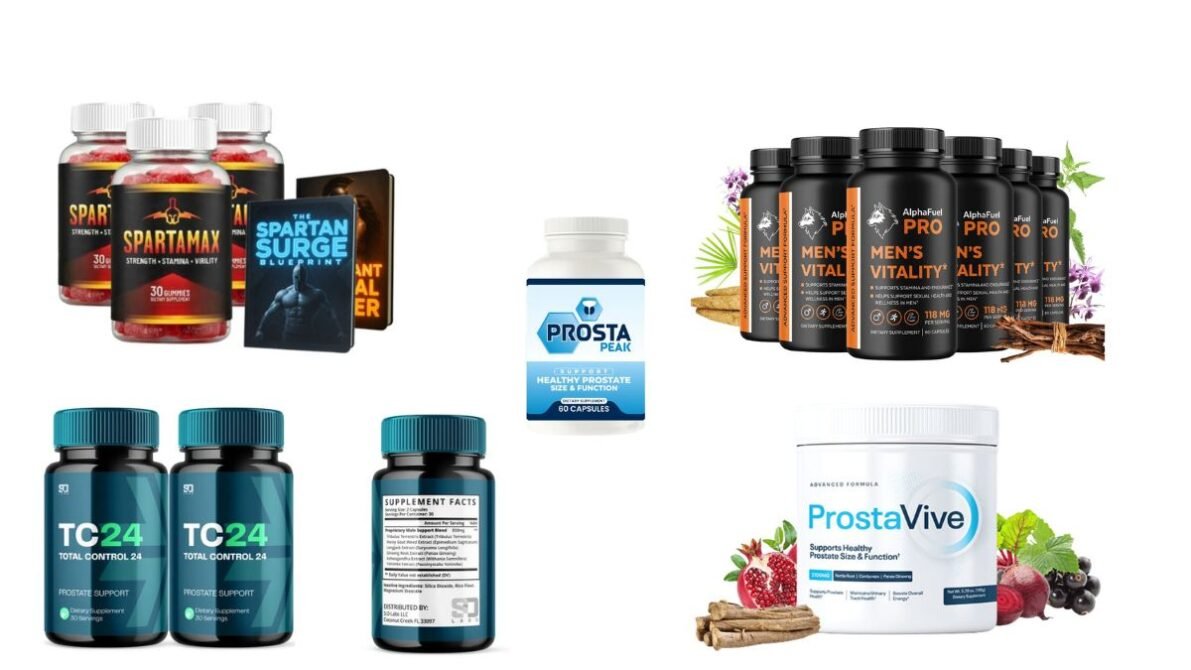
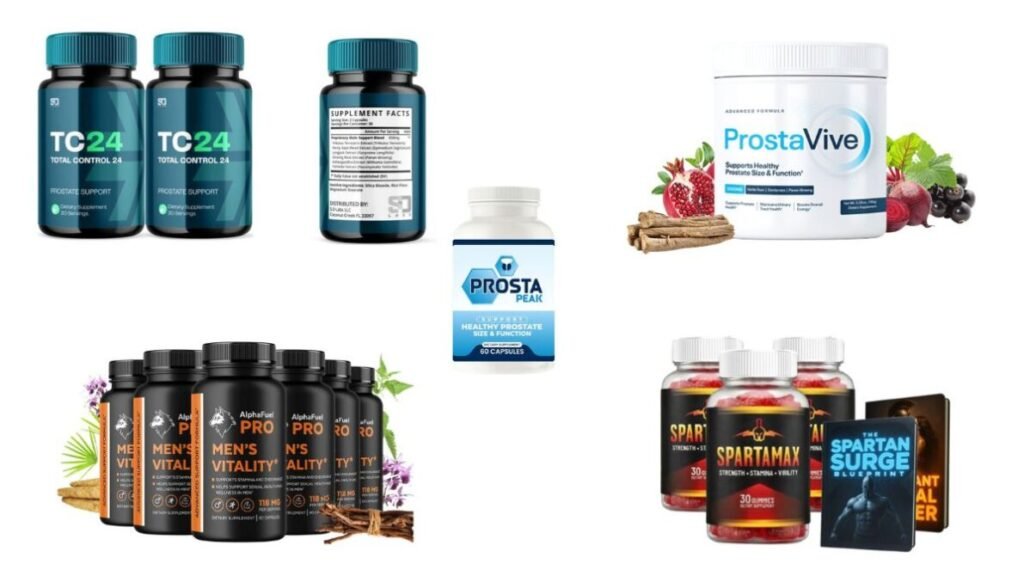
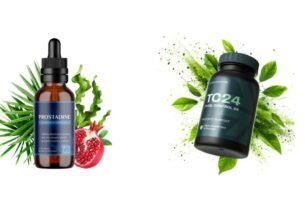
Total Control 24 builds around pygeum africanum, alongside Myrciaria jaboticaba, a branded ingredient called Lipophytol® and boron. Pygeum is a genuinely defensible choice — as the ingredient section below explains, it has the strongest Cochrane evidence of any botanical in this space.
What complicates it: the brand operates across eight or more websites, several with near-miss spellings, and they don’t all list the same formula. Most name the pygeum-based blend; at least one describes saw palmetto, beta-sitosterol and zinc instead. No amounts are published anywhere.
Our Prosta Peak review covers a formula built primarily on saw palmetto — the most popular ingredient in this category, and the one with the most consistently negative trial record. It also contains pygeum, which is the better choice, at an undisclosed amount. That article covers a second issue worth knowing about: the formula includes soursop, which has a neurotoxicity literature and no prostate rationale at all.
The check for this group: does it contain pygeum or beta-sitosterol, and does it tell you how much? The ingredients that work in prostate formulas are identifiable, and the doses used in trials are published.
Group Two: A Prostate Label on a Testosterone Formula
This is where the contradiction described above stops being theoretical.
Our ProstaVive review examines a powder sold for prostate health whose eleven ingredients include tongkat ali, fenugreek, ashwagandha, boron and zinc — five ingredients whose primary market position is raising testosterone. The product’s own page describes fenugreek as supporting male sex hormones.
One ingredient in that formula points the right way: nettle root, which has traditional use in lower urinary tract symptoms and interacts with sex hormone binding globulin in a direction consistent with reducing androgenic drive. It’s one of eleven, at an undisclosed proportion.
The product also cites a real 2023 study from Fukushima Medical University — which we verified, and which is genuine. What that paper examines is androgen-independent mechanisms in BPH, including ischemia and inflammation. It’s a legitimate citation supporting a blood-flow argument, and it sits oddly beside a formula built on androgen-raising herbs.
The check for this group: read the ingredient list and ask what each component is normally sold for. If most of them appear in testosterone products, you’re holding a testosterone formula regardless of what the label says.
Group Three: Performance and Vitality Formulas
The third group targets circulation, energy and sexual performance. Different biology again — largely nitric oxide and blood flow rather than hormones.
Our SpartaMax review covers a gummy containing L-arginine, tongkat ali, maca, ashwagandha, horny goat weed, beet root and grape seed extract. The format is the interesting part: gummies are easier to take consistently than capsules, which matters for adaptogens that only work with sustained use — but they carry meaningfully less material per serving. To the brand’s credit, one of its own pages acknowledges exactly that, stating that gummy formats carry lower doses and expectations should be set accordingly. That’s an unusual admission and it deserves noting.
Worth checking before you buy: the guarantee period differs between the brand’s various websites, with some stating 365 days and at least one stating 60.
Our AlphaFuel Pro review covers a product in the same space, and it’s the one article on this site published without any affiliate link at all. The reason is in that review: the sales page names no ingredients whatsoever, and the FDA’s own guidance states that products marketed for sexual enhancement are likely to be contaminated with hidden drug ingredients — most commonly sildenafil or tadalafil — adding that the agency cannot test every product on the market.
The specific danger is interaction with nitrate medications, which can drop blood pressure to dangerous levels. And the men most likely to have erectile difficulty are heavily represented among men who take nitrates, for the vascular reasons the next section explains.
The check for this group: if a product for sexual performance doesn’t publish its ingredients, that’s the strongest signal on this page. It’s also the category where the regulator has said most explicitly that unlabelled products carry real risk.
What You Might Be Delaying
This is the section that matters more than the rest of this article combined.
For urinary symptoms. Getting up repeatedly at night, a stream that starts and stops, the sense of never quite emptying — in a man over 50, those usually mean benign prostatic hyperplasia. Common, manageable, and not dangerous in itself.
Usually. The same symptoms can come from prostate cancer, bladder cancer, a urethral stricture, a neurological condition or diabetes. There is no way to tell which from how it feels, and no supplement distinguishes between them. Untreated BPH itself can progress to chronic high-pressure retention, a potentially life-threatening condition, and to permanent changes in the bladder muscle.
Get medical attention promptly for:
- Blood in the urine
- Inability to pass urine at all
- Fever alongside urinary symptoms
- Persistent pelvic or lower back pain
- Sudden worsening of urinary difficulty
- New bone pain
For erectile difficulty, there’s a second reason to be seen, and it isn’t about the bedroom.
The arteries supplying the penis are roughly 1 to 2 millimetres across; coronary arteries are 3 to 4. When atherosclerosis narrows blood vessels, the smallest ones show it first. Consensus guidance concludes that ED symptoms precede coronary artery disease symptoms by roughly two to three years, and cardiovascular events by three to five years — a window that allows for risk factor reduction. The same guidance recommends, at its highest evidence grade, that all men with ED undergo assessment including testosterone, fasting lipids, fasting glucose and blood pressure.
That’s four inexpensive tests, in a two-to-five-year window, for the leading cause of death in men. That window doesn’t reopen, and it’s the specific thing a supplement purchase can cost you.
How to Read a Men’s Health Supplement Label
Five checks, each under a minute.
1. Work out which of the three categories it’s actually in. Read the ingredients and ask what each one is normally sold for. A prostate label on a list of testosterone boosters is the most common mismatch in this aisle.
2. Look for the ingredients with real evidence — the next section names them — rather than the ones that appear by association.
3. Check whether amounts are published. “Proprietary blend” means you’re told a combined total, not how much of each. Several products in this category publish nothing at all, and at least one publishes its supplement facts panel as an image file you can’t copy or search.
4. Count the official websites. Two of the five products covered here operate across seven or more domains, some with near-miss spellings, and they don’t all list the same formula or the same guarantee. Whichever page you buy from, screenshot the price and the refund terms that day.
5. Ask whether it’s presented as an addition or a substitute. A product positioned alongside medical care is being sold honestly. One positioned as letting you skip the appointment isn’t — and in this category, that appointment is where the sentinel symptoms get caught.
The Ingredients With Real Evidence
Worth knowing which names to look for, because the gap between the best and worst ingredients in this category is unusually wide.
Beta-sitosterol has the strongest evidence for BPH symptoms of any botanical, and it’s less commonly used than saw palmetto — which is worth knowing when comparing labels.
Pygeum africanum comes next. A Cochrane review of 18 randomised trials covering 1,562 men found that pygeum users were more than twice as likely to report improvement in overall symptoms, with 19% less nocturia, 24% less residual urine volume and 23% better peak urine flow. The trials used around 100 mg daily of standardised extract. That’s a real result at a specific, achievable dose — which makes it the ingredient worth looking for, and the amount worth checking against.
Saw palmetto is the most popular ingredient in this category and has the weakest record. The STEP trial found no improvement over placebo. CAMUS tested escalating doses to 960 mg daily over 72 weeks and found placebo numerically better. A Cochrane review of 27 randomised trials covering 4,656 men concluded little or no benefit. One genuinely useful finding did emerge: saw palmetto does not affect PSA readings at any dose, so it won’t mask a cancer screening result.
Nettle root — as distinct from nettle leaf — has modest evidence in lower urinary tract symptoms and appears in European phytotherapy, often combined with saw palmetto.
Tongkat ali, fenugreek, ashwagandha and boron belong to the testosterone group. Each has some human research, with modest and inconsistent effects. They aren’t prostate ingredients, and in a prostate product their presence is a signal about what you’re actually buying.
L-arginine and horny goat weed belong to the circulation group — L-arginine as a nitric oxide precursor, horny goat weed via icariin, a weak PDE5 inhibitor acting on the same enzyme as prescription ED drugs. That last point matters: it means even the herbal route touches the mechanism that carries the nitrate warning.
And what outperforms all of them: for BPH, prescription treatments arrest progression and reduce the risk of retention and surgery, and they’re inexpensive as generics. For erectile difficulty, weight loss and increased physical activity have been reported to improve erectile function directly, at the highest evidence level — treating the cause rather than the symptom. For testosterone, sleep, resistance training and body composition move it more reliably than any botanical.
The Full Library, by Objective
Everything covered above, organised by what you’re actually comparing.
Prostate-targeted formulas
- Total Control 24 review — pygeum-based, and the domain and formula inconsistencies to check
- Prosta Peak review — saw palmetto’s trial record, and an ingredient with no prostate rationale
Prostate label, testosterone formula
- ProstaVive review — five testosterone ingredients in a prostate product, and why that runs against the pharmacology
Performance and vitality
- SpartaMax review — the gummy format trade-off, and inconsistent guarantee terms
- AlphaFuel Pro review — no ingredients published, and what the FDA says about this category
Frequently Asked Questions
Do testosterone boosters affect the prostate?
Potentially, and it’s the right question. Prostate growth is driven by DHT, which the body makes from testosterone — and the only drug class acting on BPH’s causal mechanism works by blocking that conversion, lowering prostatic DHT by 85 to 90%. Herbal testosterone effects are modest and inconsistent, so the practical risk from a supplement is likely small. But a prostate product built on testosterone-raising ingredients is working against the established pharmacology, and if you take prostate medication that warrants a urologist’s input.
What’s the best ingredient for prostate health?
Beta-sitosterol has the strongest evidence for BPH symptoms among botanicals, with pygeum africanum close behind — a Cochrane review of 18 trials in 1,562 men found pygeum users more than twice as likely to report improvement, at around 100 mg daily of standardised extract. Saw palmetto is the most popular and the least supported: a Cochrane review of 27 trials in 4,656 men found little or no benefit.
Can a supplement shrink an enlarged prostate?
No supplement has been shown to reduce prostate volume. Some ingredients have evidence for improving urinary symptoms — pygeum and beta-sitosterol most credibly — which is a different outcome from shrinking the gland. The drug class that does reduce prostate volume works by lowering DHT, and it requires a prescription and a diagnosis.
Why do so many men’s health products have several official websites?
It’s common in direct-response commerce, and it creates a practical problem: the sites don’t always agree. Among the products covered here, ingredient lists and guarantee periods differ between domains under the same brand. Whichever page you buy from, screenshot the price and the refund terms on the day you order, because those are the terms that apply to you.
Is erectile difficulty a sign of something else?
It can be one of the earliest. The arteries supplying the penis are much smaller than the coronary arteries, so vascular disease often shows there first — consensus guidance puts the interval at two to three years before coronary symptoms and three to five before a cardiovascular event. That’s why guidance recommends every man with ED get blood pressure, fasting glucose, lipids and testosterone checked, whether or not he wants treatment for the symptom itself.
Are male enhancement supplements safe?
The FDA’s guidance states that products in this category are likely to be contaminated with hidden drug ingredients — most commonly sildenafil or tadalafil — and that the agency cannot test every product on the market. The specific danger is interaction with nitrate medications, which can lower blood pressure to dangerous levels. If a product for sexual performance doesn’t publish its ingredients, that absence is the most important thing about it.
When should I see a doctor rather than buy something?
Blood in the urine, inability to pass urine, fever with urinary symptoms, persistent pelvic pain, sudden worsening of urinary difficulty, or new bone pain all need prompt medical attention. Beyond that, any new or persistent urinary change in a man over 50 warrants assessment, because BPH, prostate cancer, bladder cancer and several other conditions produce identical symptoms.
Does saw palmetto affect PSA test results?
No, and this is genuinely useful to know. The CAMUS trial confirmed saw palmetto has no effect on PSA at any dose tested. So it won’t mask a prostate cancer screening result — which is a real reassurance, even though the same trials found it didn’t improve urinary symptoms either.

Raphael Albert is the founder and content creator of Nutra Pulse. Passionate about health, nutrition, fitness, and wellness, he spends his time researching scientific studies, health trends, and evidence-based lifestyle strategies to create informative and easy-to-understand content. While he is not a doctor or licensed healthcare professional, his goal is to help readers make more informed wellness decisions. All content is for educational purposes only and should not replace professional medical advice. Always consult a qualified healthcare provider regarding your health concerns.
1 thought on “Men’s Health Supplements: 3 Critical Categories and Hidden Risks”