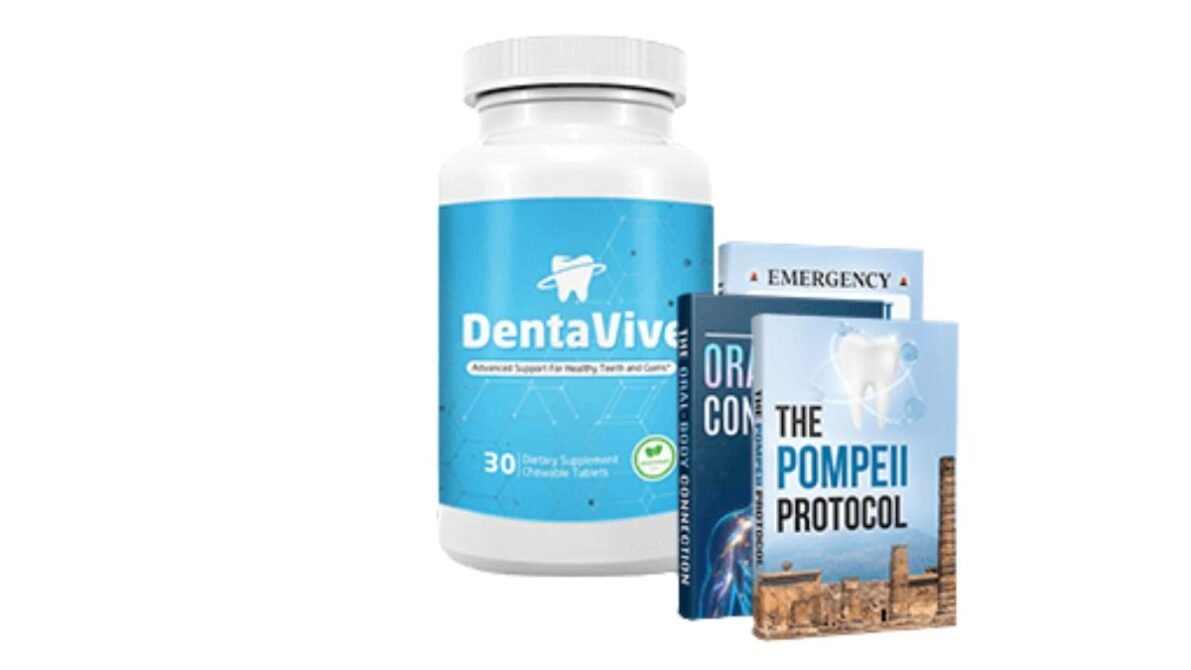
On the money: a couple of links below go to the seller and pay this site a commission. The section explaining why enamel can’t be rebuilt from the inside is the one that matters, and it’s not the one a commission would have written.
These statements have not been evaluated by the Food and Drug Administration. This product is not intended to diagnose, treat, cure, or prevent any disease. A cavity that has broken through enamel does not heal, and bone lost to gum disease does not return. Both are far more manageable caught early — bleeding gums, sensitivity, or a tooth that aches are reasons to book a dental appointment.
There’s one question that determines whether DentaVive can plausibly do anything at all, and the brand’s own websites answer it two different ways.
One official site describes what’s “packed into each capsule of DentaVive.” Another states that “each chewable tablet delivers 3.5 billion live probiotics directly into your mouth.” A third refers to seven ingredients “in every tablet.”
That isn’t a wording preference. For a product built on oral probiotics and enamel minerals, whether you swallow it or chew it is the entire mechanism. A capsule you swallow delivers its contents to your stomach. A tablet you chew delivers them to your teeth and gums.
Only one of those is where the problem lives.
So this DentaVive review can’t start with ingredients, because the same ingredients do completely different things depending on an answer the seller hasn’t settled. Everything below follows from that — including a piece of dental science that rules out one of the product’s headline claims outright, regardless of format.
What DentaVive Is — Depending on Which Site You Read
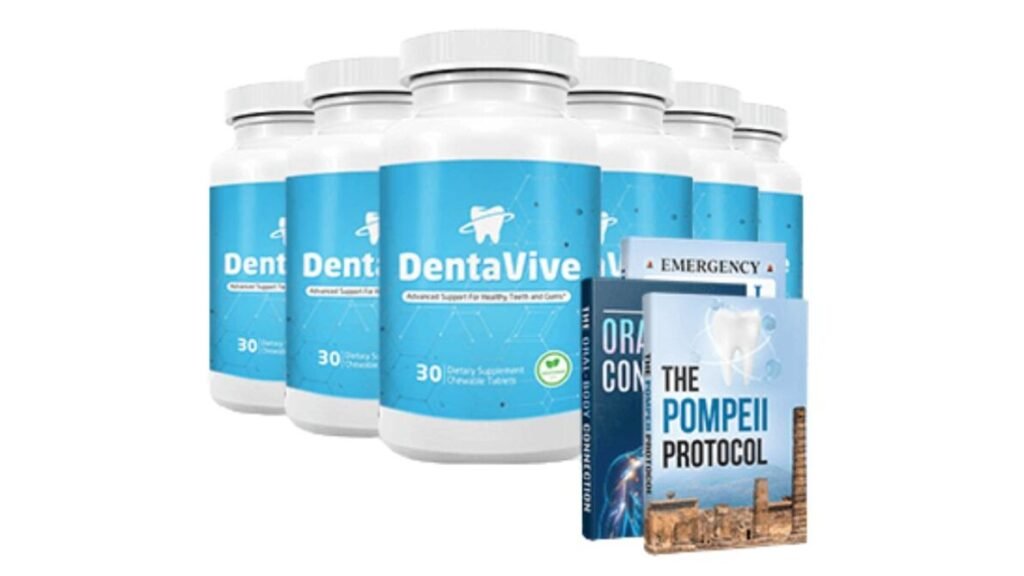
DentaVive is sold through the official DentaVive site, with BuyGoods as the retailer of record and a 60-day money-back guarantee that explicitly accepts empty bottles.
The order page itself lists no ingredients at all — it’s pricing, a guarantee, and a video presentation built around an archaeological discovery in Pompeii. For a formula, you have to go looking across the brand’s other sites, and they give you different answers:
- One names Lactobacillus reuteri, zinc, calcium and peppermint leaf extract.
- Another names Streptococcus salivarius K12, tricalcium phosphate, inulin, zinc, vitamin D3 and cranberry.
- Another names L. reuteri, Bifidobacterium lactis and tricalcium phosphate.
- Another says simply that there are seven ingredients.
Some of these overlap. Several don’t. And no version I found publishes amounts for anything except a CFU figure of 3.5 billion on one site.
Pricing runs $69 for one bottle, $59 each for three, and $49 each for six — $294 for the largest package, against a struck-through $414.
Why Capsule Versus Chewable Isn’t a Detail
Here’s the principle, and it’s worth carrying to every oral health product you ever look at.
Your mouth’s problems are surface problems. Plaque is a biofilm physically attached to teeth. Gum disease is inflammation driven by that biofilm sitting below the gumline. Bad breath comes mostly from bacteria on the tongue and between teeth producing sulphur compounds.
A probiotic intended to change your oral microbiome has to reach your mouth and stay there long enough to compete for space. That’s why the serious oral probiotic research uses lozenges, chewable tablets, and mouth rinses — formats that dissolve in contact with teeth and gums.
A critical evaluation of oral care probiotic strains describes the mechanism directly: strains like S. salivarius K12 and L. paracasei work by competitive adhesion, occupying binding sites on tooth surfaces to block colonisation by cavity-causing pathogens.
Occupying binding sites on tooth surfaces. You cannot do that from inside a capsule that opens in the stomach.
So if DentaVive is a chewable tablet, the probiotic component at least has a plausible route. If it’s a swallowed capsule, the oral-microbiome premise doesn’t survive contact with anatomy. And the seller’s own materials say both.
Before ordering, that’s the question I’d put to customer service in writing: is this chewed or swallowed?
Enamel Rebuilds From the Outside, Not the Inside
Now the part that holds regardless of format, and it’s the more important finding.
Several of the brand’s sites promise enamel remineralization, attributing it to tricalcium phosphate. The idea sounds intuitive: swallow calcium and phosphate, and your teeth get the minerals they need to rebuild.
That isn’t how enamel works.
Mature enamel is acellular and avascular — it has no living cells and no blood supply. It cannot receive minerals from your bloodstream the way bone can. Remineralization happens exclusively at the tooth surface, where calcium and phosphate ions from saliva redeposit into weakened enamel.
That’s why every genuinely evidence-backed remineralizing product is topical. The CPP-ACP complexes with the strongest research bind to the salivary pellicle on the tooth surface, localising calcium and phosphate exactly where remineralization occurs. They’re commercialised as pastes, varnishes, mouthwashes and chewing gums — never as swallowed supplements, because a swallowed supplement can’t reach the surface.
The evidence for the topical versions is real but measured. A systematic review found CPP-ACP clinically effective for remineralizing white spot lesions, though results were inconsistent across studies, and the effect was enhanced when combined with fluoride. White spot lesions are early, pre-cavity demineralization. Once decay has broken through into a cavity, no product remineralizes it — that’s a filling.
So: if DentaVive is chewed, its tricalcium phosphate briefly contacts the teeth, which is at least the right direction, though at an undisclosed amount and without the fluoride that the research pairs it with. If it’s swallowed, the enamel claim has no mechanism at all.
Calcium in your diet matters for the bone that holds your teeth. It does not rebuild enamel from within.
The Probiotics: One Site Names the Right Strain
Credit where it’s genuinely due, because one detail here is better than most of this category manages.
One of the brand’s sites names Streptococcus salivarius K12 — and K12 is one of the few oral probiotic strains with real published support, specifically for fresh breath and competitive exclusion of pathogens. Naming it is a meaningful step above products that advertise “probiotic strains” and never say which.
Two caveats keep it from being decisive.
First, the other sites name different organisms — L. reuteri, B. lactis — and B. lactis is a gut species with no established oral colonisation role. So you can’t be confident which strains you’d receive.
Second, expectations should be calibrated even for good strains. A randomised placebo-controlled trial of L. reuteri tablets in people with gingivitis found shifts in bacterial counts but no significant changes in the clinical variables over eight weeks. The bacteria moved; the gums didn’t measurably improve. That’s honest research and a useful reality check: oral probiotics are a promising adjunct, not a treatment.
Inulin as a prebiotic is a reasonable inclusion in principle, though inulin feeds gut bacteria far better than oral ones, and it’s fermentable — worth knowing if you have IBS.
Zinc and vitamin D3 are sensible for gum tissue and bone if you’re deficient. Most people eating an ordinary diet aren’t.
“Backed by FDA Approval” Is Not a Thing
One of the brand’s sites states the product is “backed by FDA approval, meaning it meets stringent safety, efficacy, and quality standards.”
That is not accurate, and it’s worth knowing precisely why, because the phrase circulates across this entire industry.
The FDA does not approve dietary supplements. Under US law it has no authority to approve supplements for safety or effectiveness, or to approve their labelling. Supplements are regulated as food rather than drugs. Responsibility for safety sits with the manufacturer, and the agency acts afterwards — through warnings, recalls and seizures.
What a company can truthfully say is that a facility is FDA-registered, which means the agency knows it exists and may inspect it. Registration is not approval, and no inspection assesses whether a product works. Some of DentaVive’s other sites use the accurate phrasing — “produced in an FDA-registered facility” — which makes the “FDA approval” claim on the other site harder to read as an innocent shorthand.
If you see “FDA approved” on any supplement, that alone tells you the copy wasn’t checked by someone who knows the rules.
Eight Websites — and a Rival With Two Letters Different
Searching for this product returns at least eight addresses presenting themselves as the official site, with regional prefixes, hyphenated variants, and at least one that appears to be a typosquat — a misspelling of the brand designed to catch mistyped searches.
They don’t agree on the formula, the product format, or the claims. That’s the source of most of this article’s findings.
There’s a second problem that could cost you money more directly. A separate product called DentiVive — spelled with an “i” — is also sold as a dental supplement, with an entirely different formula built around zinc, chromium, alpha-lipoic acid and resveratrol, and a different named creator.
DentaVive and DentiVive are two letters apart. If you search for one and land on the other, nothing on the page will necessarily correct you. Whichever you’re actually looking for, check the spelling in the address bar before entering card details, and screenshot the price and guarantee on the day you pay.
What I Liked
BuyGoods is the retailer of record. A refund administered by an established payment platform, rather than by the seller’s own returns desk, is materially easier to enforce.
The 60-day guarantee explicitly accepts empty bottles, stated plainly. That’s a genuinely consumer-friendly term and it’s consistent across the sites.
S. salivarius K12 appears by name on one site. It’s the right strain to reach for, and naming a strain at all puts this above much of the category.
The framing on at least one site is honest about scope — describing the product as designed for daily use “as part of a complete oral care routine,” and stating it should be paired with regular brushing, flossing and dental check-ups. That’s correct, and it’s more than several competitors say.
A CFU count is published on one site — 3.5 billion — which is a real number you can weigh, unlike products that publish none.
The ingredient concept isn’t absurd. Probiotics plus a mineral plus a prebiotic is a coherent design for oral health. The problems here are route, disclosure and consistency — not a made-up mechanism.
Things to Consider
The brand’s own sites disagree on whether it’s a capsule or a chewable, which is the question that decides the mechanism.
Enamel cannot be remineralized from the bloodstream — it’s avascular, and the process happens at the surface from saliva.
Ingredient lists differ across at least four official-looking sites.
No amounts published for any ingredient on any version I found.
“Backed by FDA approval” appears on one site and is not a thing that exists.
The order page itself lists no ingredients at all.
“Over 150,000 people” appears with no source or destination.
A near-identically named product with a completely different formula is on the market.
The VSL is built on an archaeological narrative — the same structural template used by a men’s health product from the same affiliate network.
Who Should Be Careful
Probiotics and minerals are among the gentler supplement categories, but there are real cautions.
Anyone significantly immunocompromised — on chemotherapy, post-transplant, or with a central line. Live bacterial products warrant medical input in those situations.
Anyone with a heart valve replacement or history of infective endocarditis. Discuss any live probiotic with your cardiologist or dentist.
Anyone with IBS or sensitive digestion, because of the inulin — it’s a fermentable fibre and a common trigger for bloating and gas.
Anyone already taking calcium, zinc or vitamin D supplements. Stacking minerals from sources that don’t publish amounts is how people quietly exceed upper limits.
Anyone with kidney disease, where calcium and vitamin D supplementation needs medical supervision.
And the important one: persistent bleeding gums, gums pulling away from teeth, loose teeth, sensitivity that doesn’t settle, or a tooth that aches need a dentist. Cavitated decay doesn’t remineralize, and bone lost to periodontitis doesn’t return. The gap between treating gingivitis and treating periodontitis three years later is the gap between reversible and permanent — and no supplement narrows it.
What Actually Works for Teeth and Gums
The honest hierarchy, unchanged by anything in this bottle.
Mechanical plaque removal is the foundation — brushing twice daily, cleaning between teeth every day, and professional scaling at the interval your dentist recommends. Biofilm is physically attached; removal is physical.
Fluoride is the single most evidence-backed intervention in preventive dentistry, and it works topically, from toothpaste, at the tooth surface. If enamel strength is your concern, this is the product with decades of trials behind it.
Reducing the frequency of sugar exposure matters more than the total amount, because each exposure is a separate acid attack.
Not smoking, and controlling blood sugar if you have diabetes — two of the strongest modifiable risk factors for gum disease.
And if the topical mineral idea appeals, CPP-ACP products exist as pastes and gums, sold openly, with published research and stated concentrations — designed to sit against your teeth, which is where the chemistry happens.
Oral probiotics may well earn a place as an adjunct alongside all of this. K12 and M18 are the strains to watch. Adjunct means alongside, and it means named strains, stated counts, and a format that reaches your mouth.
Price, Guarantee, and the 150,000
Pricing is $69 for one bottle, $59 each for three ($177), and $49 each for six ($294), with free shipping on the multi-bottle orders and three digital bonuses. Current terms are on the DentaVive site, with BuyGoods handling the order and refunds.
The 60-day guarantee is the strongest part of the offer, and the empty-bottle provision is stated clearly. If you buy, keep the BuyGoods receipt — that’s your refund route — and start any refund conversation well inside the window rather than on the last day.
The page states the product has helped over 150,000 people. There’s no link to where any of them can be found, no review platform, and no verification method described. No verified-purchase pool exists, since the product is sold direct only, and what fills the search results is affiliate content across the brand’s many domains. Treat any specific number or testimonial as unverified.
Final Verdict
DentaVive is a coherent idea undermined by the fact that nobody will tell you what it is.
Probiotics, a mineral and a prebiotic is a reasonable design for oral health. Naming S. salivarius K12 on one site shows someone read the right literature. BuyGoods and an empty-bottle guarantee make it low-risk to try.
But the brand’s own websites can’t agree on whether you chew it or swallow it — and that single question determines whether the probiotics reach your teeth at all. No version publishes amounts. Four sites list four overlapping-but-different formulas. One claims an FDA approval that doesn’t exist for supplements. And the enamel remineralization promise runs against basic dental physiology unless the tablet is chewed, because enamel has no blood supply and rebuilds only from saliva at its surface.
Who might reasonably try it: someone who confirms with the seller that it’s a chewable, who wants a pleasant daily addition alongside proper brushing, flossing and dental visits, and who understands they’re buying a possible marginal benefit rather than a treatment. As a complement to real care, that’s defensible. Buy one bottle, not six.
Who should skip it: anyone hoping to remineralize a cavity, anyone with active gum disease who hasn’t seen a dentist, and anyone who’d be discouraged from booking the appointment.
If the ingredients appeal to you: buy an oral probiotic that names its strains and its format — K12 and M18 are sold openly under those designations — and if you want topical minerals, CPP-ACP pastes and gums are available with published concentrations. Both cost less than $49 a bottle and you’ll know what you have.
And the part that beats all of it: fluoride toothpaste, flossing you actually do, fewer sugar exposures across the day, and the cleaning appointment. Decades of evidence, and free or nearly so.
If you’re comparing oral health supplements, our DentiCore review reaches the same conclusion from the other direction — a mineral tablet you definitely swallow, sold for a problem that lives on the surface of your teeth. Between the two, the question worth carrying is always the same: where does this product physically go, and is that where your problem is?
Frequently Asked Questions
Is DentaVive a capsule or a chewable tablet?
The brand’s own websites say both — one describes “each capsule,” another “each chewable tablet.” That matters more than it sounds: oral probiotics work by occupying binding sites on tooth surfaces, which requires the product to dissolve in your mouth rather than your stomach. Ask customer service in writing before ordering.
Can a supplement remineralize tooth enamel?
Not from the inside. Mature enamel has no blood supply, so it can’t receive minerals from your bloodstream. Remineralization happens at the tooth surface, from calcium and phosphate in saliva — which is why every evidence-backed remineralizing product is topical: pastes, gels, varnishes, and chewing gums. And once decay has broken through into a cavity, no product remineralizes it.
Which probiotic strains are in it?
It depends which of the brand’s sites you read. One names Streptococcus salivarius K12, which is a genuinely well-supported oral strain. Others name Lactobacillus reuteri or Bifidobacterium lactis, the last of which is a gut species with no established oral role. No version publishes how much of anything you’re getting.
Is DentaVive the same as DentiVive?
No — these are two different products with names two letters apart. DentiVive has a completely different formula built around zinc, chromium, alpha-lipoic acid and resveratrol. Check the spelling carefully before ordering, and screenshot the page you buy from.

Raphael Albert is the founder and content creator of Nutra Pulse. Passionate about health, nutrition, fitness, and wellness, he spends his time researching scientific studies, health trends, and evidence-based lifestyle strategies to create informative and easy-to-understand content. While he is not a doctor or licensed healthcare professional, his goal is to help readers make more informed wellness decisions. All content is for educational purposes only and should not replace professional medical advice. Always consult a qualified healthcare provider regarding your health concerns.