Upfront: this review includes an affiliate link, so we may earn a small commission if you buy through it, at no extra cost to you. It doesn’t bend the verdict – you’ll see below exactly where this formula is reasonable and where the sales pages contradict themselves.
These statements have not been evaluated by the Food and Drug Administration. This product is not intended to diagnose, treat, cure, or prevent any disease – including Alzheimer’s or age-related memory loss. Cognitive decline can be a symptom of real medical conditions, so a supplement is not a treatment, and nothing here replaces an evaluation by your own clinician.
New to brain and memory supplements? Our Synaptigen review breaks down how these nootropic formulas actually differ, and why a named ingredient means little without a disclosed dose behind it. This MindVault review runs into an even trickier version of that problem – the label changes depending on which “official” page you read.
MindVault Review: The Short Version
The ingredients in MindVault are a reasonable, familiar nootropic lineup — the problem is you can’t be sure which version of the product you’d actually receive. MindVault’s own official pages don’t even agree on the formula, and none discloses individual doses.
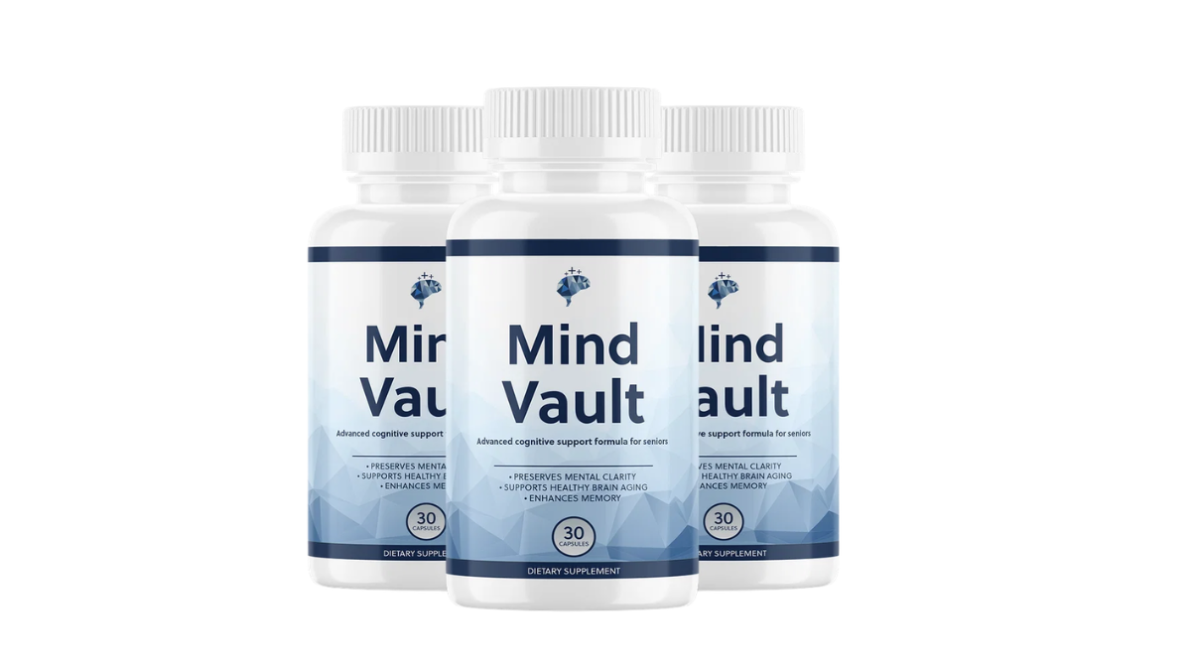
MindVault is a capsule marketed to adults 45+ for memory, focus, and mental clarity, built around some combination of Bacopa Monnieri, Alpha-GPC, Phosphatidylserine, Huperzine A, L-Theanine, and (on some pages) low-dose caffeine. The catch is right there in that “on some pages”: one set of official sites advertises it as caffeine-free and stimulant-free, while ingredient breakdowns for the same product list caffeine as an active. When a product can’t tell you whether it’s a stimulant, the fair verdict starts with caution, not a star rating.
One thing to settle first: if you’re worried about real memory loss – not the occasional lost word, but missed appointments, getting lost, or changes other people notice – that’s a doctor’s visit, not a supplement decision. Some causes of cognitive change are treatable, and no capsule should stand between you and a diagnosis.
The Caffeine Contradiction: Read Two Official Pages, Get Two Different Products
This is the finding that shapes the whole review, so it’s worth being specific. Across MindVault’s network of official-looking sites, the formula story splits in two. One set of pages markets it explicitly as caffeine-free: “without caffeine or synthetic stimulants,” “free from artificial stimulants,” a “gentle” formula built on Bacopa, Ginkgo, Phosphatidylserine and L-Theanine. A different set of ingredient breakdowns for the same brand lists a ten-ingredient stack that includes Caffeine (low-dose) alongside Huperzine A, GABA, L-Tyrosine, Alpha-GPC and Niacin.
Those two descriptions can’t both be true of one capsule. Either it contains a stimulant or it doesn’t – and that’s not a trivial detail. Caffeine sensitivity, sleep, blood pressure, and interactions all hinge on it. When a product’s own marketing can’t keep its formula straight, it’s a sign of a network of sites selling under one name without central quality control, and it means the “official site” you land on may not describe the bottle that actually ships. Before anything else, that’s the problem to solve.
What MindVault Actually Is
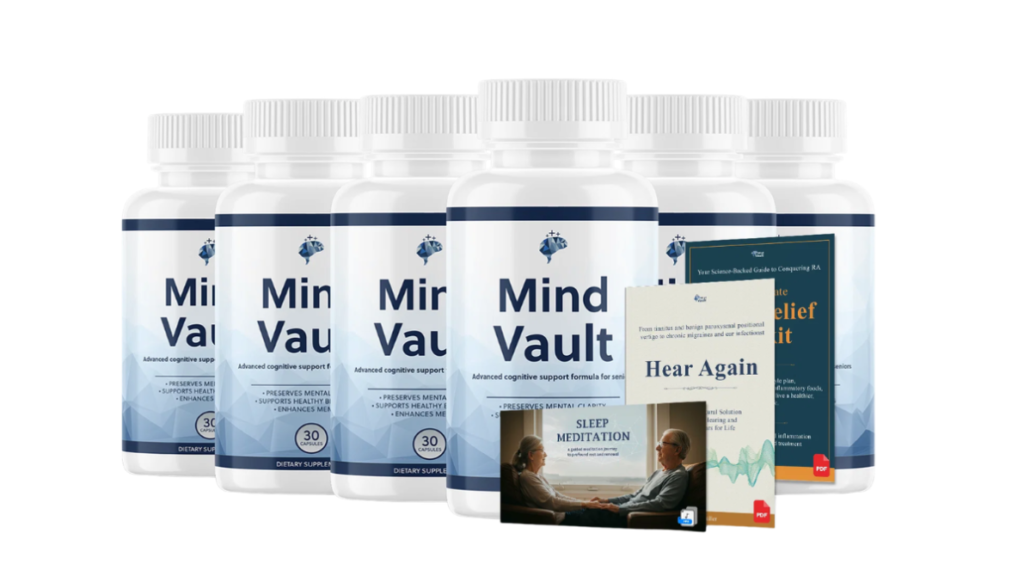
Setting the formula confusion aside for a moment, MindVault is a once-daily nootropic capsule aimed squarely at the 45-plus “I keep losing names and focus” audience. Per the MindVault official website, it’s made in the USA in a GMP-certified facility, marketed as non-GMO and gluten-free, priced around $49 a bottle, and backed by a 60-day money-back guarantee.
On the plus side, several pages do name their ingredients rather than hiding behind “proprietary complex” alone, and the ingredients themselves are legitimate members of the nootropic toolkit – not a “borrowed” formula from an unrelated category.
The problems are narrower and specific: the formula isn’t consistent across the brand’s own pages, no page we found discloses per-ingredient milligram doses, and there’s no clinical trial on the finished product. So what you’re really buying is a reasonable-sounding ingredient list whose strength you can’t verify.
Named Ingredients, Hidden Doses
We anchor these reviews to what you can verify, so here’s the verifiable statement: MindVault names ingredients but doesn’t disclose how much of each you get. That matters because, for nearly everything in this stack, the research is dose-specific. Alpha-GPC’s cognitive trials used 1,200 mg/day in older adults; Huperzine A works in the microgram range (50-200 mcg) and is potent enough that too much is a safety question, not a bonus; caffeine’s effect flips from helpful to counterproductive depending on the amount.
A label that names these but hides the numbers tells you the recipe, not the strength – and one ingredient breakdown page even admits it “cannot independently verify” the dosages and points you to the physical label instead. Until MindVault prints per-ingredient amounts consistently, that gap is the ceiling on how confident anyone can be, us included.
Can an Oral Capsule Reach the Brain?
Before grading the ingredients, we check whether the delivery route can physically reach the target – and here it’s plausible, with a familiar caveat. Alpha-GPC, Bacopa, caffeine and Huperzine A are all absorbed orally and either cross or act across the blood-brain barrier, so an oral capsule aimed at cognition isn’t anatomically hopeless.
GABA is the one honest exception: whether oral GABA meaningfully crosses into the brain at all is genuinely doubtful, so its inclusion is more marketing than mechanism. The route works in principle for most of the stack; “in principle” just isn’t the same as “at the dose in this bottle,” which the label won’t confirm.
Alpha-GPC: Real Cognitive Data, Mostly in Impairment – Plus a Safety Flag
Alpha-GPC is the ingredient with arguably the strongest mechanism, so it earns the closest look, honestly up and down. It’s a highly bioavailable choline source that raises acetylcholine, the neurotransmitter most tied to memory. Its best clinical data is in cognitive impairment – randomized trials used 1,200 mg/day in dementia patients.
In healthy adults the evidence is thinner, though a 2024 randomized crossover trial in healthy men did find an acute improvement in Stroop-test performance at 315-630 mg. But honesty requires the flag too: a large observational study has linked long-term Alpha-GPC use to higher 10-year stroke risk – not proof of harm, but a real signal worth raising with a doctor, especially with cardiovascular history. Evidence grade: moderate for cognition (strongest in impairment), at a dose MindVault doesn’t state.
Huperzine A: Potent, Genuinely Interesting – and the Riskiest to Dose Blind
Huperzine A is the ingredient that makes the missing dose most concerning. It’s a potent acetylcholinesterase inhibitor – the same drug class as prescription Alzheimer’s medications like donepezil – which is exactly why it’s interesting and exactly why guessing the dose is a bad idea. Its evidence is real but caveated: the Alzheimer’s Drug Discovery Foundation’s review of 22 trials found possible short-term cognitive benefit but concluded the data can’t support firm conclusions because of small samples and study-quality problems.
The practical point for a shopper: because Huperzine A is pharmacologically potent, it should not be combined with prescription cholinesterase inhibitors without a neurologist, and taking it at an unknown dose in a blend is precisely the wrong way to use it. Evidence grade: moderate, in the microgram range – and a dose you shouldn’t have to guess at.
Bacopa, Caffeine and L-Theanine: The Best-Supported Pieces
The parts of this formula with the cleanest evidence are also the least flashy. Bacopa Monnieri has a genuine memory signal in older adults, but with a condition: it works gradually, needing about 8-12 weeks of consistent use, which is why “it did nothing in two weeks” complaints usually reflect impatience, not a dud.
Caffeine paired with L-Theanine is the most-studied combination in the whole nootropic space – a 2021 review of caffeine’s cognitive effects supports real gains in alertness, processing speed and memory, with L-Theanine smoothing out the jitters. The irony is obvious: this is one of MindVault’s strongest cards, yet half its own pages claim it’s caffeine-free – so you may not even be getting it. Evidence grade: moderate-to-strong for the combo, if it’s actually in your bottle.
What I Liked
- The ingredients are legitimate nootropic actives, not a formula borrowed from an unrelated category.
- Some pages name the full ingredient list rather than hiding everything in a proprietary complex.
- A 60-day money-back guarantee lowers the cost of a fair trial.
- Made in a US GMP-certified facility; marketed non-GMO and gluten-free.
Things to Consider
- The brand’s own official pages contradict each other on whether it contains caffeine.
- No page discloses per-ingredient doses – critical for potent actives like Huperzine A.
- Alpha-GPC carries an observational long-term stroke-risk signal worth discussing with a doctor.
- Oral GABA’s ability to reach the brain is doubtful; likely marketing more than mechanism.
- No clinical trial on the finished product, and a spread of look-alike domains with different formulas.
What Real Users Are Saying
The site’s own five-star reviews recycle a near-identical “David M. – Chicago” style testimonial across multiple domains, so they don’t count as independent feedback and can’t be treated as independent evidence – the traceable pattern is modest and mixed.
Aggregating third-party reviews and nootropic-forum discussion, users who stick with it for a full 6-8 weeks more often report subtle gains in focus and afternoon mental energy; those judging it at two weeks tend to report nothing, consistent with Bacopa’s slow onset. Independent review sites generally land on “legitimate but not a miracle,” and several flag exactly what we did: the formula varies by seller. Treat any dramatic on-site transformation story with the usual skepticism.
Medication Interactions & Safety
This is where the undisclosed, inconsistent formula becomes a genuine drawback rather than an annoyance – because you can’t tell a pharmacist exactly what you’re taking. The specific cautions worth raising: Huperzine A should not be combined with prescription cholinesterase inhibitors (Alzheimer’s medications) without neurologist supervision, and adds risk with certain other neurological drugs.
Alpha-GPC’s observational stroke-risk signal makes it worth discussing if you have cardiovascular or cerebrovascular history. Phosphatidylserine may interact with blood thinners. Caffeine – if present – affects sleep, blood pressure and anxiety, and matters for anyone caffeine-sensitive. GABA may add to the effect of sedatives or anti-anxiety medication. If you’re pregnant, nursing, have a seizure disorder, or take any psychiatric, neurological, or blood-thinning medication, clear MindVault with a clinician first. This isn’t scaremongering; it’s the direct consequence of a potent ingredient at an unstated dose.
Who Might Consider It – and Who Should Skip It
MindVault may be worth a cautious try if you’re a healthy adult with occasional brain fog, you’ve confirmed the exact formula on the label you receive, you’re not on interacting medication, and you’ll give it a real 6-8 weeks. It’s the wrong pick if you want to know your exact doses before committing (the label won’t reliably give you that), if you’re sensitive to stimulants and can’t confirm whether your bottle contains caffeine, if you take neurological or blood-thinning medication, or – most importantly – if your memory concerns are new, worsening, or noticeable to others, in which case the first step is a clinician, not a capsule.
Where to Buy MindVault
If, after weighing the trade-offs, you want to try it, buy only from the official MindVault website, where the 60-day guarantee applies – and then do one thing before you swallow the first capsule: read the actual Supplement Facts panel on the bottle and confirm whether it contains caffeine and what the Huperzine A dose is. If the label won’t tell you, that’s your answer about whether to take it. Save your order confirmation so the guarantee is easy to invoke. If you’d rather know exactly what you’re taking, a single-ingredient standardized Bacopa or a dose-labeled Alpha-GPC product is the more transparent route.
Final Verdict on MindVault
The honest core of this MindVault review is a formula that’s reasonable on paper and unverifiable in practice. The ingredients belong in a brain supplement, and a couple of them (Bacopa, caffeine-plus-theanine) have solid support. But a product whose own official pages disagree about whether it’s a stimulant, which hides the dose of a genuinely potent ingredient like Huperzine A, and which carries an Alpha-GPC safety flag it never mentions, hasn’t earned blind trust.
It sits above the anonymous, no-ingredient funnels we refuse to link – but well below a transparent product that prints one consistent, fully dosed label. The fair verdict is conditional: it may offer gradual, subtle support for some healthy adults who confirm their exact label first and clear it with a doctor – not a proven memory booster, and definitely not something to take on faith. As always, “may support” is the honest ceiling, and new or worsening memory problems belong with a clinician, not a bottle.
Frequently Asked Questions
Does MindVault contain caffeine?
Frustratingly, it depends on which page you read. Some of MindVault’s own official sites advertise it as caffeine-free and stimulant-free, while ingredient breakdowns for the same brand list low-dose caffeine as an active.
Because the marketing contradicts itself, the only reliable answer is the Supplement Facts panel on the specific bottle you receive – check it before taking the product, especially if you’re caffeine-sensitive.
Is MindVault a scam?
Not exactly – the ingredients are real and it ships with a working guarantee. But the marketing shows problems that warrant caution: contradictory formulas across its own pages, no disclosed per-ingredient doses, recycled testimonials, and an undisclosed dose of the potent ingredient Huperzine A. It’s a legitimate-but-unverifiable product, not an obvious fraud.
Can MindVault prevent Alzheimer’s or reverse memory loss?
No. No supplement prevents Alzheimer’s or reverses memory loss, and any page implying otherwise is overreaching. Some ingredients (Alpha-GPC, Huperzine A) have been studied in cognitive impairment, but that’s not the same as prevention or a cure, and MindVault is a dietary supplement, not a treatment. New or worsening memory problems need a medical evaluation.
How long does MindVault take to work?
If it works for you, expect it to be gradual. Its slow-acting ingredient, Bacopa Monnieri, typically needs 8-12 weeks to show a memory effect, though caffeine (if your bottle contains it) can produce same-day alertness. Judging it at two weeks is too early for the memory side, which is the source of most “it did nothing” complaints.

Raphael Albert is the founder and content creator of Nutra Plus. Passionate about health, nutrition, fitness, and wellness, he spends his time researching scientific studies, health trends, and evidence-based lifestyle strategies to create informative and easy-to-understand content. While he is not a doctor or licensed healthcare professional, his goal is to help readers make more informed wellness decisions. All content is for educational purposes only and should not replace professional medical advice. Always consult a qualified healthcare provider regarding your health concerns.