Disclosure: two links below go to the seller and pay this site a commission. This one gets more credit than most products reviewed here — and the dosing section still doesn’t go the seller’s way, so you can judge for yourself.
These statements have not been evaluated by the Food and Drug Administration. This product is not intended to diagnose, treat, cure, or prevent any disease. Persistent digestive symptoms — particularly blood in the stool, unexplained weight loss, or a change in bowel habits lasting more than a few weeks — need a doctor rather than a supplement.
I review a lot of supplements, and the method is always the same. Find the ingredient list. Look up each ingredient. Compare what’s in the bottle against the amounts used in published human trials. Report the gap.
Most products in this space make that impossible. Proprietary blends with no totals. Sales pages that name plants without quantities. Checkout forms with no ingredient list at all.
Bioma doesn’t do that, and it deserves to be said plainly before anything else. The label is published, two of its three components carry stated milligram amounts, the bacterial strains are named, the CFU count is given, and the product is sold on Amazon — which means, unusually for this category, that a genuine verified-purchase review pool exists.
So for once the method works. Here’s what it turns up.
What’s Actually on the Label
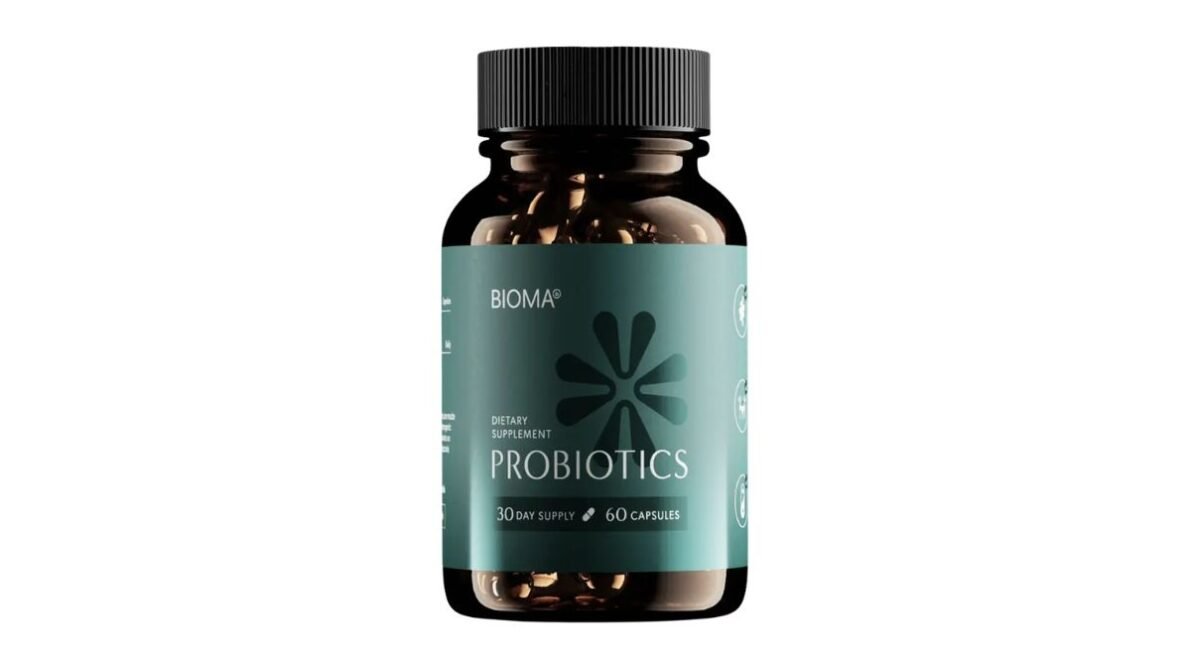
Bioma is a once-daily delayed-release capsule, sold through the official site and also on Amazon. It’s marketed as a synbiotic — a combination of prebiotic, probiotic, and postbiotic — which is a coherent and current way to think about gut supplements rather than a marketing invention.
The three components:
Xylooligosaccharides (as iXOS), from corn cob — 100 mg. The prebiotic. XOS is a non-digestible fibre that Bifidobacteria ferment preferentially, which makes it a sensible pairing with the strains in the capsule.
Tributyrin (as Corebiome) — 90 mg. The postbiotic. Tributyrin is a butyrate precursor designed to survive stomach acid and release butyrate further down the gut, where it feeds the cells lining your colon.
Proprietary Probiotic Blend — 9 billion CFU per serving. Three species: Bifidobacterium lactis, Bifidobacterium longum, Bifidobacterium breve.
Other ingredients are unremarkable: microcrystalline cellulose, hypromellose capsule, magnesium stearate, silicon dioxide.
Both iXOS and Corebiome are branded ingredients from named suppliers with their own research programmes. That’s a real signal — branded ingredients cost more than generic raw material and usually come with published data attached. Whoever formulated this was doing something more considered than mixing bulk powder.
Now the numbers.
The Prebiotic Is the Problem: 100 mg Against 1,400 mg
This is the central finding of this Bioma Probiotics review, and it’s arithmetic rather than opinion.
The best-known human trial on XOS was a double-blind, randomised, placebo-controlled study in 32 healthy adults, running eight weeks. Participants received 1.4 g or 2.8 g of XOS daily, and Bifidobacterium counts increased in both groups compared with placebo, with the 2.8 g group showing significantly greater increases. A later pilot in healthy and prediabetic adults used 2 g daily for eight weeks.
So 1.4 grams is the lowest daily dose with a clearly demonstrated bifidogenic effect in humans. The Global Prebiotic Association’s own summary notes that this is impressively low compared with other prebiotics — fructooligosaccharides typically need 10 to 20 grams — but adds that studies more commonly use 4 to 8 grams of XOS per day.
Bioma contains 100 mg. That’s 0.1 grams — roughly one fourteenth of the lowest well-documented effective dose, and about one fortieth of a typical study dose.
To be fair to the product, two things are worth saying. Branded XOS ingredients are often marketed on purity and a specific chain-length profile, with the argument that a cleaner preparation works at lower amounts. And in vitro work has shown bifidogenic activity at small concentrations. But “shown in a flask” and “shown in 32 people over eight weeks” are different tiers of evidence, and the human tier starts at 1.4 grams.
If the prebiotic component is a meaningful part of why you’re buying this, that gap is the thing to weigh.
Tributyrin: A Good Idea at a Fraction of the Studied Amount
The tributyrin is the most interesting ingredient here and the one I’d most want to see at a proper dose.
The logic is sound. Butyrate is a short-chain fatty acid that colonocytes use as fuel, and it’s associated with intestinal barrier integrity. Swallowed as sodium butyrate, most of it is absorbed in the small intestine before reaching the colon. Tributyrin is a triglyceride ester that resists gastric acid and releases butyrate further along — which is a genuine formulation improvement, not a marketing story.
The research on this specific branded ingredient is real, and so are its limits. A 2025 study evaluated Corebiome using a simulated human intestinal model, finding that roughly 41% of a capsule dose was hydrolysed to butyrate in the small intestine while about 59% remained available to enter the colon, with three weeks of supplementation increasing butyrate and Bifidobacterium abundance. Encouraging — and it’s in vitro, in a bioreactor, not in people. The authors disclose that the work was funded by the ingredient’s manufacturer, which is normal and correctly declared.
The doses in that work were 300 mg for the capsule format. A separate human pilot study of a different tributyrin complex used 200 mg and 400 mg daily in healthy adults over 21 days. Butyrate trials in inflammatory bowel disease have run from 300 mg up to 3 g daily.
Bioma contains 90 mg — under a third of the lowest of those figures.
Same shape as the prebiotic: right idea, right ingredient, roughly a third to a fortieth of the amounts anyone has studied.
The Probiotic Blend, and a Number That Doesn’t Match
Here I have to report something I couldn’t fully resolve, and I’d rather flag it than smooth it over.
The brand’s own site lists the Proprietary Probiotic Blend at 90 mg. The Amazon listing for the product gives the same blend as 29 mg. A third source described it as 22.5 mg.
I can’t tell you which is current. It could reflect different formula versions, different SKUs, or an error in a secondary listing. What I’d suggest is practical: read the panel on the bottle you actually receive, and if the figure matters to you, ask the company which version you’re getting before ordering.
The CFU count is more consistent — 9 billion per serving — and that’s a reasonable, if unremarkable, potency. Plenty of products advertise 50 billion, though higher CFU is not automatically better; what matters is whether the specific organisms survive to where they’re meant to act, which is what the delayed-release capsule is there for.
What isn’t disclosed is how the 9 billion divides among the three species. That’s a genuine transparency limitation, and it’s the one the product’s own promotional coverage acknowledges.
Species Versus Strains, and Why It Matters
This is a technical point worth understanding, because it applies to every probiotic you’ll ever buy.
Bioma names Bifidobacterium lactis, B. longum, and B. breve. Those are species, not strains. A strain is the specific lineage, written with an alphanumeric code — B. lactis HN019, or BB-12, for example.
The distinction isn’t pedantry. Probiotic effects are strain-specific, and this is one of the better-established principles in the field. Two strains of the same species can behave completely differently — one produces a measurable clinical effect, the other does nothing. When research says a probiotic helped with constipation or bloating, it says so about a named strain at a named dose.
Naming only the species means the published research on particular strains doesn’t transfer to what’s in the bottle, because you can’t know whether you’re getting the studied strain or a different member of the same species.
For comparison, this same company’s separate feminine health product does list strains with codes. So the capability exists; it just isn’t applied here.
Where the Weight-Loss Claims Come From
Bioma is marketed partly on weight, and it’s worth being precise about who is claiming what.
The brand’s own positioning ties gut health to weight management in fairly general terms. Some of the pages that appear when you search for the product go considerably further — describing “thermogenic probiotics” that “jumpstart your metabolic engine,” a prebiotic that helps “melt away unwanted fat cells,” and thermogenesis as a fat-burning process the supplement drives.
That language isn’t supported. Probiotics and prebiotics have been studied for effects on body weight, and the findings are modest, inconsistent, and mostly measured in fractions of a kilogram over months. There is no established mechanism by which Bifidobacteria produce thermogenesis in the sense the copy implies.
There’s a fair version of the weight argument, and it’s worth stating because it isn’t nothing: bloating and irregularity make people feel and look heavier, and relieving them can genuinely change how your midsection feels and how clothes fit. That’s a real, worthwhile effect. It just isn’t fat loss, and the two get deliberately blurred in this category.
Notably, even the paid coverage of this product concedes the point, describing the weight-loss claims as indirect and supportive rather than evidence of a standalone fat-loss product. When the promotional material is more cautious than the surrounding affiliate pages, believe the promotional material.
Check Which Website You’re On
A practical warning that costs nothing to act on.
Searching for this product turns up several sites presenting themselves as official. The brand’s own is straightforward to identify. Among the others is a typosquat domain that differs from the real product name by a single missing letter — the kind of address you land on by mistyping, and one that reads as official at a glance.
Others are affiliate-operated lookalikes carrying the aggressive weight-loss language described above, which the brand’s own materials don’t use.
If you order, get there from the seller’s link or from Amazon, check the address bar before entering card details, and screenshot the price and guarantee terms on the day you pay. That advice applies to everything in this category, but the near-miss domain here makes it worth repeating.
What I Liked
The label is published with amounts. After twenty products where this was impossible, I’m not going to undersell it. You can look up what’s in this capsule and check it against research — which is exactly what this article did.
Branded ingredients from named suppliers. iXOS and Corebiome are real commercial ingredients with published work behind them, not generic powder with a marketing name.
The synbiotic concept is scientifically coherent. Pairing a prebiotic that Bifidobacteria specifically ferment with Bifidobacterium strains and a butyrate precursor is a sensible design. Someone understood the biology.
Delayed-release capsules. The right delivery choice for organisms that stomach acid would otherwise destroy.
It’s sold on Amazon. This matters more than it sounds. A verified-purchase review pool means you can read what actual buyers say, filtered by a platform with some fraud controls — the first product in this series where that’s true.
The allergen statement is present, including shared-facility disclosure. That’s easy to omit and often is.
Vegan, gluten-free, GMP-certified US manufacturing, all stated.
Things to Consider
XOS at 100 mg against 1.4 g — the lowest human dose with a demonstrated bifidogenic effect.
Tributyrin at 90 mg against 200–450 mg in the studies on this class of ingredient.
The blend weight differs between the brand’s site and the Amazon listing.
Species named, strains not — so strain-specific research doesn’t transfer.
CFU not broken down across the three organisms.
The Corebiome evidence is in vitro, funded by the ingredient supplier, and correctly disclosed as such.
Weight-loss framing outruns the evidence, especially on affiliate lookalike pages.
A typosquat domain exists that could be mistaken for the official site.
Who Should Be Careful
Probiotics are among the safer supplement categories, and most healthy adults tolerate them well. Some genuine cautions:
Anyone significantly immunocompromised — on chemotherapy, post-transplant, or with a central line. Live organisms warrant medical input in those situations, and there are case reports of bacteraemia in vulnerable patients.
Anyone with short bowel syndrome or a history of small intestinal bacterial overgrowth, where added organisms and fermentable fibre can worsen symptoms.
Anyone with severe pancreatitis — probiotics have been studied in that context with concerning results.
Anyone in the first week or two of starting, who may notice more gas or bloating as the microbiome adjusts. That’s usually transient. If it persists beyond a couple of weeks, stop.
Anyone with a corn allergy should note the XOS is corn-cob derived, and the shared-facility allergen list is worth reading.
And the important general one: blood in the stool, unexplained weight loss, persistent abdominal pain, fever, or a change in bowel habits lasting more than a few weeks needs proper assessment. Those can be signs of conditions a probiotic won’t touch, and they’re far more treatable when caught early. Digestive symptoms that have never been looked at deserve a doctor before they deserve a supplement.
Price, Amazon, and Actual Reviews
Pricing on the direct site runs on a subscription-and-bundle model with discounts advertised up to 60%; current terms are on the seller’s page. The product is also listed on Amazon as a 60-capsule, 30-day supply.
That Amazon listing is genuinely useful and I’d use it regardless of where you buy. It gives you a verified-purchase review pool — real customers, filtered by a platform with fraud controls, saying what happened when they took it. That’s the single thing missing from every other product I’ve covered in this series, where “reviews” meant unverifiable numbers on a sales page.
Read those reviews with the usual care — pay attention to the two- and three-star ones, which tend to be the most informative — but read them. They’ll tell you more about real-world tolerance and effect than any sales page or any article, including this one.
If you buy direct, check whether you’re enrolling in a subscription and note the cancellation terms before you pay.
Final Verdict

Bioma is a thoughtfully designed product at doses that don’t match the research behind its own ingredients.
That’s a milder criticism than this series usually delivers, and it’s meant to be. The concept is sound, the ingredients are real branded materials with published work, the label is published, the strains are named at species level, and it’s sold somewhere you can read honest reviews. Compared with most of this category, that’s a different standard of operation entirely.
But the arithmetic is the arithmetic. The prebiotic is at roughly one fourteenth of the lowest human dose that produced a measurable bifidogenic effect. The postbiotic is at under a third of the studied range for its class. If those two components are doing the work the marketing describes, they’re doing it at amounts nobody has demonstrated works.
Who this may reasonably suit: someone who wants a synbiotic in one capsule, values the delayed-release format and the branded ingredients, has ordinary bloating or irregularity rather than a diagnosed condition, and understands they’re buying a modest, unproven-at-this-dose product rather than a fix. If that’s you, buy the smallest quantity, give it four to eight weeks, and judge honestly.
Who should look elsewhere: anyone buying it primarily for weight loss, and anyone who specifically wants the prebiotic effect the XOS research describes — for that, a standalone XOS product at 1.4 to 2.8 grams costs less and matches the trials.
And the unglamorous alternative that beats it. Dietary fibre has a far larger evidence base than any prebiotic supplement, across bowel regularity, microbiome composition, and cardiometabolic markers. Most adults eat well under the recommended amount. Beans, oats, whole grains, vegetables, and fermented foods like kefir and live yoghurt do what this capsule is reaching for, in gram quantities rather than milligrams, for the price of groceries.
If you’re comparing supplements in this category, our Moringa Magic review covers a single-ingredient product where the same question decides everything — what dose did the research use, and how much is actually in the capsule?
Frequently Asked Questions
How much XOS do you actually need?
Human trials showing increased Bifidobacterium used 1.4 to 2.8 grams daily over eight weeks, and study doses more commonly run 4 to 8 grams. Bioma contains 100 mg — around a fourteenth of the lowest documented effective amount. Branded XOS ingredients sometimes argue for efficacy at lower doses on purity grounds, but the published human evidence starts at 1.4 grams.
Is 9 billion CFU enough?
It’s a moderate, reasonable potency. Higher CFU isn’t automatically better — survival to the site of action matters more, which is what the delayed-release capsule addresses. The bigger limitation is that the count isn’t broken down by organism, and the bacteria are named by species rather than by strain, so strain-specific research can’t be applied to what’s in the bottle.
Will it help me lose weight?
Probably not directly. Probiotic and prebiotic effects on body weight in published research are modest and inconsistent, measured in fractions of a kilogram over months. What can genuinely change is bloating and regularity, which affects how your midsection feels and how clothes fit — real and worthwhile, but not fat loss. Language about “thermogenic probiotics” on some sites isn’t supported.
Is it safe to take every day?
For most healthy adults, yes — probiotics are among the better-tolerated supplement categories, and some gas or bloating in the first week or two is common and usually settles. Talk to a doctor first if you’re significantly immunocompromised, have short bowel syndrome or a history of SIBO, or have digestive symptoms that haven’t been assessed.

Raphael Albert is the founder and content creator of Nutra Pulse. Passionate about health, nutrition, fitness, and wellness, he spends his time researching scientific studies, health trends, and evidence-based lifestyle strategies to create informative and easy-to-understand content. While he is not a doctor or licensed healthcare professional, his goal is to help readers make more informed wellness decisions. All content is for educational purposes only and should not replace professional medical advice. Always consult a qualified healthcare provider regarding your health concerns.